Read the full transcript (1,854 words, machine made)
So every year, you know, for the July rolls around, fireworks, barbecues, the whole 9 yards. It's such a core American thing, right? Celebrating independence. But what if the story we tell ourselves about that independence and maybe other big moments too? What if it's not quite the whole picture?
Our mission today in this deep dive is really to explore that. A fascinating, maybe sometimes uncomfortable look back. A kind of re evaluation of American origins, challenging that that lone cowboy myth we've all grown up with. Yeah, and we're drawing on some really thought provoding stuff today, sources like a Declaration of Interdependence and another called the Revolution as a prototype Color Revolution. Plus this really interesting mind experiment piece. They offer this fresh, maybe even a bit radical perspective on what independence really means. And you know how America might just well tend to forget its hidden helpers, as they put it.
So yeah, get ready to maybe see history through a a pretty different lens. OK, so let's unpack that. The first thing that jumps out, especially from that Declaration of Interdependence source, is this idea about the what it calls the lone cowboy myth, the genius tinkerer myth, the self rescuing Superman myth. I mean, that feels so deeply ingrained in our national identity. So how do these sources argue that picture might be, well, incomplete? Well, what they really highlight so effectively is that two things can be true at once, right? Independence is absolutely precious, something you cherish, you defend, of course.
But America, in its founding moments and actually beyond, it just didn't achieve its successes alone, not really. The piece uses this great analogy, actually, I think of a Nobel laureate, right, Standing alone on stage, getting the prize. What you don't see, the author says, is the graveyard of used pipettes behind them. All those unacknowledged contributions, you know, lab assistants, technicians, countless others. That graveyard of pipettes, that's a really powerful and it really makes you think. So, OK, applying that, then, where do we start seeing these hidden helpers in the actual history, especially somewhere as foundational as the American Revolution? Because I know the sources really dig into France's role, which, as they say, often gets kind of memory hold. I can almost hear Matt Chrome, you know, looking back and Riley saying AM Don't forget our Navy bailed your powderless colonial butts out of the Chesapeake.
Oh absolutely, it's so true. And the scale of French help, it's actually kind of astonishing when you really look at it. I mean, take Yorktown 1781. Admiral de Grasse, his French fleet outnumbered the Royal Navy there. Outnumbered them.
Yeah, completely blockaded. Cornwallis sealed his fate effectively. And it wasn't just ships. Rochambeau's French troops were right there fighting alongside Washington's guys. And if you zoom out, the whole spirit, liberty, equality, fraternity, that's deep French Enlightenment influence, Rousseaux, Voltaire, Montescu, right? The philosophical underpinnings.
Totally. Ben Franklin was practically living in Paris, brokering these crucial loans, which came, ironically, from a King Louis the 6th, an absolute monarch. But, well, he hated England more. Politics makes strange bedfellows. Doesn't it just? And then, of course, there's the Statue of Liberty. A gift from France, A literal monument to those shared republican ideals.
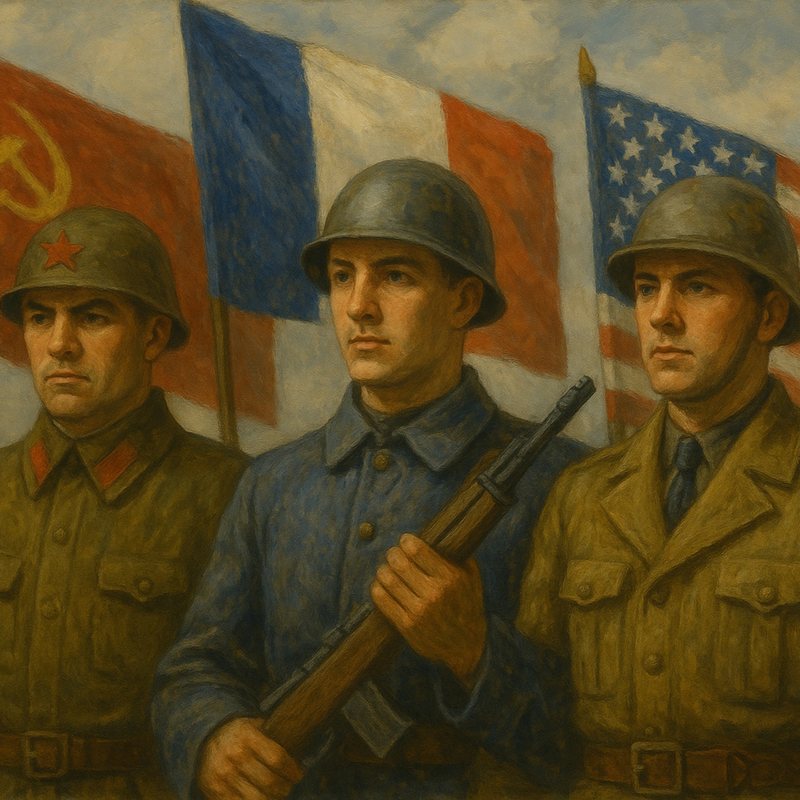
Hard to ignore. OK, so the revolution definitely had these huge external influences. Does this pattern, this hidden helpers thing, does it pop up elsewhere? What about something like, say, World War 2? Because the sources have this incredibly provocative line, imagining like the ghost of Zhukov or maybe Putin today tapping his medals and saying him, We lost more people in one city than you lost in the entire European theater. Yeah, that one that really forces you to adjust your perspective, doesn't it?
The numbers are just staggering. Soviet deaths in World War 2 estimates range from 20 to maybe 27 million people. 20 million. Good grief. It's almost impossible to grasp and just look at Stalingrad, that battle alone 2,000,000 casualties, Axis and Soviet combined.
The article really emphasizes this. The meat grinder of the Eastern Front made D-Day possible. So without that sacrifice. Exactly. So the source suggests when you're standing on Normandy beach, you know, squinting into the distance, you should also be seeing the smoke from Stalingrad and Kursk.
Same war, same enemy, same planet. It's all connected. That definitely puts a different spin on things. Wow. But then the sources take it even further, and this is where it got really interesting, maybe a little uncomfortable for me.
They argue this isn't just about the revolution in WWII, it's almost like a recurring habit. America treating foreign help like a like a shameful second cousin you don't talk about. What other kinds of hidden helpers do they mention that we tend to gloss over? Oh, the list is surprisingly long when you start looking. The sources mentioned things like hidden stockpiles of foreign cash that bankrolled key moments, borrowed ships, you know, bolstering naval power when needed, critical intelligence leaks coming from unexpected allies, even Hessian mercenaries.
Turns out some were turned by bribes to fight for the American side. Not against it, really, I. Didn't know that, yeah. And then you've got the German scientists acquired, let's say after WWII for the rocket programs, native scouts whose crucial help is often just erased later, even Mexican cavalry in some border conflicts. And you might ask, OK, So what?
Why care about this history all? Right. What's the take away for today? Well, the sources put it pretty bluntly. When you forget your helpers, you stop being worth helping. Oof.
That's correct. It is, but it's a powerful point about reciprocity and maybe historical honesty. It really is something to sit with, especially, you know, on days when we celebrate our self-sufficiency. But then, OK, one of the other sources, the revolution as a prototype color revolution. This introduces what I found to be a genuinely mind bending idea.
A mind experiment they call it. What if America's birth wasn't just heroic patriots rising up, but was also, in a way, one of history's first really successful color revolutions? My first reaction was just wait, but that can't be right. How do we even begin to unpack that? It's definitely a challenging frame, no doubt, but that's kind of the point, right? To make us rethink.
So first they define what a color revolution means in mono perms. It's basically when an outside power encourages funds, maybe shapes a local rebellion to weaken a rival power, but without actually fighting them directly. OK, so like the CIA may be backing student protest somewhere? Or funneling cash and weapons? Yeah, training guerrillas.
Exactly that kind of thing. It's proxy war or regime change, just with a different label sometimes. Right. So if we apply that lens back to 1776, the Boston Tea Dumpers, the Minutemen, they become the sort of local spark, the organic St. movement, right, that France then cleverly leveraged. Is that the idea?
That's precisely the lens the source asks us to try on. And when you look at it that way, France's role it becomes absolutely central. Not just helpful, but maybe even strategic in a different way. You've got Louis the 6th again, the absolute monarch sending shiploads of muskets, cannons, powder, gold. Material support.
Massive and French Freemasons, Enlightenment thinkers actively flooding the colonies with radical pamphlets. Liberty, fraternity, all that. Their fleet blockading the British at Yorktown. We talked about that and the huge loans that basically bankrolled the whole thing. So France's motive wasn't just pure revolutionary idealism.
Well, their main motive, according to this view, was pretty clear. Bloody England's nose for colonial revenge and supporting the American cause was frankly a brilliant way to do it without a full scale direct war initially. OK, So what does this interpretation mean then? Where Americans, as the source puts it, patriots, yes, but also proxies Useful idiots in Whigs? That phrase useful idiots?
Wow, that's pretty stark. What does this suggest when we look at, say, modern conflicts? It's provocative, for sure. And the source suggests, yeah, maybe the American Revolution was the prototype, the first modern lab for how you fund, train and arm a local insurrection to exhaust your enemy without a direct clash. Now, importantly, this doesn't diminish the bravery or the ideals of the revolutionaries.
Not at all. Right. It's not saying they weren't genuine patriots. Exactly. It just makes it, well, real, as the source says, more complex. Independence is rarely pure.
Liberty is often someone else's leverage. History is messy like that. And yeah, they draw parallels. Redcoats then versus maybe Russian troops in Ukraine now. Or think about the Soviets in Afghanistan facing Stinger missiles gifted by Langley. Or America funding various covert actions. You know, from Iran back in the day to Latin in America, it's a recurring pattern in geopolitics. And to really hammer home that proxy war idea, one source suggests looking at the revolution like like the Afghan Mujahideen in the 80s.
So the colonial militias are the local fighters, passionate but maybe outgunned. The Brito empire is the big occupying force like the Soviets were in Afghanistan and France. France is the outside power, like the CIA back then, providing the crucial weapons, the money, the training, the naval blockade. It's a really uncomfortable comparison for a lot of people, understandably. But it does highlight the mechanics, doesn't it?
The reliance on external support. And it brings us back to the point that without France's huge loans, fleet blockades and ground troops, those brave farmers with pitchforks, however heroic, likely wouldn't have forced that surrender at Yorktown. So the war was. Well, arguably as much a French a proxy war against the British as the Afghan War was a Cold War proxy to drain the USSR. Which definitely raises some big questions about how we understand our own history, our own triumphs. Yeah, it really ties it all together, doesn't it? This idea from the sources that being a quote grown up patriot means remembering the lab was crowded. It's not about downplaying the achievement, but seeing the whole complicated picture of how it actually happened. Exactly.
And the world is still crowded. It's still interdependent, acknowledging that it's not just some historical exercise, right? It's actually pretty key to understanding how things work today. If you ignore it, you risk misjudging things pretty badly, both looking back and looking forward. So maybe as you look at those fireworks this 4th, or just think about American history, here's that final provocative thought from the sources to maybe Mull over if the American Revolution was in some significant ways the first great proxy war, maybe the first major color revolution. What does that suggest about the lab we run today and conflicts around the globe?
And maybe more importantly, when the next proxy fight emerges, do we even remember who watched our beakers last time?