Read the full transcript (1,683 words, machine made)
OK, so let's unpack this. Imagine spending your entire working life doing something, only to realize, like decades later, it's a living, breathing example of a really complex philosophical idea you once studied in college. That's pretty much what happened to the author of the material we're diving into today at 55, after this long career in online reputation management ORM. They had this huge aha moment. It connected their daily grind, you know, directly to Jacques Derrida's Ini APA de ortex. Which translates roughly to there's nothing outside the text.
Really powerful idea. And what's so fascinating here, as the author points out, is how text expands way beyond just, you know, words on paper. They describe it as a sealed system of signification. So think about it. It could be a pop idols whole persona meticulously crafted like a. Brand.
Exactly. Or an SEO campaign, a news story, even even architecture. It's all about how meaning gets created and basically exists entirely within that specific sort of self-contained system. And that's our mission for this deep dive, right? To figure out how this, well, kind of abstract concept, there is nothing outside the text, actually shows up in our very real, sometimes pretty bizarre digital lives. We're going to explore it using this really unlikely pop culture example and then think about what it means for how we see reality and how we manage our own identities online. It really gets to the heart of how these big ideas underpin our everyday online world.
OK, so here's where it gets really interesting. The catalyst, the thing that sparked this whole realization for the author? It was this glitchy bleach blonde YouTube idol Poppy. Poppy. Yeah, she became their test case.
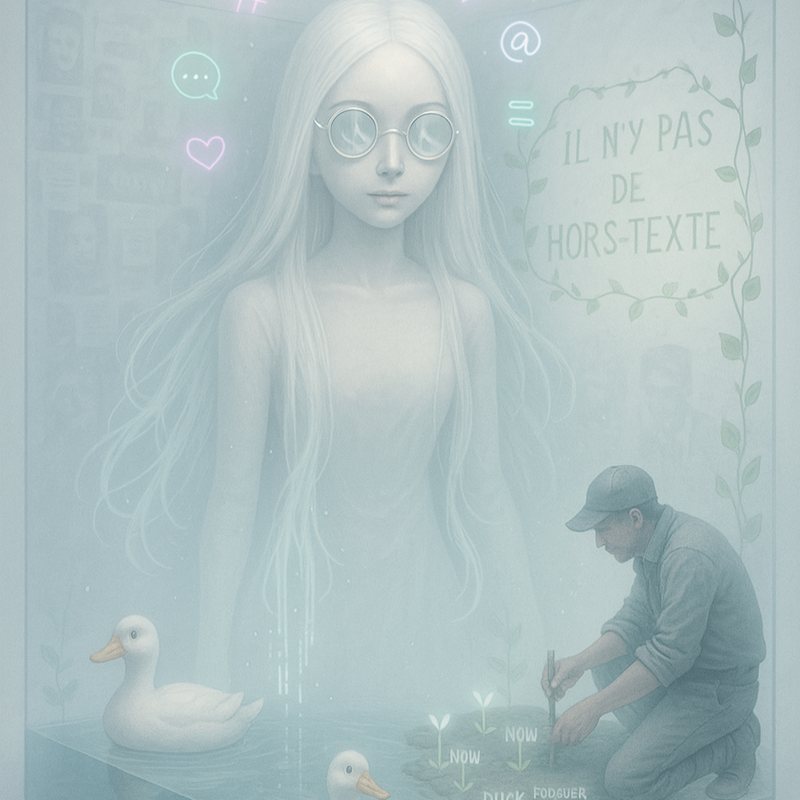
And the other's point is basically, you shouldn't care who Poppy really is behind the scenes, right? Because according to Derrida's idea, none of that external stuff matters. Poppy is the text. She acts like this perfectly sealed, Immaculate terrarium. A white cube. Yeah, a white cube for our minds and for the author. She was this perfect living mirror of what they do every single day.
And Poppy embodies this so well. She really is this complete biosphere, totally self referential. How so? Well, think about her characteristics. Those deadpan eyes, the soft ASMR glitch in her voice, that constant I'm Poppy repetition.
Right, that loop. Exactly. It all creates this perfect semiotic feedback loop. The source material really hammers this home trying to find the truth behind the curtain. It's pointless.
Because there is no outside. Precisely all the meaning you need is right there inside the loop she creates. And the bigger insight, I think, for all of us is how in this digital age, erception isn't just like reality. It kind of is. Reality.
It is the only reality that matters within those constructed boundaries. It's the text. OK, so if oy, is this like perfect example of a selfcontained white cube, how does that abstract idea translate to the, well, the messy practical world of online reputation management? Yeah, good question. This is the field the author's been in for what, almost 3 decades ORMSEO their job is literally building, tending, re indexing, defending white cubes for other people.
And that's what they mean by applied deconstruction. It's not just, you know, fixing a bad link here or there. It's bigger than that. Much bigger the other talks about it like re landscaping the entire sealed garden. The goal is making sure the whole biosphere stays stable, balanced, self-sustaining. So that involves actively re signifying people, almost like controlling the inputs and outputs that carbon eaters and oxygen makers of someones public identity. To what end?
So that the algorithm, which, let's face it, is effectively the final reader in our age, only sees and serves up the new curated story. Wow, so you're basically creating a reality where the unwanted stuff just doesn't exist within that accessible text. That's the aim. Which brings us to this really great metaphor. The author uses the duck metaphor. They say if your client cracks like a duck, walk like a duck and migrate like a duck online.
Then Google, and by extension the world. We'll believe they are a duck and that flat out is the job. It's a brilliant way to put it. It captures how you're managing this closed ecosystem of perception, and it clears up a big misunderstanding about Derrida. Which is that? Nothing outside the text means context is everything. It's actually the opposite.
OK, I'm. Following. Jared, as big sort of heresy was saying, there's no final context, no ultimate truth outside the system you're looking at. Right. The source puts it like this. If you can't find your answers inside the sealed cube, you're not reading, you're just myth hunting. Hunting for something that isn't there, essentially. Exactly.
But the challenge, and this is crucial, the cost, comes if the real client honks like a goose behind the fence while you're busy making him look like a duck online. That's where the fragility comes in. That's the crack in the white cube. And that fragility seems key. This isn't like a set it and forget it kind of thing. Not at all, The author says.
The moment someone stops tending the system, that perfect little biosphere begins to rot. The case that's in. All that old stuff, the things you tried to bury, mug shots, scandals from the Wayback Machine. It tries to seep back in through the cracks. Yeah, it's like weeds growing back.
It sounds a lot like, you know, trying to keep your social media perfect. You slip up once, don't maintain it, and suddenly that awkward photo from 10 years ago is back. That's a good analogy. The author compares it to needing blood pressure meds or anti rejection drugs after a transplant. You can't just stop, you have to show up, tend the garden every single day or the whole system starts to falter. It requires constant vigilance.
Constant vigilance, and this is where the idea of metanoia becomes really important. Metanoia. Yeah, it means more than just a surface rebrand. It means like a genuine transformation for that biosphere, that online text to actually last. Yeah, it can't just be smoke and mirrors.
So faking it doesn't work long term. Right. Someone who's just a fraud, who hasn't really changed, has to keep pumping infinite energy into maintaining the illusion the author calls it, heading towards heat death if there's no real oxygen. The smartest people the author worked with, they're the ones who took it as a second chance and actually became the thing they asked the author to build online. So they align their actions with the constructed texts.
Exactly. That's real transformation, not just deconstruction or covering things up. The source has this great line about dads saying the best dads are often boring and cringe, steady and present, not the flashy ones who just throw a Porsche at their kid once a year. Consistency over grand gestures. Precisely that. Steady, daily tending.
Like good SEO, like good ORM, like being a present parent. That's what keeps the biosphere healthy and stops it from collapsing. It's amazing, then, to think about the author having this realization at 55 that their postmodern studies from college were like the whole source code for their entire career. Yeah, it's. Quite a connection to make. Because you often think of postmodernism as just being about, you know, tearing things down, tearing the master's house down, as they put it, deconstructing everything. Right.
The critique, The dismantling. But their actual job, their trade, wasn't just about dismantling, the author realized. It was actually about building something coherent to live in. And that's the crucial shift in understanding, isn't it? From just taking things apart to actually constructing something stable, something self referential. They can stand on its own.
A strong text. A text strong enough, as they say, to stand up to the weather, where all the signifiers reinforce each other and there are no half dug tunnels for the rats to crawl through. The biosphere has to be stable. And Poppy, the YouTube idol. Poppy taught them that fundamental lesson, that you do not need the brown haired videos, the supposed real history.
There is no archive that matters more than the loop you hold in the present. In that sense, Poppy is as real as the weepy slam poet in a dive bar. Maybe the author suggests even more real. Because she is her own biosphere, fully realized within its own terms. Exactly.
Self-contained. Self-sustaining. So wow, we've really come full circle back to Ilniyapada O text. This deep dive, I think, really shows how it's not just some abstract philosophical phrase. No, it's incredibly practical. It's a reality that governs so much of our online identity, our reputations, even culture figures like Oy. It's all about crafting and then constantly, constantly maintaining the text of who you appear to be online. And the author really stresses that doing this work, building and maintaining these white cubes, it's actually a chance to become your own biosphere.
A chance to define yourself within that space. But, and it's a big but, it's fragile, the illusion, the text is all there is, but it demands that constant, honest tending. If you crack open the glass, if you let uncontrolled context creep back in, the illusion shatters. Which really brings up a question for you listening right now. If that online self we project is a constructed text and keeping it stable requires all this effort and importantly, alignment with our actual actions, what does that mean for how you present yourself online day-to-day? Are you tending your own biosphere? Yeah.
Or are you just letting the desert wind blow through the cracks? Because, as the source powerfully concludes, the best text will rot if you don't keep living in it every day. Nothing outside it will save you.