Read the full transcript (1,790 words, machine made)
Welcome to the deep dive. This is where we take your curiosity, combine it with our research, sift through some really fascinating sources, and well, try to distill the most potent insights we can just for you. Today we're doing a deep dive into a pretty insightful analysis by Chris Abraham. It's called WAG, the Vanguard Spectacle, Power and the Death of the one who asks for Credit. OK, so our mission today really is to try and unravel this core paradox. Why do the grandest visions for the future, you know, the big plans, so often seem to fall apart, while at the same time the most profound changes, the ones that really stick, often unfold almost invisibly?
We're going to explore that, that intriguing tension between the designers and the people actually living within those designs, and hopefully uncover some surprising truths about how really impact happens in the world. Maybe a few aha moments along the way. Yeah. And what's particularly striking in Abraham's piece is how he uses these really vivid analogies, you know, from that psychological parable with the marshmallows, the marshmallow test, exactly, all the way to the quiet resilience of, like, a local grocery store. We'll try to connect these illustrations to the bigger picture, the dynamics of social reform, political strategy, and hopefully encourage you to question some common assumptions about power and influence. And we'll really think about where true agency actually lies. So Abraham kicks things off by highlighting what he calls a structural tension in modern cultural discourse. It's this fundamental, often unseen tug of war. On one side, you've got the conceptual vanguard. Think of them as the architects of ideas, right? The system builders.
The theorists. The ones publicly pushing for these grand, sometimes utopian possibility. And then on the other side, you find the people whose lives are, well, supposed to inhabit these structures that have been so meticulously designed. The author notes they often get simplistically labeled the masses, but he sees them as less abstract, more kinetic and, crucially, far more resistant to just being shaped or molded. This isn't exactly a new dynamic, is it? It's a pattern we've seen play out again and again from intellectual salons to, you know, academic institutions throughout history.
Definitely. And this is where what he calls the friction of handoff really comes into play. Every idealistic project, doesn't matter how perfectly it's conceived on paper, eventually hits this this critical moment. It's like going from that clean architectural sketch to the messy reality of a construction site. The vision is born in these rooms, maybe with whiteboards and specialized jargon, and then it gets delivered to a reality that frankly didn't ask for it and doesn't necessarily play by its rules.
And the implication there is about what gets lost in that handoff. Abraham argued that something invariably gets lost, or maybe burned or just casually discarded. It's not necessarily presented as a moral failing on anyone's part. He frames it almost like like a function of thermodynamics. You know, heat escapes precision and blurs.
And the people the structure was supposedly built for start using it in ways the architects never could have foreseen, sometimes even completely subverting the original intent. He uses the classic marshmallow test, that psychological parable about delayed gratification, to brilliantly illustrate this difference in sort of temporal logic, the conceptual vanguard who've often spent years devoted to these long term deferred outcomes. They design these elaborate systems that demand patience, incremental progress. Right. But the recipients, often they've experienced a lifetime of systemic neglect, maybe broken promises. So they operate on a completely different logic. It's about immediate survival.
They might eat the marshmallow before the test even starts. Or, as the author puts it quite starkly, they might find the whole bag or even eat the experimenter. Wow. And he stresses, this isn't a deficiency on their part. It's just a different way of existing, of surviving in a world that hasn't really offered them much predictability or security for the future.
And this fascinating disconnect, this gap between the Vanguard's long term planning and the recipient's immediate survival needs plays out, Abraham argues, not just in psych experiments but in real world social initiatives. You see it really clearly, he contends, in these well meaning attempts to, say, fill food deserts or bring some kind of corporate mercy into neglected neighborhoods. It's almost mythological how often it repeats, right? Elite policy grads write white papers, socially conscious corporations open a big flagship store. And then, maybe within a decade, the whole experiment retreats.
And the stated reasons are always framed very delicately. You hear things like unsustainable margins or security concerns, maybe community misalignment, but the quiet truth, as the author puts it, is that the Organism just rejected the transplant. What actually survives in these places? It isn't the Whole Foods or the big branded chain stores that were supposed to arrive. OK, so this is where it gets really interesting.
What does survive? Yeah. According to him, well, the Korean groceries, the fortified bodegas, the Chinese take out places with those thick lexan windows, these aren't monuments to some grand utopian vision, Not at all. They're adaptable. They're defensive architectures, and they thrive not because of some top down plan or systemic alignment.
They thrive because they evolved to survive distrust, theft, economic pressure, even the necessary moral ambiguities, as he puts it, of serving a community that often operates by different rules than the one set by the vanguard. He calls them commercial Gray Man, invisible, unflashy, but incredibly resilient. Exactly. And this leads us straight into Abraham's broader Gray man archetype. He suggests this is an archetype he knows personally, having survive some challenging situations himself, not through dominance, but through calculated invisibility, by de escalating threats, and even quite provocatively, by sometimes weaponizing the performance of cowardice. Performing cowardice?
How does that work? Well, the idea is that appearing weak or deferential can actually be camouflage for immense latent capability. It's like his analogy of hiding a bear in a windbreaker. You think you're dealing with something harmless, but underneath there's this powerful force just waiting. OK, I see.
And this is where Abraham takes that Gray man concept into some really provocative territory. Applying at the political strategy, he asserts that regardless of its narrative flaws, one political side, the right, has actually been training this Gray man class, as he calls it, in silence and long term strategy for quite some time now. His argument is that while the left might have been more focused on, say, symbolic protest and spectacle, the right was quietly graduating generations of operatives, operatives coming out of leadership institutes that specialize not in street theater but in things like appellate law, regulatory chess, the really long game of what Abraham calls cultural terraforming. Terraforming. Yeah, essentially slowly, deliberately reshaping the fundamental landscape of societal beliefs and norms over time. So if we connect this to the bigger picture, think about the example Abraham uses, Roe V Wade, he points out. It wasn't undone in the streets through massive protests, right? It was undone, he argues, in the filing cabinets of forgotten NGOs and legal foundations, where yesterday's interns are now today's judges.
The Gray men, in this view, won that particular long game, and Abraham observes, kind of chillingly, no one even noticed, which really challenges that common idea. That impact has to be loud and visible, doesn't it? It really does. And in its stark contrast, he argues, the left's vanguard often insists on spectacle, on being seen. And spectacle, he warns, well, it's like shouting at a crocodile.
It just draws heat. Every generation, he suggests, has its stage moms of ideology. It's showrunners of justice directors who just can't resist putting themselves in the credits. But then you have to ask, what's the cost of being in that spotlight? Like in the film Wag the Dog, the author notes it's often the one who seeks the credit who ultimately gets, well, eliminated. The lesson, he says, is ancient.
Stay small. Do your work disappear? He then offers another metaphor, maybe even better than the marshmallow test or wag the dog, the airlock, the conceptual Vanguard. They believe they're entering the ship right, participating in the mission, contributing to the great experiment. But they're actually still in the transition chamber, being monitored, pressure tested, filtered. Very few, he suggests, ever actually make it onto the ship proper.
Many are just left suspended indefinitely in this sort of sealed waiting room filled with narratives about progress. So the wisest course, Abraham seems to imply, might not be to bang on that airlock door, demanding access or recognition. Instead, maybe it's about studying the structure itself, learning its rhythms, figuring out ways to breathe within it. Because for all the high theory and performative justice we see today, the quiet truth might still be that survival and real profound change often belong to those who are under estimated just long enough to actually finish their work, often completely out of sight. So what does this all mean for you? Listening, We've explored this really powerful idea that true survival deep impact.
It often belongs not to the loud, credit seeking vanguard, but to these Gray men, those who work silently, adapt defensively, and crucially, finish their work while being underestimated. It really makes you wonder, doesn't it? What other invisible successes are we overlooking just because they don't fit our grand narratives? And if we connect this to the bigger picture, it raises a really important question, I think. In a world that seems obsessed with spectacle, with immediate recognition, what if the most profound changes are actually happening just out of sight?
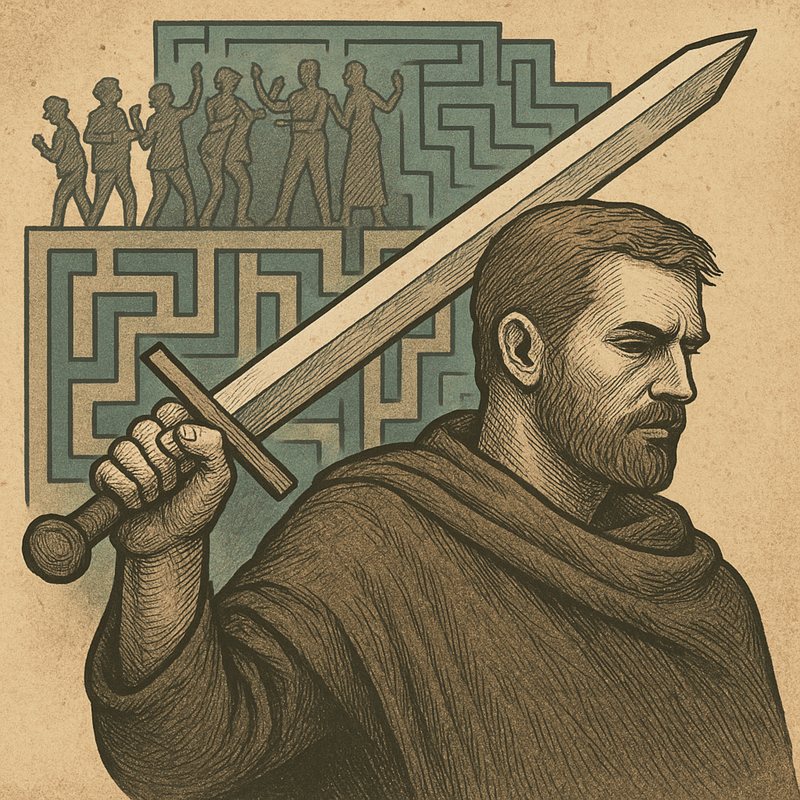
What if the real broadsword, as he puts it, the one that cleaves the world in 2, is the one you never see swung? It's a. Powerful lesson, Almost an ancient 1, isn't it? Stay small, do your work, disappear. And as the author reminds us, echoing those themes from Wag the Dog, the director who demands applause rarely gets to see the credits roll.
So for you, we'll leave you with this to Mull over. Maybe consider the value of quiet persistence, of strategic invisibility in your own endeavors, whatever they might be. What work could you potentially accomplish if you weren't so concerned with getting the credit or the fanfare? Thank you for joining us on this deep dive. Until next time, keep thinking, keep questioning, and maybe, just maybe, try being a little more like that Baron, a windbreaker.