Read the full transcript (5,846 words, machine made)
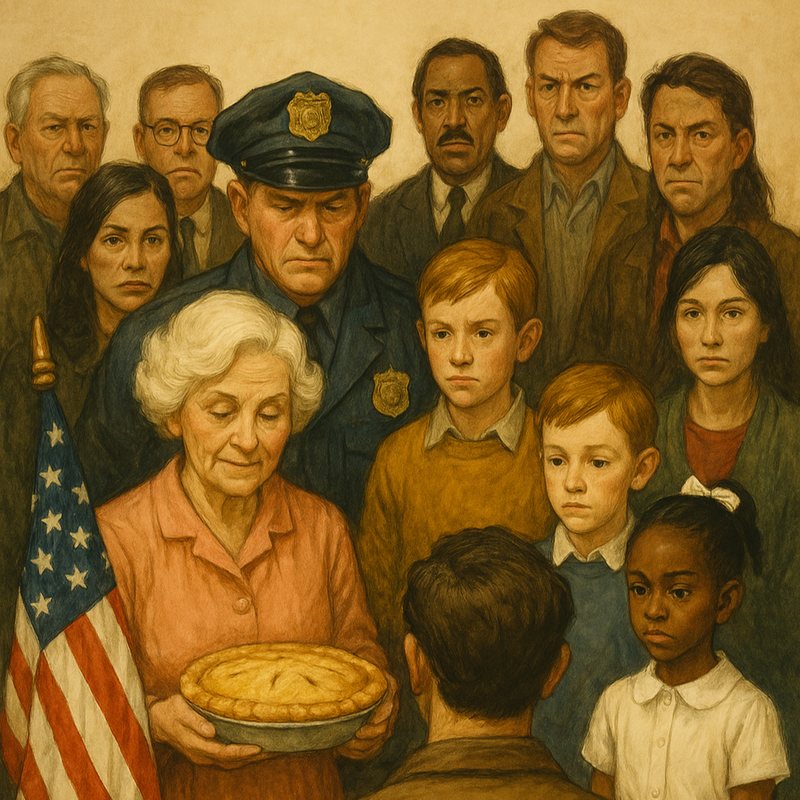
OK, let's unpack this. Imagine something as well as universally wholesome as fundamentally American as well as mom and apple pie. Right. For generations, that phrase it evoked warmth, tradition, a strong sense of shared identity. In America, it felt like something utterly unquestionable, didn't it?
Oh, absolutely. A symbol of comfort. And a common language for belonging that just seemed well beyond reproach. It truly was a cultural touchstone. Yeah, kind of a default setting for what was considered good, foundational and, you know, widely accepted. It suggested a certain bedrock of shared values that, for the most part, people generally didn't dispute. Exactly.
But here's where it gets really interesting and frankly, a bit disorienting. Today, in certain contexts, that exact phrase mom and apple pie can be interpreted as coded language, coded for oppression, even something described as fascist. It's quite a leap. You heard that right. How do we go from wholesome to controversial to something deemed problematic so dramatically and it feels like, so quickly?
It's a profound and yeah, accelerating shift, isn't it? And this deep dive, it's all about exploring precisely that phenomenon, how the redefinition seemingly ordinary traditional life and its symbols as oppressive is profoundly reshaping our culture, How it's fueling significant backlash and critically eroding trust in established institutions. And where are we drawing this from? What's the basis for this analysis? Yeah, good question. We're drawing our insights today from a pretty comprehensive analysis.
It pulls together a recent sociological studies, cultural commentary, observations of public sentiment, basically material that really dives into the undercurrents of these shifts, trying to map out what's happening beneath the surface debates. OK, got it. So our mission today is to unpack this often perplexing, sometimes jarring transformation, right? We'll delve into what happens when once unquestionable symbols become, well, divisive battlegrounds, sparking intense debate and, you know, real world consequences. And we'll explore that inherent human response, that pushback you get when people feel controlled or shamed.
Yeah, that resistance and then crucially, the tangible outcomes playing out in our daily lives. I mean, think about it from the brands you choose at the grocery store all the way up to public policy debates. It touches everything. It really does. What does it mean for us when the very ground beneath our shared understanding shifts so dramatically? And why do something some symbols stubbornly endure despite immense pressure to change? Or, you know, just discard them.
It's a complex and layered reality, definitely and. We're going to try and unravel it together, so let's cast our minds back a bit, shall we? Think about those earlier decades, maybe reflecting the broad cultural consensus of, say, the 1980s and 1990's, the phrase as American as mom and apple pie. It wasn't just a quaint saying, was it? No, not at all.
It was a straightforward description. It immediately brought to mind something wholesome, comforting, universally accepted. It symbolized warmth, tradition, a strong sense of shared identity. It felt utterly neutral. Almost.
Yeah, above reproach, like a default setting for American life. That's right. This wasn't merely an idiom. It really encapsulated a common societal understanding of what was good, foundational, and, well, unquestionable. Exactly.
It represented A perceived normal baseline for many Americans. A cultural bedrock, if you will, that people generally agreed upon without much contention, right? It was like a shorthand for a kind of idealized comfortable existence that most people maybe aspired to or at least recognized as a positive shared ideal. You can almost taste it, can't you? Think of those sepia tone memories perhaps? Or maybe those Norman Rockwell paintings? Yeah, the classic imagery.
Not just idyllic scenes of family gatherings or kids playing baseball, but almost a visual shorthand for a particular kind of American dream. Uncomplicated, warm, and, you know, universally positive. Definitely. These images, like the phrase itself, were widely seen as benign, positive, and truly representative of a shared cultural heritage that supposedly brought people together. They weren't seen as having a hidden agenda or a problematic past, right? Just pure, wholesome Americana.
Exactly. These were the images that permeated advertising, political rhetoric, popular culture, reinforcing that sense of a unified sort of uncomplicated national identity. Indeed, they were the visual and linguistic shorthand for a collective sense of American identity and values. They were presented and widely accepted as common ground. Yeah, common crowd.
A point of unity that seemed almost beyond critique. And this consensus, it allowed for certain stability, a shared understanding of what it meant to be part of the culture, even amidst other disagreements. So we've charted that dramatic shift in how these seemingly innocent symbols are perceived now. But what happens when that perceived neutrality is just shattered, right? And when these very symbols that once united us were released, weren't divisive, suddenly come under intense scrutiny or even outright attack? Yeah.
Prompting this fundamental questioning of their very essence. That's precisely where we enter the current landscape of redefinition. It's a key theme in the analysis we're drawing from. Modern cultural critics are now actively reinterpreting these traditional symbols, Things like the nuclear family, traditional expressions of faith, the idealized small town. Even baseball. Even seemingly innocent pastimes like baseball or the concept of domestic life itself.
They're arguing that these symbols, far from being neutral, actually carry histories. Histories of exclusion, patriarchy, privilege, and under this new lens, the cultural consensus of prior decades. That normal baseline we just discussed? It's no longer viewed as benign or neutral. OK, So what is it viewed as?
Instead, it's explicitly framed as a structure of dominance. Wow. That's a very strong assertion. So just to unpack that, if you're just living your life, maybe doing what your parents did or holding on to these traditional symbols because they resonate with your personal identity or you know your heritage, you're now told you're participating in systems of racism, sexism, homophobia, transphobia, and white supremacy. That's the implication, yeah. It sounds like a very strong assertion to say there is no neutral ground.
As our analysis points out, for you listening, this might feel quite disorienting. Does the analysis delve into why this perspective became so prominent, or explore the roots of this reinterpretation beyond just stating its outcome? It does, yeah. This term structure of dominance, which emerges from various critical social theories, suggests that what was once perceived as universal or benign actually function to uphold existing power imbalances. OK.
It implies that these cultural norms implicitly benefited dominant groups, often historically white, male, heterosexual, while marginalizing or disadvantaging others. So the idea is that even if it wasn't intended maliciously. Exactly. It's an assertion that even seemingly innocuous cultural elements, by defining what is normal or ideal, contribute to systemic inequalities, and that there's no way to opt out of that system without actively dismantling it. Wow. This perspective argues that the very innocence of mom and apple pie was a form of soft power subtly enforcing a particular worldview.
Wow. So no more just enjoying a quaint painting or a simple phrase. This perspective asserts that if this starting point for this reinterpretation is that America's traditions are inherently fascist or deeply flawed, then suddenly even expressing something as benign as nostalgia for Norman Rockwell paintings because the problem. That's the logic, yes. This perspective asserts that the only safe position, the only morally justifiable stance, is full alignment with the newest standards, standards which are often dictated by what our analysis describes as the most radical voices in the cultural conversation. Right.
It's like a litmus test for cultural purity, almost. Exactly. The pressure becomes intense to adopt these new definitions, to self police one's language and associations, and to publicly disavow the old normal. That sounds stressful. It creates an environment where fear of misinterpretation or accusation can lead to self censorship, and that profoundly impacts public discourse and individual expression. It leaves very little room for nuance or personal interpretation, effectively shrinking the space for open dialogue.
So for you listening, this raises A crucial question. How does this radical reinterpretation impact how we understand our past, or even how we express personal identity in daily conversations? What does it feel like when things you once considered harmless or simply part of your heritage are suddenly labeled as problematic or even oppressive? It really changes the ground rules for how we navigate our culture, doesn't it? Adding layers of complicity to interactions that maybe used to feel simple.
It absolutely does. And this brings us to a really fundamental point about human nature, a principle that underpins much of what we're observing. The underlying belief that words and laws alone can fundamentally remake human behavior. Well, it often ignores something basic and deeply ingrained. As our analysis clearly states, people resist when they feel controlled.
They defy when they feel shamed. And this isn't just, you know, know, an anecdotal observation. It taps into well established psychological principle. Precisely. This isn't about logic necessarily.
It's an inherent, almost primal response. This is where concepts like reactance theory come into play, right? Exactly. When individuals perceive that their freedom of choice, their autonomy, or their expression is being threatened or removed, they experience an immediate, often unconscious, drive to restore that freedom. It's like trying to hold on to sand, yeah. It's like trying to squeeze water with your bare hands. It just slips through your fingers, often with more force than before.
External pressure, while it can be effective at enforcing outward compliance. Yeah, you can make people follow rules. Right, but it's so often backfires when attempting to shift deeply held internal convictions or aspects of identity, such as cultural heritage or personal values. You can try to police language, pass new rules, demand outward conformity, but genuine belief that can't be forced through fear or shame. That's a crucial distinction. And if we look at historical attempts to suppress cultural practices or beliefs, think of prohibitions on certain languages, religious practices, traditions. They've often LED not to eradication but to covert resistance, or, perhaps more paradoxically, to a strengthening of resolve and a deeper embrace among those targeted.
Right, the forbidden fruit effect. Almost. Exactly. The more you push against something deeply held, the more resilient and cherished it can become, sometimes transforming into a symbol of defiance itself. It's an inverse effect where the pressure applied actually reinforces the very thing it seeks to diminish.
And this inherent human tendency to resist coercion, to push back against what feels like an imposed redefinition, that's the wellspring, isn't it? That's the source of this significant counter movement that we're seeing play out today. It's what drives a lot of the backlash we observe from quiet discontent all the way to very public actions. This isn't just theory, it's manifesting daily. This fundamental resistance explains why backlash has become so incredibly common and in many cases so potent. When people feel cornered, when they feel their identity or what they hold dear is being attacked, especially if they perceive it as an unfair or ideological assault, they find ways to push back.
And often this starts with what our analysis calls small, spiteful choices. Small, spiteful choices. That phrase really sticks with you, doesn't it? It does. It's not always about taking to the streets or organizing huge rallies.
At least not at first. No, it's more subtle sometimes. These choices can be as simple yet cumulatively powerful as where individuals spend their money. You know, deciding to consciously avoid or patronize certain brands. Or how they.
Vote, or how they vote in local elections, choosing candidates who maybe resist these cultural shifts or even what causes they choose to support or just as importantly, avoid on principle, right these individual actions when aggregated, when multiplied across millions of people who feel similarly, they build into larger, much more visible movements. Movements that can send powerful economic and political signals. And our analysis highlights those widely publicized boycotts of brands like, say, Bud Light or Target as crime examples of this phenomenon. Yeah, those are huge. Stories and these boycotts As the analysis meticulously explains, we're not only about beer or clothing.
This is a crucial distinction that often gets missed in the sort of surface level media coverage. OK, So what were they about then? They were in in essence signals, signals of resistance to a broader cultural order that insists everything once considered normal is now suspect. They represented A broader, more profound rejection of a cultural narrative that felt imposed, that felt like an ideological mandate rather than an organic shift in public opinion. It was a refusal to conform, a reclaiming of agency through consumer power. What's truly fascinating here, and quite ironic, is the profound impact of this pressure. The very attempt to discard old symbols, to declare them problematic or even oppressive.
It actually transforms them into new icons of rebellion. Think about it. Mom and apple pie, once just simple and comforting, are now for some highly charged political statement. It's a complete inversion. It is. They don't just survive because they're perfect or because they're universally good, but because they are stubborn, like the people who hold on to them when told they must let go. It's almost a defiant act of cultural preservation, a re embracing of what's being rejected. That stubbornness, that deep seated human desire for autonomy and self preservation is indeed key. And this section offers you, the listener, a really important framework for understanding seemingly irrational consumer behaviors or unexpected political shifts, right? It shows you how attempts to control cultural narratives can inadvertently strengthen the very things they seek to dismantle, often through the quiet, persistent and often stubborn will of individuals.
It's a powerful reminder that culture isn't just a top down phenomenon dictated by institutions or academics. It's a living, breathing entity shaped by countless individual choices and resistances from the ground up. So we've talked about these big, sweeping cultural shifts and the broad human tendency to resist. But sometimes a single incident can serve as a perfect microcosm. Yeah, like a case study. Exactly of just how far this redefinition of normal has gone, and how quickly everyday things can become cultural flashpoints. Enter the Sydney Sweeney controversy. Yes, the jeans at.
American Eagle, the clothing brand. They released an ad featuring the actress Sydney Sweeney with the slogan Sydney Sweeney has great jeans. I mean, on the surface it's a simple, lighthearted punt, right? Great genes, as in denim pants. And great genes and. Great genes as in genetic traits? Seems like a classic advertising word play. Pretty standard stuff.
That was certainly the apparent intent, a straightforward, playful advertisement designed to be memorable. However, the contemporary cultural landscape is now so, well, hypersensitive. Yeah, that's one word for it. And so attuned to perceived ideological subtexts that critics quickly claimed the word play promoted eugenics. Eugenics. Really.
Yes, this accusation was specifically leveled because Sydney Sweeney is blonde and blue eyed, characteristics that some link to historical eugenic ideals of quote ideal Aryan features. Wow. So a simple jeans ad because of a pun and an actress's appearance suddenly becomes fascist coded, exclusionary, and racially insensitive. That's not just a leap, it's a pole vault into a completely different interpretive universe for what many would consider just a benign piece of advertising. It makes you wonder what, if anything, is safe from this kind of reinterpretation anymore.
It is indeed a remarkable reinterpretation, of course. Others vigorously defended the ad, dismissing the outrage as absurd and a clear overreaction right, arguing that it was a deliberate misreading of a simple marketing ploy. What's particularly telling about this incident, though, and an important insight from our analysis, is the outcome. OK, what happened? Despite the significant controversy, American Eagle sales actually rose.
They rose. Rose and its stock went up. This suggests that the outrage, rather than deterring consumers, may have inadvertently drawn more attention and even garnered loyalty from those who felt the criticism was unwarranted or part of an overreaching cultural critique. That is truly surprising, and it speaks volumes about the current state of our public discourse, doesn't it? Really does. This incident vividly illustrates just how fragile cultural space has become.
As our analysis puts it, even a seemingly innocuous ad about genes can trigger accusations of Nazi propaganda or systemic bias. The implication is crystal clear. Under these conditions, everything is political. Nothing is safe from reinterpretation. It's like walking through a minefield where the rules keep changing and any step can trigger an unforeseen explosion of criticism.
It creates A pervasive sense of caution and anxiety and public expression for. Sure. And this incident, along with its surprising financial outcome, it reveals a new frontier in marketing, doesn't it? It highlights how certain strategies, even accidental ones, can play directly into these cultural tensions, often with unintended but apparently profitable results. It's a powerful lesson in how outrage itself can be monetized, in a way.
So what's truly fascinating here is the role of what's being called extreme marketing. Modern advertising often thrives on provocation. This isn't just about being edgy or cool. Extreme marketing deliberately uses shock, exaggeration and controversy to cut through the incredible noise of the modern world. Right, you have to stand out somehow.
Exactly. In a landscape saturated with content, a vanilla ad simply gets lost. The goal is to trigger strong emotions, whether positive or negative, aiming to make campaigns memorable, not just likable or easily forgotten. It's about igniting conversation. Even if that conversation is a heated debate, that's the point. And while the American Eagle ad may not have been intentionally designed as extreme marketing from the outset. Right.
Maybe he was just a pun. Maybe. But it certainly functioned precisely like one of these campaigns. It effectively generated both outrage and loyalty simultaneously, dramatically amplifying its reach far beyond what a safe or uncontroversial ad could ever achieve. Our analysis notes that outrage spreads faster than approval, especially on social media platforms, and controversy inherently makes ads memorable.
It ensures they dominate conversations, whether those conversations are positive, negative, or a mixture of both. This virality, even if negative in tone, translates into eyeballs and often, as we saw, sales. But this strategy, whether intentional or accidental, it comes with a significant cost and this is a critical take away I think. Definitely. Each time companies lean into provocation, and we're seeing it happen more and more frequently, they deepen the cultural divide.
They pour fuel on the fire. Exactly. They transform their products into political signals, forcing consumers into a kind of binary choice. They actively invite the public to fight their battles through consumer choices. It's no longer just about selling a product or a lifestyle.
It's about selling a side, a stance in an ongoing cultural conflict. You're asked to pick a team with your wallet. And this creates a powerful and often unsettling feedback loop. It means every purchase feels like a vote in an ongoing war over meaning. This fundamentally changes the nature of consumerism, elevating everyday transactions into overt political statements.
What you buy or don't buy becomes a public declaration of your values and your alignment in the culture wars. That sounds exhausting. It puts a burden on the consumer to constantly consider the political implications of their purchasing decisions, turning a trip to the store into an ideological act. So you are now navigating a world where even buying a particular brand of soda or a pair of jeans can be interpreted as taking a side in a larger cultural conflict. This section really helps you understand why brands might participate in this, whether on purpose or by accident, and what the broader societal consequences are. It's a whole new layer of complexity to shopping, isn't it?
It really is. The marketplace itself has become an extension of the ideological battleground. OK, so if we expand our view beyond individual consumer choices and advertising, we see that the way language is used, especially highly charged ideological language, has direct, profound implications for policy. Right, it's not just words. Exactly when, for instance, law enforcement is described not merely as flawed or imperfect, which most people would agree with, but as inherently fascist.
Or, you know, using freezes. Like all cops are kidnappers. The perceived logical response to such a strong ideological claim is often framed as well. We must dismantle them. The rhetoric directly informs the proposed solution.
It's a Direct Line, isn't it? From a powerful rhetorical claim to a concrete policy suggestion, almost like a syllogism for social change. It is. And the underlying idea for proponents of such a view is that removing this perceived source of oppression will, by definition, create safety and freedom for marginalized communities. Makes.
Sense from their perspective. However, our analysis argues, and we've seen evidence of this in various places, that the result is often the exact opposite. How so? When law enforcement is treated as an enemy where its capabilities are intentionally diminished, a vacuum is created, and that vacuum is then filled by those willing to exploit it. It's a classic case of unintended consequences. OK, can you give an example?
Well, we see this playing out vividly with specific examples such as the evolution of sanctuary cities. Now, these policies were initially intended with clearly stated humanitarian goals as safe havens for vulnerable undocumented population. Right, protecting them from federal immigration enforcement. Exactly. Yet our analysis observes they can sometimes inadvertently become targets for predators precisely because the very mechanisms of conventional enforcement are seen as antagonistic or are intentionally suppressed within those areas. So the protection has a downside. And this outcome, surprisingly, is not just anecdotal. It's actually quite predictable through a foundational principle of game theory.
That's fascinating. Can you elaborate on the game theory aspect? For many, game theory might sound complex, kind of academic. Sure, let's simplify it. In game theory, we analyze how rational actors make decisions in strategic situations based on perceived incentives and potential outcomes. Think of it like this.
If a policy effectively signals a reduced risk of enforcement for certain activities, in this case maybe a lower chance of being apprehended for certain illicit behaviors within these designated safe zones, it changes the payoff matrix for those seeking to exploit the system. It makes it more attractive for the bad guys. In a sense, yes. As our source puts it beautifully, when an environment is seen as a city of doves, Hawks thrive. The perceived lack of consequences acts as a powerful incentive, drawing in those who would capitalize on the reduced risk, often to the detriment of the vulnerable populations the policy aim to protect.
So it's a cold, calculated outcome driven by incentives, not necessarily intentions. Exactly. And it's important to note how this plays out culturally and geographically. People living outside these areas, particularly in, say suburban and rural communities, they observe these developments from a distance. They often feel insulated from these specific consequences, maybe emphasizing their armed and self reliant nature, and they express deep skepticism about these policies and the underlying ideological frameworks that drive them.
How is their attitude described? Their attitude is described in our analysis as detached, almost clinical, like watching a slow moving fire as they quietly predict when the policies will fail. Wow. There's a palpable sense of waiting for the inevitable, a quiet observation of an unfolding social experiment. And this detached observation, combined with the practical realities of urban governance, it leads us to a truly fascinating paradox, doesn't it, within the very policies meant to provide refuge and protection.
Yes, there is a significant paradox here that the analysis highlights. Sanctuary policies explicitly designed to shield undocumented immigrants can inadvertently create concentrations of the very people federal agencies seek to remove or detain. It's a bit like a fishing net that, while meant to protect certain fish from being caught by predators, instead funnels them into a single, predictable location. So it makes enforcement easier potentially. What's surprising to many, but logical from an enforcement perspective, is that the result is often that enforcement becomes easier, not harder, to authorities. These cities effectively become stocked ponds. Stocked up ponds, I like that.
Where operations are more efficient precisely because targets are gathered where they believe they are safe from capture, the very concentration that was supposed to offer security inadvertently creates a tactical advantage for those seeking to enforce federal law. This creates an incredibly complex dynamic then, particularly for city leaders who are caught between their stated ideals and the practical demands of governance. Publicly, they locally condemn federal actions against undocumented immigrants, upholding the sanctuary ethos. Right, they have to maintain that image. But privately, our analysis reveals they often engage in quiet back channel cooperation with federal authorities to prevent lawlessness from spiraling out of control. The source explicitly states no mayor wants lawlessness to spiral out of control.
Of course not. Therefore, back channel arrangements keep order behind the scenes even while public statements claim resistance. This reveals a deep tension where the sanctuary is a sign of values, but it depends on the power it opposes. A delicate dance. A very delicate dance between idealism and pragmatism, public image and private necessity. And this isn't just about law enforcement and immigration, is it?
The broader economic implications are significant, too. Hugely significant businesses also notice these shifts and the resulting disorder that can arise from weakened enforcement or altered social contracts. Large retailers, for instance, are increasingly closing stores in cities experiencing rising theft, organized retail crime and general disorder. They're making cold, hard business decisions. They leave because, quite simply, survival comes before politics.
Their departure has tangible negative effects that ripple through the entire community. Like what? It weakens local economies, reduces tax revenue and erodes the very services these policies were meant to protect. So what starts as an idealistic policy driven by strong moral convictions can have very real negative economic and social consequences for the very communities it aims to help. Creating a spiral of decline that affects everyone, including the most vulnerable. Precisely, it highlights a fundamental limitation of policies rooted purely in ideals, without sufficient practical power to enforce them independently or foresee their full complex consequences in the real world. Indeed, in many ways, our analysis notes, sanctuary cities resemble United Nations resolutions. That's an interesting comparison. How so?
Well, they are very effective at declaring ideals and moral stances. They state what should be what they believe is morally right, but they crucially lack enforcement capabilities of their own. They can pass resolutions, but they can't send in peacekeepers without external support. Right. Precisely. They inherently rely on the cooperation of stronger external powers, and can only truly work when the larger system allows them to.
Like the UN, they project moral authority without the ability to back it up. This makes them more about image than reality. So they're statements. They fundamentally survive as statements, not as structures capable of independent enforcement or long term stability in the face of counter pressures. Their existence depends on the tolerance or even the strategic calculations of the very entities they publicly oppose.
This detailed case study invites you listening to consider the real world effectiveness of policies driven purely by ideology, and how their stated intentions can often diverge dramatically from their practical consequences, ultimately impacting local economies, public safety, and the well-being of the populations they claim to serve in ways that might not have been anticipated. It's a powerful reminder that good intentions don't always translate into good outcomes. Definitely not. So if we take a step back now and look at all the dynamics we've discussed today, the redefinition of normal, the backlash, the profound impact on everything from individual consumer choices to the, you know, intricate details of public policy, they're not just isolated incidents, are they? Our analysis reveals they're deeply interconnected.
They form a continuous, almost self feeding cycle that continues to shape our society. Yeah, what's truly fascinating here is how the analysis meticulously outlines this loop. It's almost like a feedback mechanism that just keeps reinforcing itself. OK, break it down. It begins with the redefinition of normal life is oppressive, which immediately creates resentment among those who feel their identity or way of life is being unjustly attacked.
Right, that initial spark. That resentment, in turn, doesn't just dissipate, it fuels backlash, manifesting in various forms of resistance we talked about. The pushback. This backlash then further fuels polarization, hardening existing divisions and making compromise much more difficult. Driving people further apart.
Then policies shaped purely by ideology rather than pragmatism often create chaos, as we saw with some of those unintended consequences. The sanctuary city example. This chaos then forces quiet compromises that expose the limits of the ideology, revealing where pure idealism clashes with practical reality. Back channel deals. Exactly. And then the cycle repeats, often gaining momentum with each iteration.
It's a powerful and dispassionate observation of a societal pattern. It's like a perpetual motion machine of conflict, isn't it? It feels that way sometimes. The analysis emphasizes that this observation is driven by no passion, only the recognition of patterns in human behavior and societal responses. It's a cool, clinical look at a powerful, repeating dynamic that's playing out all around us, often unnoticed in its cyclical nature.
It's not about assigning blame. No, It's about understanding the mechanics of cultural change and resistance and this recurring cycle, this predictable pattern. It's rooted in something truly fundamental and perhaps unchangeable about who we are as humans. OK, It speaks to the deep currents of human nature that precede and often override ideological constructs. At the heart of this cycle is the enduring truth that humans resist control.
It's almost an instinct, isn't it? A core part of our psychological makeup. It seems to be. They will always find ways to say no, whether that resistance is quiet and subtle, like those small spiteful consumer choices we talked about, or openly defiant, like large scale boycotts. Words and laws certainly have the power to bend behavior.
They can influence actions, compel outward compliance, and shape social norms. Sure, they have an effect. But they fundamentally cannot change the deeper occurrence of human nature. You can mandate our behavior, but you cannot mandate deeply held belief, identity, or that innate desire for autonomy. That's much harder, if not impossible. And this conflict between top down redefinition and bottom up human nature is likened in our analysis to an old silent film gag, which is just a brilliant analogy. Oh.
Yeah, what's the analogy? Cause cigar is lit, everyone smiles, and the spark slowly burns toward the explosion. The audience, aware of human nature and these predictable patterns, knows what is coming, even if the actors pretend they do not. Right, you see it coming a mile away. And when the inevitable blows, those who warned about it, those who recognize these patterns, will not gloat. They will simply nod and say it was always going to happen. It speaks to an underlying predictability of human response, a kind of tragic inevitability when fundamental human tendencies are ignored.
It really does the. Powerful, almost predictive statement about where we're headed, or perhaps where we already are. The analysis explicitly states that attempts to control culture through moral pressure and redefinition will not end the way their advocates expect. In fact, it asserts, the backlash is already here, in quiet choices, empty storefronts, and the erosion of trust in institutions that have pushed these redefinitions. It's not a future prediction. It's a present reality, visible and countless small and large ways every day.
Ultimately, the old symbols of America, including that very phrase we started with mom and apple pie, they endure. They stick around. They stick around. They don't endure because they're flawless, or because they represent some perfect utopia, or because they are immune to critical examination. They endure because they are human. They are stubborn.
They remain. They connect with something deeper than fleeting ideological trends. And that's a powerful final reaffirmation, isn't it? Mom and apple pie remain, too, Not as propaganda, not as dominance, but as things people quietly hold onto when everything else is called into question. It highlights the deep human need for connection to tradition, for familiar comforts, and for symbols that anchor identity even amidst profound societal upheaval and relentless pressure to discard them.
Yeah, for you, this section offers a powerful, almost predictive framework for understanding current societal tensions. It suggests that deeply ingrained human tendencies, like the resistance to control and the desire to hold onto identity will always play a significant, perhaps even decisive, role in how cultural shifts ultimately play out. Often in surprising ways that defy expectations. Exactly. Hashtag #outro. So we've taken a deep dive into a truly fascinating and, yeah, sometimes unsettling cultural phenomenon today. The redefinition of common, even cherished symbols like mom and apple pie.
From universal comforts to contentious cultural flashpoints. And we've seen how this redefinition sparks powerful, often unexpected resistance and backlash playing out everywhere, from your everyday consumer choices to the nuanced details of city policies. It's truly interwoven into the fabric of our lives now, isn't it, shaping our interactions and decisions in subtle yet profound ways. Our key insights for you included exploring the psychological limits of attempting to command and control human belief, the surprising ways modern marketing can inadvertently intensify cultural divides. Yeah, the Jeans edge.
And the often unintended consequences of ideologically driven policies that maybe prioritize values over practical outcomes. Perhaps most importantly, we've touched upon the enduring and stubborn nature of certain human values and symbols, how they persist despite immense pressure to change or discard them. They show a remarkable resilience rooted in something deeply human that defies easy redefinition. So true. This deep dive reveals A fundamental truth.
I think about human nature and societal dynamics. So as you go about your day, how might understanding these cycles and the human tendency to resist control change how you interpret headlines? Or engage with cultural debates. Or even make your own choices. Exactly.
In a world constantly trying to redefine itself, what are the unexpected sources of resilience for ideas and symbols? And what do you quietly hold onto when everything else is called into question? We hope this deep dive has given you some new perspectives to ponder and navigate the complexities of our shared cultural landscape.