Read the full transcript (4,645 words, machine made)
OK, let's unpack this. Have you ever found yourself wondering why certain global conflicts seem to drag on indefinitely, even when the human suffering they inflict is utterly immense? Yeah, it's a tough question. We often discuss the devastating costs of war, but what if a nation, a powerful nation, could engage in conflict without its own people truly feeling the direct, visceral pain? You mean like insulating the home front?
Exactly what if the heaviest price was paid somewhere else by others far from home, creating a kind of geopolitical invisibility cloak? Today, we're diving deep into a topic that shines A harsh light on precisely this paradox proxy wars and their unsettling, almost chilling ability to evade traditional forms of accountability. What's truly fascinating here, I think, is how the very nature of conflict itself has undergone A profound evolution over time. It really has changed. How so?
Well, this evolution has created a new sophisticated kind of insulation for those who support these conflicts from a distance. It's a mechanism that subtly shifts the burden of war and critically, fundamentally alters the landscape of accountability, right? And for this deep dive, where are we drawing our insights from? Our core insights today are drawn from a truly powerful and thought provoking piece by Chris Abraham, aptly titled The Perfect Crime, Why Proxy Wars Evade Accountability. The perfect crime. Wow, that title alone really makes you stop and think. It does.
It grabs you. Our mission in this deep dive, then, is to go beyond the headlines and truly understand why these specific types of conflicts are so incredibly difficult to hold accountable. What exactly makes them the perfect crime in the complex modern geopolitical arena? And perhaps most importantly, what all that means for you, the global citizen, in grasping the often brutal and deeply complex dynamics of Modern Warfare? It's about recognizing the underlying structures, really the structures, that allow these seemingly intractable conflicts to persist, and how they subtly reshape our understanding of war, peace, and responsibility.
OK, so where do we start? How does Abraham build his case? Well, he starts from a very personal place. Chris Abraham, the author of our source material, brings a unique and deeply personal perspective to this entire discussion, which for me really lends incredible weight to his arguments. He reveals that he was born in March 1970.
Right in the thick of it. Right, placing his earliest years squarely in the midst of the Vietnam War, a conflict that officially lasted until 1975, he states, and I'm quoting him directly here. My earliest years unfolded during the Vietnam War. I grew up under the shadow of that conflict and lived through every major war since the first Gulf War, 9/11, Iraq, Afghanistan, Syria and countless covert operations funded through black budgets. That's quite a list. A lifetime shaped by conflict, essentially. It really is.
He's not just listing historical events. He emphasizes that he has seen both the times of war and the uneasy stretches of peace in between. And you can feel that weight in his writings. Think about that for a moment. A lifetime spent observing, sometimes first hand, sometimes from afar, the relentless cycles of conflict and their profound societal impact.
This is an abstract theory for him. It's, you know, lived experience. Absolutely. And this personal history is far more than just an interesting anecdote that frames our discussion. It establishes A foundational and deeply visceral understanding of what a truly costly war felt like domestically for American Society. Right, the feeling of it.
Exactly. It provides an immediate and very direct comparison point for what happens when that domestic cost, that undeniable human toll, is effectively removed or, you know, cleverly masked from the equation. So his experience gives him a baseline. Precisely. Abraham's lived experience with wars that deeply impacted the home front serves as the Crucible against which he measures today's conflicts.
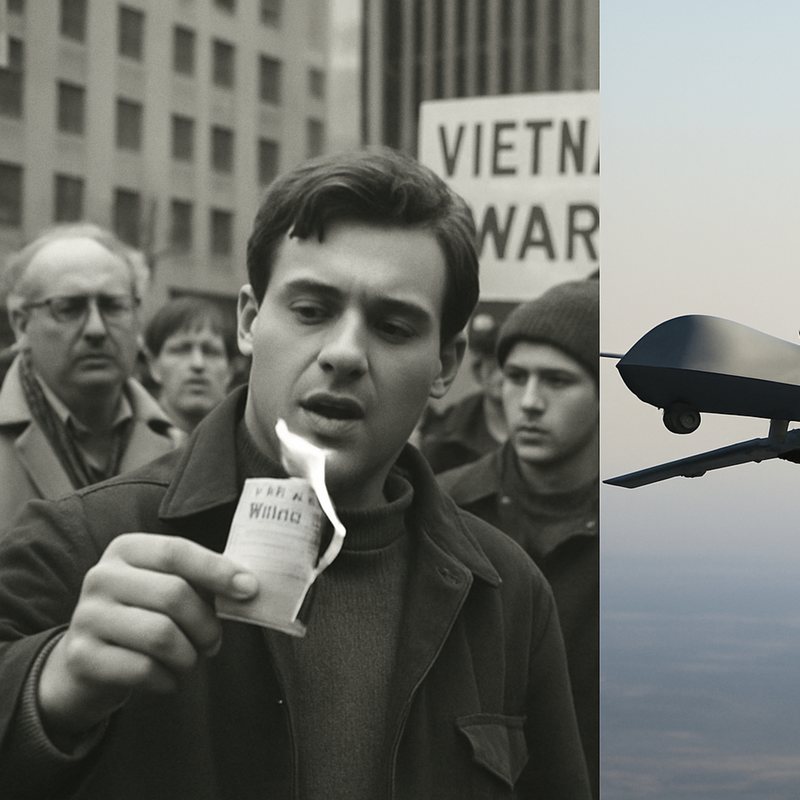
He understands fundamentally what it means for society to pay a price in blood, sweat and tears for a war, and how that personal sacrifice translates into political will or conversely, powerful anti war sentiment. OK, so let's really reflect on Vietnam through Abraham's lens, because he paints a very vivid picture. He notes it. It was a war that Americans could not ignore. Couldn't ignore, that's key.
Because they were the ones dying. He highlights how protests had weight because they were rooted in a shared national grief. A. Shared grief? That's powerful.
Imagine, if you can, the pervasive, almost suffocating impact of each draft lottery, where young men's futures, their education, their careers, their very lives were decided by the spin of a wheel and a random number. The randomness must have been terrifying for families. Absolutely. And picture the heartbreaking, all too frequent sight of each coffin draped with a flag, being returned home, not to a remote military base, but often directly to small towns and suburban neighborhoods. Bringing the war right to the doorstep.
Forcing the entire country, every community, to reckon with the war's cost. It wasn't an abstract debate discussed in Washington. It was a daily, painful reality for families across the nation. The pain was real, immediate and, crucially, unavoidable, as he says. It forced difficult conversations at dinner tables and on street corners. You couldn't just tune it out.
Which brings us to an incredibly important question for us to consider. What was it specifically about Vietnam that made public protests so undeniably powerful, so effective in driving governmental change? He's a very direct answer for that, doesn't. He he does. Abraham makes it abundantly clear, and his words resonate deeply.
My mother's protest was not about abstract morality. Not just ideals. It was about stopping the killing of people's own sons. This phrase encapsulates the core of it, this immediate, visceral and deeply personal connection to domestic suffering. Your own kids. Your neighbors.
Exactly. The constant, terrifying risk to 1's own children, one's own neighbors, one's own community provided an undeniable, unshakable anchor for anti war sentiment. An anchor. I like that, that metaphor. It was a shared national trauma that unified dissent and gave it an irrefutable moral and political force. The blood spilled was their blood. The lives lost were their lives.
And that truth was simply impossible for political leaders to ignore or dismiss for long. It wasn't just about policy. No, it was about protecting your own deeply personal. But if Vietnam was, as we've just explored, profoundly defined by this unavoidable and pervasive domestic pain, what about conflicts today? What is fundamentally shifted in the way we as societies experience and react to war?
Well, that's the crux of his argument about the present. The author makes a stark and rather unsettling argument that today's protests for Palestine, for Ukraine, are easier to dismiss. Easier to dismiss. Why? And the crucial question he poses is why? Why are these movements, even when passionate and widespread, often marginalized or swept aside by the political establishment and mainstream media? And his answer is.
Because, as he starkly puts it in these are truly powerful words, no American children are dying in those conflicts. That's blunt. It's a harsh truth, but it's absolutely central to his argument that the domestic price of war, lack thereof, dictates the political leverage of protest. Right. So if we connect this to the broader geopolitical picture, this fundamental absence of direct domestic casualties profoundly alters the nature of public engagement.
How people get involved or don't. Exactly and critically, the perception and efficacy of public dissent demonstrators for these contemporary causes, whether it's for the humanitarian crisis in Palestine or the existential struggle in Ukraine, according to the source, are painted as naive, radical or ideological. Labels. Easy labels. Yes, and this isn't just an accusation, it's a strategic narrative. They become easier targets for dismissal because, as Abraham argues, there is no domestic roof to anchor their 'cause. That anchor is gone.
Right when it is someone else's war, a conflict where your sons and daughters are not on the front lines, where flags aren't being folded for your fallen neighbors, it is easier to label the protest as fringe. So the protests lack that visceral weight. Precisely this highlights a monumental and deeply troubling shift in how public dissent is not only perceived by the powers that be, but, more strategically, how it can be so effectively sidelined and delegitimized by political actors. The emotional anchor is gone, and with it much of the traditional, undeniable public pressure that once shaped wartime policy. So if that vital anchor of domestic grief is missing, if protests can be so easily dismissed precisely because the profound pain of conflict is felt elsewhere, what does this all mean for the very concept of accountability in Modern Warfare?
It leads directly into a central thesis. It genuinely feels like the very mechanism that once held power to account the direct, undeniable human cost has been eroded, paving the way for something Abraham calls. The perfect crime. Here's where it gets really interesting and, frankly, quite chilling. As Abraham introduces this core concept, the author delivers a powerful, almost provocative statement.
Proxy wars are the perfect crime. Not crime in the usual sense, but politically. Right. He's not talking about traditional criminal acts committed by individuals, but rather a sophisticated geopolitical maneuver. He then goes on to explain their core, almost ingenious advantage. They allow nations to fight without feeling the pain of fighting.
Think about that fighting without pain. At least not your pain. Think about the sheer strategic benefit of that for a moment. The ability to achieve significant geopolitical objectives, to exert influence to counter rivals, all without incurring the crushing domestic human cost. The cost that has historically been the greatest, most potent constraint on warfare for a democratic state. Exactly what's truly fascinating here is how this concept contrasts so sharply with historical turning points that we've seen throughout history.
Would direct costs forced reevaluation? Like the ones he mentioned earlier. Exactly. The source specifically mentions Vietnam and Algeria, two major conflicts that turned when the occupiers own people bled. Bleeding at home, forced to change. In both cases, it was the direct, undeniable and mounting casualties on the home front that eventually forced the occupying powers to reconsider their involvement and ultimately withdraw.
That direct human cost was not just a factor, it was the catalyst for fundamental policy change. Couldn't be sustained politically. Right. Proxy wars, by their very design, seek to eliminate that pressure point entirely. They are engineered to ensure that the blood and sacrifice are outsourced, externalized. First, on to someone else.
Keeping the occupier, or rather the supporting power, insulated and politically safe from the blowback of human loss. But he suggests this didn't happen overnight. Right? There were steps along the way. Yes, exactly. Before we delve deeper into the perfect crime as it manifests today, the author points to earlier developments, almost stepping stones that gradually LED towards this ultimate insulation.
OK, what were those? He contrasts Vietnam and Algeria, where direct casualties were so pivotal, with Iraq and Afghanistan, noting they were different. They were fought by volunteers, not conscripts. The shift to the All Volunteer Force. Right. And this shift, while seemingly benign, perhaps even seen as a positive move away from forced service, actually had profound implications for public engagement and the political cost of war.
So what was the key? The implication of dropping the draft. This raises an important question. What exactly was the implication of this shift away from a universal conscription or draft system? The source states unequivocally, without a draft, the public felt detached.
Detached. That makes sense. It wasn't everyone's potential problem anymore. Precisely. This detachment wasn't merely psychological, it had very real political consequences.
The wars dragged on because they cost the public little in terms of direct human sacrifice. Because the burden was concentrated. Exactly. In a volunteer army, the burden of war is concentrated on comparatively small, dedicated segment of the population and their families. The vast majority of citizens go about their daily lives largely untouched by the conflict.
So the shared experience was lost. Largely, yes. While there were still casualties and the national grief for fallen soldiers was very real, it didn't permeate every household and community in the same pervasive way a draft era war would. It created a growing chasm between the military and civilian populations. A crucial step towards insulation, even if not the final form.
Yes, a crucial, if perhaps unintended step towards insulating the broader public from the direct personal costs of conflict. Even if it wasn't yet the full proxy war model, the public could mostly turn away or engages observers rather than participants with skin in the game. OK, so that's the volunteer army face. Then. Abraham argues that Ukraine takes this one step further, representing, in his view, the epitome of this installation.
The ultimate evolution, perhaps? He details the Western involvement in this ongoing, devastating conflict. The West supplies weapons, intelligence and money, but not bodies. No boots on the ground from the supporting nations. That's the key.
This is the core mechanism of the modern proxy war in action, where the support is substantial, often decisive, yet the ultimate human sacrifice, the direct loss of life, is borne by others. And this is also where concepts like black budgets become relevant, right Funding that avoids public scrutiny. Absolutely. Funds allocated with minimal public scrutiny, effectively allowing for substantial financial backing without transparent public debate on the full scope of involvement. This is precisely where the brutal efficiency of the modern proxy war becomes chillingly clear.
As the source highlights, Ukrainians and Russians die by the hundreds of thousands, while NATO nations avoid casualties. The scale of death is immense just elsewhere. Exactly. The domestic impact on the supporting nations is virtually non existent in terms of human lives. There are no folded flags delivered to suburban doorsteps, no soldiers at the door bearing devastating news. That image of the folded flag?
It's so powerful because it represents that direct, unbearable cost. And its absence is just as significant. This profound absence of direct visceral pain means that for the insulated societies providing support, the war is just a distant moral debate. Something on the news not in your neighborhood. Right. It's something discussed on cable news, debated in political circles, perhaps a topic for protests, but it doesn't manifest as a deeply personal tragedy for the average citizen. It creates a critical, almost surgical disconnect between the rhetoric of support and the reality of the immense suffering on the ground.
Absolutely. When you think about the scale of military aid, I mean the provision of advanced missile systems like Hamars, or vast sums and financial assistance or the sharing of real time satellite intelligence, this is an immense commitment. Huge resources are being poured in yet. Because that commitment doesn't translate into domestic casualties for the supporting nations, the perception of cost remains minimal. It's managed. And the author sees a similar dynamic elsewhere too. He does.
He sees a very similar pattern unfolding in Israeli war in Gaza, though he notes with different stakes, primarily referencing the nature of the conflict and the direct parties involved. But the principle of outsource suffering applies. Yes, here to the profound human cost is geographically contained, as the casualties are Palestinian and Israeli, not American or European. This geographic and national separation of casualties from supporting nations seems to be a recurring, almost defining feature of what Abraham calls the perfect crime. So the support flows, but the sacrifice doesn't fall.
Exactly this dynamic means that Western support comes without Western sacrifice. And this is the crux of why protests abroad, even if passionate and widespread, often have diminished force or are easily dismissed. Because there's no blood price being paid at home. Right. They can be painted as naive or extreme because no one at home is paying the price in blood.
This consistent pattern, evident across these contemporary conflicts, shows how the outsourcing of suffering is not merely a side effect, but a deliberate, strategic and defining feature of modern proxy conflicts. That's part of the design. It allows for a sustained engagement for the achievement of strategic goals, whether it's weakening arrival, projecting influence or supporting an ally, all with without the traditional domestic political backlash associated with high casualties. The cost is. Externalized and the accountability along with it.
And with it, the pressure for accountability is significantly reduced. This also allows for plausible deniability. On some level. You can deny direct involvement because your boots aren't on the ground even as your weapons and intelligence are deciding the conflicts trajectory. So if the profound human cost of conflict isn't born at home, if the traditional mechanisms for generating public pressure are effectively circumvented, what does this truly unsettling development mean for the future of democratic accountability, and indeed for how wars themselves are waged by powerful nations?
It raises some very serious questions about democratic control. It seems to enable an entirely new paradigm of perpetual conflict, where the true suffering is out of sight, out of mind for the decision makers and the public funding it. Which leads directly to the consequences he outlines. This brings us directly to what our source identifies as the core danger of proxy wars. And it's profound one. This is why proxy wars are so dangerous. They are insulated from democratic pressure. That insulation is the key danger. In a functioning democracy, public opinion, particularly when fueled by shared sacrifice and direct human cost, it's supposed to be a crucial check on state power, especially when it comes to the gravest decision a nation can make going to war. The ultimate check, arguably.
But here Abraham argues that fundamental check is missing. It's been bypassed. What's fascinating and deeply concerning here is precisely how effectively these conflicts bypass the traditional mechanisms that have historically forced a public reckoning with the true cost of war. What mechanism specifically? The source highlights what's utterly absent.
They require no draft, no mass funerals, no national reckoning. All the things that made Vietnam so different. Exactly. Think about the historical power of each of those elements. A draft forces every family to consider their direct stake in the conflict, making war a personal rather than abstract concern.
Mass funerals bring the cost home in the most visceral, heartbreaking way, impossible to ignore. And a national reckoning like the one we saw after Vietnam forces a society to grapple with moral and strategic failures, leading to profound introspection and policy shifts. These are the pressure points. Yes, these are the very pressure points that in the past have often compelled governments to reevaluate their commitments or indeed, to end conflicts that were proving too costly to the Homefront. Without them, the political landscape shifts dramatically.
Allowing decisions with less overseed. Allowing for decisions to be made with a kind of internal impunity. Unity you could say. And without those internal pressure points, without that shared national grief and direct human cost, the chilling implication Abraham raises is that proxy wars can continue indefinitely. Indefinitely.
That's a terrifying prospect. It's an almost terrifying thought, a perpetual state of conflict that never quite reaches a true resolution because the traditional impetus for one, the domestic backlash, is always just out of reach. Right. If we connect this to the bigger picture, it's all about the perceived cost from the perspective of the supporting nation's decision makers and its public. How they see the cost?
Precisely these conflicts continue because they cost only and rhetoric to the societies behind them. This perception of a low domestic cost, measured in terms of lives and direct suffering, is what makes these conflicts seem endlessly sustainable for those pulling the levers of power and funding them. Even if the real cost on the ground is horrific. Exactly. Even if the actual human cost in the proxy theater is absolutely astronomical, as we've discussed, millions displaced, economy shattered, generations traumatized, that devastation is entirely outsourced. Out of sight, out of mind.
From the vantage point of the decision makers and the public in the supporting nation, the Ledger looks remarkably clean. This creates an environment where long term low stakes for them. Engagement becomes the norm, despite the incredible human tragedy unfolding far away. It's a stark illustration of how economic cost, while significant, is often politically more palatable than human casualties. Much more palatable, definitely.
The author also points out how modern proxy wars go beyond earlier methods of public shielding that we've seen implemented in previous conflicts. He mentions techniques like embedding journalists, hiding casualty numbers, relying on drones. Right attempts to manage the narrative. These were always clearly to try and dull the public's perception of the human cost, to make war seem less messy or less deadly. But he argues proxy wars are different, fundamentally different. So this raises an important question. How do proxy wars differ fundamentally from these earlier attempts at insulating the public from the grim realities of conflict?
What's the core difference? The source clarifies that those older methods, while manipulative and designed to control the narrative, only dulled the pain. They blurred the edges, soften the blow, but the pain was still there, however muted or delayed. Still perceptible. In contrast, proxy wars eliminated entirely for the supporting nation. This is why they are described in such start terms. They are clean, bloodless at home and thus endlessly sustainable.
Clean only for the side not doing the bleeding. Exactly. And then, in a truly powerful concluding statement, he says they are, in the coldest sense, the perfect crime. Wow. This highlights a significant and disturbing progression in the ability of nations to completely externalize the human cost of conflict, removing it from their own societal consciousness and accountability mechanisms.
It's like perfecting the art of war without consequences for the sponsor. It's a method of warfare designed to avoid the internal reckoning that has historically brought conflicts to an end. It allows strategic objectives to trump domestic consequence in a way rarely seen before. If accountability is so effectively evaded and the pain of war is so thoroughly outsourced, what does that mean for the very possibility of achieving lasting peace or genuine resolution in these conflicts? That's the $1,000,000 question, isn't it?
It certainly suggests a future where for some, war becomes an eternal cost free exercise, at least from their insulated vantage point, which leads to the moral dimension. Yes, moral vacuum, as he puts it. So if societies that support proxy wars are effectively insulated from the true human cost, what does that imply for the very nature of winning a conflict? Abraham states quite bluntly. Wars like these cannot be won through hearts and minds. Which seems counterintuitive to a lot of modern thinking about conflict resolution.
Right, it seems to fly in the face of traditional counterinsurgency theory, or even just basic human empathy and community building in conflict zones where engaging the local population is often seen as paramount to long term success. So why can't they be one that way, According to him? What's fascinating here is the precise reason Abraham provides for this profound found disconnect. Because the hearts and minds funding them are never at risk. The funders hearts and minds are safe. Exactly.
This creates A fundamental and profound moral vacuum. The decision makers, the strategic planners and the broader public in the supporting nations don't bear the personal burden of death, displacement or daily terror that defines the lives of those directly caught in the proxy conflict. That detachment again. This detachment, this lack of personal risk, in turn, profoundly diminishes the imperative to truly engage with the human element of the conflict on the ground, to understand the local population's grievances, to build trust, or to foster genuine reconciliation. So hearts and minds becomes a slogan, not a strategy. Rooted and shared risk.
Pretty much, the concept of winning hearts and minds becomes irrelevant or at best a secondary concern when your own hearts and minds, your domestic public, are not invested in the same way. The primary goal becomes achieving strategic objectives for the external power. Rather than fostering stability or legitimacy within the proxy state itself. The source goes on to highlight what he sees as the stark moral consequence of this entire system. The suffering is outsourced to those with no choice and no voice.
That's a devastating line. It's a powerful and deeply disturbing image, the immense burden of conflict falling disproportionately and entirely on those who often have no say in its beginning, its continuation, or its eventual agonizing end. It's almost as if the collateral damage is precisely the point, or at least an acceptable and ignored byproduct. So what's the ultimate strategic outcome here? This raises an incredibly important question for us to ponder.
What's the ultimate strategic outcome of this systematic outsourcing of suffering and voice? The author argues that that is the brutal efficiency of the modern proxy war. It achieves strategic goals while insulating the societies behind it from the true cost of their actions. Efficiency in achieving goals. Insulation from costs. It's a system designed quite explicitly to achieve geopolitical and strategic objectives with minimal domestic political or human capital expenditure for the external powers.
The direct human toll, the generational trauma, the societal breakdown, the challenges of post conflict reconstruction, all of that is left to others far away. It's a mechanism for power projection that has effectively decoupled the consequences from the decision makers. Creating a morally perilous and critically, A strategically sustainable for the supporting powers form of warfare. This shift can fundamentally reshape international relations, potentially making powerful nations more inclined to intervention knowing they can avoid direct accountability. We've truly taken a deep dive today into how proxy wars, by outsourcing the human cost and isolating societies from the pain of conflict, effectively insulate the nation's behind them from democratic pressure and traditional accountability mechanisms. Yeah, it's a lot to take in.
It's a system designed to keep the cost minimal at home while the devastation, the true human cost, rages elsewhere. And the idea of the perfect crime, as Chris Abraham presents it, isn't necessarily about malicious intent in the traditional sense, but about a system's insidious efficiency. Efficiency over empathy, maybe? Perhaps it describes A mechanism that achieves strategic goals while cleverly and effectively bypassing the very domestic mechanisms, the human cost, the public outrage, the shared grief that once forced A reckoning with the true and terrible price of conflict. It's about how the nature of warfare has evolved to circumvent the constraints that previously existed.
The rules of the game have changed. In a fundamental way. So if the historical mechanisms for ending wars like shared national grief, public outrage, and widespread domestic pressure are effectively neutralized in proxy conflicts because the pain is always borne by someone else, what does that profoundly unsettling reality imply for the future of global stability? It's the big question hanging over all of this. What new forms of accountability might truly be needed, or might emerge when the pain is entirely offshored and the hearts and minds funding these wars are never genuinely at risk? A difficult question with no easy answers. Something to consider as you reflect on the conflict shaping our world and the true cost of battles waged far from home.