Read the full transcript (2,221 words, machine made)
OK, let's unpack this. What if the constant churn of the American culture war, you know, isn't just a clash of moralities or ideologies? What if it's something far more strategic? Maybe a contest of patience? Interesting premise. Yeah, today we're diving deep into a really thought provoking analysis by Chris Abraham.
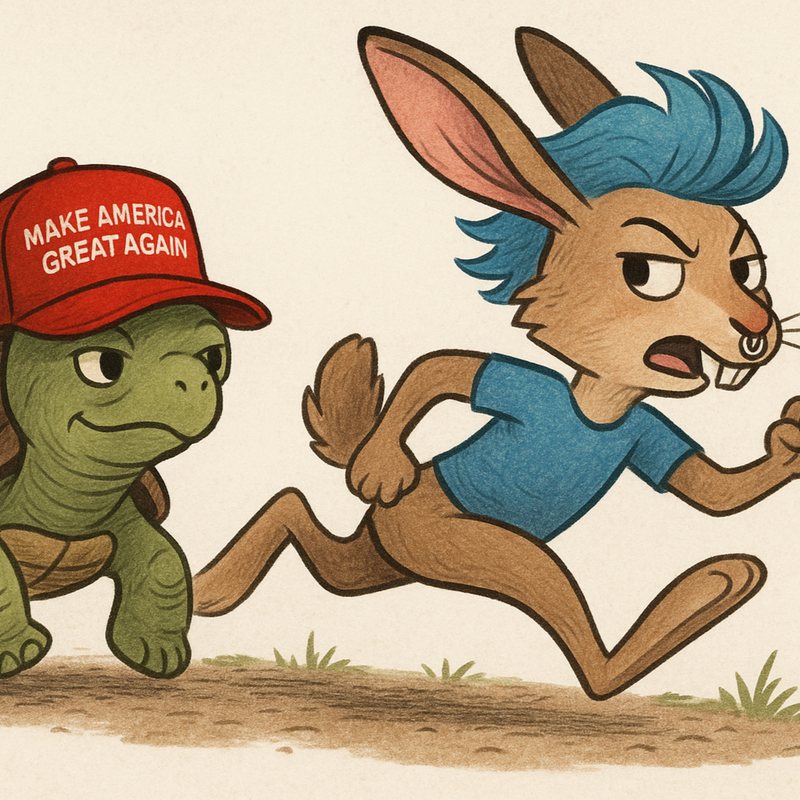
It's titled The Tortoise and the Hare. How strategic patience let's conservatives win while progressives burnout. Right. And this source, it offers a truly unique framework, doesn't it, for understanding why some political movements seem to achieve long term success while others, you know, despite having immense passion, often lose momentum. Yeah, it really challenges us to look beyond just the daily headlines, right, And consider the the underlying strategic tempo at play. Exactly that tempo.
So that idea of underlying strategic tempo certainly seems to be Abraham's core premise. And our mission today, for you listening, is to truly explore how he builds that argument. The culture war isn't necessarily one by who's smarter or, you know, morally superior, but by a profound understanding of pacing, endurance, and these often overlooked thresholds of public opinion. We're going to dissect 3 powerful metaphors Abraham uses to illuminate these dynamics. Sounds good, where do we start? So Abraham kicks off his analysis with a powerful parallel, the classic tortoise and hare fable. He argues progressives often embody the hair, making what he sees as a critical misstep.
And what's that? They mistake urgency for power. What does that actually look like in practice, according to his view? Well, it's quite striking when you read it. The source describes progressives as operating in this kind of state of permanent emergency where almost every issue, whether it's climate change, racial equity, trans rights, it's framed as completely existential. The takes for always incredibly high. Exactly, Abraham sites examples like climate will collapse in 12 years or or racial equity must be enforced now. Now the causes themselves are obviously profound. That's not the point here.
But the central insight, according to the source, is that this constant Sprint, this what he calls a politically suicidal timeline. It often backfires. The source argues this belief that loud is strong, fast is effective, urgent is persuasive. Well, it's actually just exhausting. Exhausting.
Yeah, I could see that it alienates people. That's the argument. It alienates rather than persuades and can squander real momentum. Because, you know, velocity isn't the same as sustained force. You can't Sprint forever.
That makes a lot of sense. You really can't maintain that pace indefinitely. So if progressives are the sprinting hair in this analogy, who's the tortoise and what's their strategic advantage according to Abraham? OK, so Abraham posits that conservatives are the tortoise, and he's he's quick to point out they're not smarter, not morally superior, but by design, enduring their fundamental ideological project, as he describes it, is essentially not to move. They want as little to change as possible. OK, so resistance to change itself is the strategy? In a way, yes.
This inherent resistance makes them, in his words, nearly immune to the pressure of the moment. The core of it is a profound patience, a willingness to play the long game. Can you give us some specific examples from the source? Something that really illustrates this conservative long game. Absolutely. And this strategic patience idea is illustrated through some, well, pretty powerful examples Abraham gives. Like what, for instance, on gun control, he says it's not about immediate capitulation if restrictions come in. It's more a willingness to adapt over decades, saying something like fine, we'll switch to revolvers, bolt actions and 10 round mags for a decade.
OK, a tactical retreat. Almost. Or maybe just adaptation for abortion. It's framed as the strategic 50 years, slowly stacking the judiciary to undo previous rulings. Great, the Longview on the courts.
Exactly, And when faced with pandemic measures that restricted gatherings, the approach described was simply close. Churches during a pandemic. We'll wait, yes. Wait it out. Yeah, and on school curricula, the source describes the approach as redraw school curricula to include radical gender theory. We'll sit on the sidelines quiet until the moment you cross our kids, and then we'll run for school board and end it all in one cycle.
Wow. OK, that's very specific. It is the the genius, according to Abraham, is their understanding of how to just say no for decades until, as he puts it, the country forgets how to say yes. Even if it means taking criticism. Even if it means suffering insults and condescension while stacking boards and flipping counties.
It's about understanding the ebb and flow of societal change and knowing when to push versus when to simply be. OK, but how does this strategic patience, or maybe the lack of it on the other side, play out for the vast majority of people? You know, those folks not constantly immersed in online debates or protests? Abraham introduces another compelling idea here. The frogs in the pot.
Ah. Yes, the frogs. Who are these frogs and what happens when the water starts to warm up? So the frogs in this metaphor are the normies, the conservatives, the non political, the moral Majority. The quiet middle, maybe?
Kind of. They represent the vast body of the American public who possess power in numbers, in votes, and, crucially, in what the source calls emotional inertia. Emotional inertia. Interesting. Yeah, as the source describes it, these frogs are in a pot of cool water, and it's slowly warmed by ideological change.
We're talking gradual shifts here. Like what kind of shifts? Things like a little more gender ideology in the schools or a few more pronouns in HR. Maybe a new cartoon with a non binary lead or a new acronym on the DEI training small things individually. OK. Incremental changes, right?
The water gets warmer bit by bit, and generally they tolerate it because, as Abraham puts it, they are tolerant, passive, sleepy. So for you listening right now, this raises a pretty critical question. Yeah. When does this warming water stop being tolerable? When did the frogs finally reach their boiling point? And that is the crux of it.
It's where the source identifies what it sees as a significant blind spot for, well, one side of the political spectrum under estimating this collective emotional threshold. So what happens when that threshold is crossed? Abraham explains that when these frogs feel their basic moral compass about things like sex, children, truth, biology, race, fairness, when that feels like it's under assault, Yeah, they don't necessarily protest loudly on Twitter or March in the streets. No, they jump and they jump. Hard jump where? Not toward the left, but away from it. The progressives perceived urgency, Abraham argues, starts to feel threatening to people who never consented to the project in the 1st.
Place OK, so the speed itself becomes alarming. That's the idea, as the source vividly puts it. The radical thinks they are liberating people. The frog thinks the kitchen is on fire. That's a stark image. It is.
And when they jump, according to this analysis, they do not negotiate. They recoil. They shut it all down. They don't care about nuance. And how does that manifest in the real world?
Well, the examples given are things like pulling kids out of public school, suddenly voting Republican when they didn't before, flipping school boards, or maybe retreating more into church communities. And the result from this perspective is that progressive change isn't just stalled, it can actually be reversed. Wow. OK, And tying these powerful dynamics together, the hairsprint, the frogs jump. Abraham introduces his third metaphor. It's the minefield of the herd, representing that big, slow moving, maybe 80% of people who don't want utopia or a revolution.
They just don't want to be shouted at by either side. What does the source say happens if you try to rush this herd? The source is very clear on this. The herd, it says, will often go along quietly with minor changes. They're adaptable to a point.
But there's a limit. Exactly. The warning comes when you try to rush them, try to force new moral codes overnight, try to shame them into compliance with 10 new identities and a dozen pronoun updates in a year. Or, you know, try to ban gas cars to fund police and abolish gender. What happens then?
Abraham says the herd doesn't follow its stampedes. Stampede. Yeah. And when it's stampedes, it's not just the shepherd who loses, it's the whole movement. The fences are trampled.
The cause is crushed. That's a really stark warning. It sounds like, from this perspective, a fundamental misunderstanding of where real leverage and influence actually lie. That seems to be the argument. The source also contrasts the the typical perception of these herd members with their actual strategic power.
Can you elaborate on that a bit? Yeah, that's a key insight. In the piece, Abraham observes that progressives sometimes mock conservatives as dumb yokels, Bible thumpers, you know, the whole stereotype. Skynard blaring, Bud Light swilling monster truck fans. Like a caricature.
Exactly. However, the source emphasizes that, well, the human brain doesn't very much in cognitive horsepower across cultural lines. That person who fits the stereotype might have a 140 IQ and a 30 year grudge. OK. So don't underestimate them based on appearances or assumptions. Precisely.
And the crucial point Abraham makes is that when that person decides to act, maybe they don't scream on social media. Instead, he runs for county office. He sits on zoning boards. He becomes a school principal. The institutional approach. Yes, heat changes the policies with patience and quiet resolve. The source really drives home the point that real change doesn't happen in the streets, it happens over decades in the bureaucracy.
Which highlights again this potential misunderstanding of where true power is cultivated, at least according to this analysis. That's the core of that metaphor, yeah. OK, so we've got the patient tortoise versus the sprinting hare. We've got the frogs reaching their boiling point if the heat turns up too fast, and we've got the herd that stampedes if pushed too hard or too quickly. What are the real world consequences? Abraham highlights when all three of these dynamics are, let's say, misunderstood or ignored. Well, Abraham is quite clear about the outcome. In his view, when the hairsprints the frogs boil and the herd scatters, the results he describes is invariably cultural retrenchment, legal rollback and the ascension of the very forces the progressives claim to be resisting. So it backfires completely.
That's the argument presented. And for any movement, this raises a really crucial question, doesn't it? Are you designing your strategy primarily for your most ardent supporters, your base? Or are you thinking about the broad, often quiet majority? The source argues that making that distinction and choosing the latter is absolutely crucial for long term success. It's quite a compelling analysis, whether you agree with the premises or not.
And Abraham doesn't just diagnose the problem as he sees it. He does offer some advice for progressives if they want to quote win the future. What's his suggested path forward? The advice given is pretty direct and probably challenging for some. It's things like stop screaming at the herd and start whispering to the frogs.
Spring to the frogs. OK, which seems to mean shifting from demanding immediate radical transformation to offering pathways and, crucially, to drop the moral ultimatums and build social trust. Build trust over demanding compliance. That seems to be the essence. The source concludes that the culture war from this strategic viewpoint is ultimately one with patience, with restraint, with the wisdom to know when not to push.
So back to the beginning. Right. Or, as the old fable goes, slow and steady wins the race. Wow, what a fascinating deep dive into the strategic underpinnings of the cultural war, at least as presented by Chris Abraham. We've seen how his metaphors, the tortoise and the hare, the frogs in the pot and the shepherd and the herd paint this picture of patients, thresholds and sometimes unintended consequences.
It really suggests it's less about the what of political ideas sometimes, and maybe more about the how and the when of change. And just reminder, for everyone listening, this deep dive was purely about conveying the arguments and insights presented in the source material. Absolutely. We're not endorsing any particular political viewpoint here, but rather trying to help you understand the different perspectives and strategies that might be at play. And if this analysis holds any water, if the culture war is truly a contest of patience and understanding these social thresholds, well, then the challenge for any movement seeking change isn't just articulating A compelling vision.
It's also about mastering the art of the long game and that subtle dance of persuasion. So the provocative thought maybe for you to consider is how might these insights apply beyond the culture war to other areas, perhaps in your own life or work, where you want to see lasting change? Something to definitely Mull over.