Read the full transcript (3,789 words, machine made)
Welcome to The Deep Dive, the show where we really tried to distill stacks of articles, research all sorts of notes into the most important Nuggets for you, our listener. Taking the complex and making it, well, digestible. Exactly. And today, we're plunging into something that really shapes how we see the world, often in ways we don't even realize. It's about how we consume news of conflict. I mean, think about your own routine. How do you get updates on, say, global hotspots? Is it the traditional TV news?
Probably less and less for many. People, right? Or is it something more immediate, more visceral, maybe more raw, like a short video clip popping up on your phone? Yeah, or a really striking image, something shared on social media that just sticks with you, gets that emotional reaction. Precisely.
And that shift leads us to this really central and honestly quite unsettling idea that our sources are unpacking for us today, which is that Modern Warfare, it isn't just fought with bombs and bullets anymore. It's also waged with cameras, with live streams, with, well, expertly curated images. A second front, almost an information front. Exactly. We're talking about a profound transformation here, an evolution of what used to be called, very discreetly, human, human intelligence.
Right, the old spy stuff. Into something our sources are calling, quite provocatively, human, human entertainment. Human. That's yeah, that hits differently. It's not just a clever word play, is it? Not at all, according to the sources. They argue it represents A fundamental change in how conflict is presented and maybe more importantly, how it's perceived across the globe.
And what's really fascinating, or maybe disturbing depending on how you look at it, is how this redefinition changes our whole engagement with conflict. How so? Well, think about human the original kind. It was always in the shadows, wasn't it? The domain of, you know, the field operative.
Maybe the classic spy in a trench coat meeting an informant in secret. Cultivating sources over months, years even. Right where the analysts locked away somewhere, pouring over classified files, trying to piece things together. It was intelligence for a very small, specific group. Generals.
Policymakers. Exactly. People making decisions behind closed doors. It was meant to be discreet, controlled, definitely not for public consumption. OK, so that's the baseline human secret controlled for the few. How does that contrast with this new human? What makes it so immediate and in your face? Oh, the contrast is just stark.
Today's human intelligence, if you can even call it that, in the same breath, is overwhelmingly first person. Like shot on a phone. Yeah, often shaky, maybe pixelated footage from a smartphone or even a body camera worn by a soldier, a fighter. And our sources, they paint these incredibly vivid pictures, examples like the crying child, you know, covered in dust, pulled from rubble after an airstrike. We've all seen those images.
Gut wrenching. Or the sound, the screams of a mother under sirens looking for her family. Or, you know, a fighter filming their own actions with a GoPro on their helmet. That's a whole different perspective. It is, and this stuff doesn't go into a secret file. It's uploaded almost instantly.
It hits TikTok X Instagram. It, just as the sources say, floods your feed. Not just the news feed, but your personal social media. Exactly. It's direct, it's often totally unfiltered, and it's immediate.
The lag time between something horrific happening and the whole world seeing it. It's shrunk to practically nothing, minutes sometimes and the. Speed. This rawness. It takes on another dimension, doesn't it?
Our sources argued. This new form of intelligence, this human, it does more than just inform. Yeah, it goes way beyond informing. It captivates you, it compels you. It keeps you scrolling. It definitely horrifies, no question about that. But the sources say it also entertains. That feels wrong to say.
It feels deeply uncomfortable. And that's exactly the point the sources are making. This is the core of human the suffering isn't just witnessed passively. It's consumed. Actively consumed.
Think about that word. Witnessing implies maybe presence, maybe helplessness. Consumption suggests something different, more detached, maybe even voyeuristic. Like clicking on the next video even though it's awful. Precisely. The algorithms push the emotional stuff, the shocking stuff, and this constant stream transforms real human suffering into a kind of, well, content, a commodity. So the horror becomes the hook.
The horror itself becomes the hook. It gets those strong reactions, shock, grief, anger, maybe even that morbid curiosity. But those feelings become part of the experience of consuming the show. It's a really profound shift from intelligence, being purely informative, to being primarily engaging, emotionally engaging. It almost creates this weird detached relationship with suffering that's happening far away.
Empathy gets tangled up with just watching. Yeah, a parasocial relation for distant trauma. And that brings us to this unsettling analogy. The source uses the idea of That's entertainment. Like the old Broadway song about making even heartbreak beautiful on stage, applying that to war seems incredibly dark.
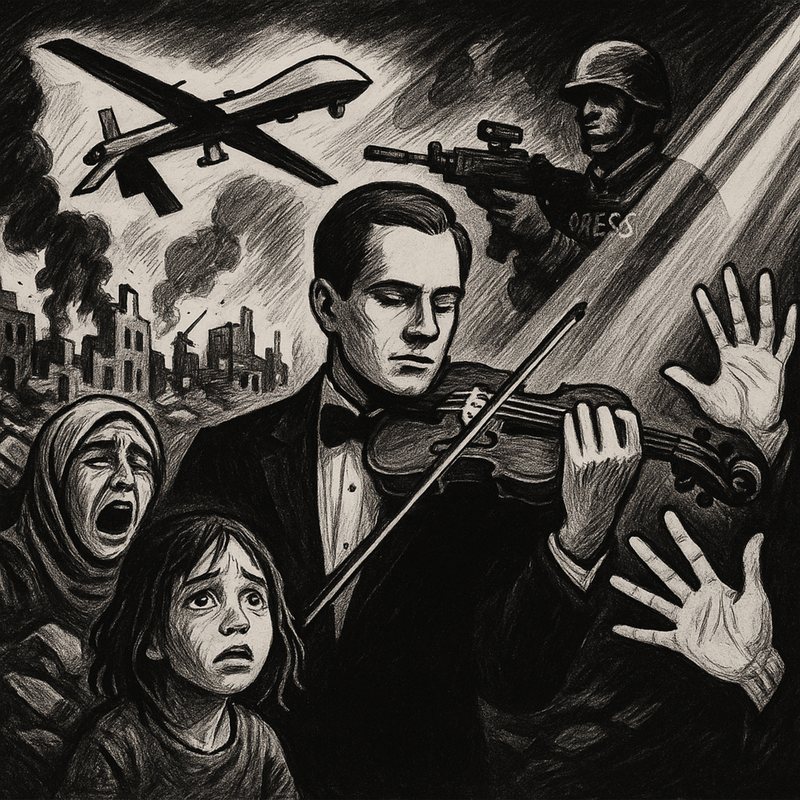
It is dark and it's meant to be provocative. The source takes that very framework, making tragedy captivating, and applies it directly to places like Gaza. How does that work in practice? Well, the raw images, the suffering, they become the verses in this grim performance, right? You have the crying child, maybe framed perfectly. The keening mother.
Her cries echoing against the ruins. Then maybe a sweeping drone shot over flattened buildings, giving that tragic overview. OK, and then, the sources argue, the producer steps in. You get the swelling violins, the sad music laid over the footage, the captions with poignant messages. Setting the mood, basically.
Exactly. It gives it a dramatic structure and emotional score and narrative arc. It makes this genuine human tragedy more digestible, maybe more compelling for a global audience, more consumable, even if the consumption is driven by outrage or sadness. Which leads to that really blunt statement from our sources. Horror itself is the show. War has become theater atrocity content. Wow.
What does that even mean for how we understand conflict? It means potentially complete reframing. If war is theater, if atrocity is content, then maybe our primary role shifts from being informed citizens who might act to being spectators. Just watching the drama unfold, yeah. Consuming the tragedy as a narrative, a series of compelling, awful events.
It forces us to ask, you know, is our scrolling, our sharing, our emoji reactions? Are angry online debates? Is that just participating in the show? Does it blur the line between real empathy and just a kind of desensitized entertainment? That's the uncomfortable question. Does our consumption, even if we mean well, actually help perpetuate it by making suffering A valuable commodity for different actors?
Does the spectacle become more powerful than the suffering itself in grabbing attention, but maybe not in driving real, decisive action? So who are the producers of this theater? Who's packaging this content? Our sources introduce this really interesting, maybe controversial term, soft Spooks. Yeah, soft Spooks.
It definitely challenges our usual assumptions about who's neutral in a war zone. We tend to think of journalists, aid workers, NGO staff, people with press vests or Red Cross logos as impartial witnesses, right? That's the ideal, isn't it? The comforting idea that they're just there to document the facts, bear witness without any agenda, be the neutral eyes and ears for the world. But our sources are saying no, not quite.
They call them narrative operators, effectively soft Spooks. That sounds loaded. It is loaded, but the key distinction the sources make is this. They're not traditional spies working for, say, the CIA or MI 6. They're not doing classic espionage.
So who do they work for? They work for causes, they're donors for specific advocacy campaigns, and crucially, they work for global public opinion. Their mission is to influence hearts and minds. Exactly to generate awareness. Get sympathy, Dr. Action donations, political pressure for the specific cause or population they represent.
So their footage, their stories, while showing real events, consciously shaped, they apply an editorial hand. They choose which stories to tell, which angles to push, which images will hit hardest internationally. It's not about making things up. The source is stressed. Right. The suffering is real.
The children in the rubble. The hunger that's not fabricated. Absolutely not. The sources are very clear. The devastation, the loss, the terror. These are undeniable, horrific truths. The sauce books aren't and inventing these, but they're using that editorial hand, that calculation. There's this understanding that horror to cut through, all the noise online must be packaged.
Like a documentary filmmaker choosing shots and music. That's a good analogy. The footage is real, but the presentation is strategic, designed for maximum emotional impact. And the motivations behind this packaging? Our sources point to some very practical reasons. Yeah, often quite pragmatic.
NGOs need funding, right? Compelling stories bringing donations, Media. Outlets need need clicks and views. Emotional content drives traffic. Activists need engagement to mobilize. Support pressure politicians.
Organize protests. So in this context, the suffering becomes both truth and a tool, a weapon in the information war. That's exactly how the sources frame it. A dual entity, undeniable reality, and a powerful strategic weapon used to generate empathy, outrage, action, funding. And they say everyone plays this game not.
Just one side. No. Israel plays it, Hamas plays it. Almost every modern actor in conflict engages in it. That raw human, this different actual human experience gets transformed, edited, scored with violins, may be pushed out globally.
The goal isn't just to inform anymore. It's to generate feeling. Because feeling is power. It moves people. It moves money.
It shifts opinion in ways cold facts rarely do. This idea of war as theater, it's not entirely brand new, is it? Our sources mentioned a historical example, the Nyira testimony back in 1990. Why is that so important here? Ah yes, Nyira.
It's a crucial historical marker, a chilling president. This was just before the 1st Gulf War. A young woman, identified only as Nyira testified before AUS congressional committee. She gave this incredibly emotional, tearful account, claims she was a Kuwaiti refugee, saw Iraqi soldiers taking babies out of incubators in a hospital and leaving them to die on the floor. Oh my God. Horrifying.
Absolutely horrifying and it was broadcast everywhere. President Bush senior cited it. It was widely accepted, very powerful and swaying public opinion towards intervening against Iraq. Hugely influential. But there's a catch. Wasn't there?
A massive catch. It came out later. Now Ira wasn't just some random refugee, she was the daughter of the Kuwaiti ambassador to the US. Wow. And her entire testimony scripted, coached, rehearsed by a major American PR firm, Hill and Knowlton, hired by the Kuwaiti government.
So it was pure theater. Pure theater, exactly as the source describes it. APR stunt designed to evoke maximum emotion and justify war. It wasn't organic, it was a performance. Our source calls it the prototype for war as spectacle. It showed how easily a powerful emotional narrative, even a fake one, could shape reality for millions. Devastatingly effective, it proved the power of weaponized human intelligence for public consumption. OK.
So if Nyira was the prototype, what makes Gaza, according to these sources, the full Broadway production? How is it different? More advanced? It builds on that model, but the key difference is the sheer scale, the immediacy, the ubiquity of it all. Now in Gaza, almost every image, every video, every testimony.
It serves this dual purpose. Evidence and advertisement, Witness and spectacle. Exactly. It's proof of the horror, the human cost, but it's simultaneously advocacy, a narrative piece pushing a specific perspective designed for mass consumption. And the source says the razzle dazzle the.
Editing the music, the camera angles. Yeah, that stuff isn't a distraction from the reality. It is the product. It implies this highly sophisticated construction of public perception. The presentation is the message. And again, it's not just one side performing this. Not at all, the sources stressed. This is universal and modern conflict, Israel's counter narratives, their press conferences, the videos the IDF releases of tunnels or weapons they'd have. Their own production value.
Absolutely carefully edited, narrated, pushed out through official channels, social media. They have their own narrative flair. In a war fought under cameras, where everything could be recorded and broadcast instantly, performance is as critical as the battle itself. It's a battle for the story. Fundamentally, controlling the narrative is paramount for everyone involved.
This focus on narrative brings us to something incredibly harsh that the sources highlight famine, specifically famine as a strategic weapon. They really pushed back on the idea that hunger in Gaza is just an unfortunate accident of war. Yeah, that's a very direct claim from the sources. They stated plainly the hunger isn't an accident, it's a deliberate tactic and has a long, ugly history. Starvation as a tool of war. It's ancient.
Medieval sieges surround a city. Cut off supplies, wait for starvation and disease to force surrender. Think about the blockades in World War One. World War 2 designed to cripple the enemy, break morale, stop their ability to fight. It's brutal, but historically effective. So applying that to Gaza now, the sources suggest the restrictions on aid, fuel supplies, that's not just collateral damage, it's actual doctrine. Precisely.
The blockade, the limits on fuel, water aid, the control over supply lines. The source presents these not as incidental outcomes, but as deliberate doctrine. With a specific goal. A clear, strategic, ruthless goal. Make resistance unsustainable.
Break civilian morale. Force Hamas and by extension Gaza to yield it's pressure. Immense constant pressure without necessarily firing a shot in every instance. That sounds just incredibly cool. What's the underlying logic there?
The logic, as the source explains it, is stark. War isn't about fairness. It's about leverage. Famine provides a slow, relentless leverage. It creates massive civilian suffering.
Which then becomes part of the spectacle, the human we talked about. Right. Those images circle the globe, increasing pressure, increasing desperation. But in the cold calculus of war strategy, that civilian suffering becomes a key pressure point designed to create an unbearable situation that compels surrender, perhaps with less direct military cost or condemnation than other actions. And naturally the different sides frame this suffering completely differently.
Oh, absolutely. That's where the narrative war really heats up. Israel frames its actions around security, dismantling Hamas, rescuing hostages, preventing aid diversion. They argue restrictions are necessary for their safety. While Hamas uses the suffering.
As a rallying cry to galvanized support domestically and internationally to highlight the humanitarian crisis. Position themselves as defenders against depression. Generate global outrage. And the civilians are trapped, starved of food and starved of agency, pawns in the game. That's the tragic reality depicted.
Their suffering serves different narrative functions for the warring parties. This brutal logic, especially around famine, connects directly to how our sources discuss mercy and war. It's not portrayed as kindness, is it? More like a negotiation. Exactly. Forget any romantic notions.
The source defines mercy in war very clinically. It's not given freely, it's granted only to the defeated and only after they completely surrender. So mercy is conditional on strategic defeat. Entirely conditional. It's a concession from the victor, not a right of the vanquished.
It's about power dynamics, not compassion. The sources use that analogy of the Knights fighting under the King's eye to illustrate this. Can you walk us through that? Yeah, it's a vivid picture. Imagine 2 Knights battling it out. A king watches, thumb poised.
One knight is clearly stronger, has wounded the other knocked him down. The weaker knight is defeated, right? The stronger knight stands over him, sword ready. Now the King's thumb comes into play. If the fallen knight surrender, throws down his weapon, yields, the king might turn his thumb up. Mercy.
Life spared, maybe. But if he refuses, if he spits, tries one last hopeless attack. If he chooses defiance, even when beaten, the thumb goes down. No mercy. The end.
That's the consequence of refusing to surrender when you're clearly overcome. And the source is applying this directly. Israel is the strong knight Gaza, Hamas is the defiant 1, and therefore no mercy is forthcoming under this logic. That's the brutal interpretation presented. Israel has the power is dismantling its opponent Gaza. Hamas chooses defiance.
And according to this framework, mercy only follows capitulation. It's not a moral judgement on the defiance itself, but a statement about the unchanging rules of war. Terms are set by the victor after resistance ends. And we see this historically. The sources mentioned Germany and Japan in 45. Absolutely.
Germany. Japan. Utterly defeated. They surrendered unconditionally. They didn't negotiate terms.
They accepted them then, and only then did the rebuilding start the path back. The alternative being. Complete annihilation, fighting to the very last man. Which brings us to that other, darker analogy. The source uses the Black Knight from Monty Python.
Tis but a scratch. Exactly. Gaza, in this view, keeps fighting even as limbs are Hacked Off. Brave, maybe, but the source presents it as suicidal if the aim is survival and rebuilding, which requires surrender when facing overwhelming odds. All of this points towards a really stark conclusion from the sources about the world stance that Gaza has basically been abandoned. It's a tough assertion, challenges a lot of the rhetoric we hear.
But the force argues yes, geopolitically Gaza is alone, despite all the talk, especially from the Arab world. No armies, no jets. No meaningful military intervention. Egypt keeps Rafael mostly shut. Jordan protects its own border. Gulf states might offer money for after, but avoid confrontation now.
What about Iran? They support Hamas, don't they? They provide weapons, money, rhetoric, yes, but the source frames this as Iran using Gaza as a pawn in its bigger chess game with Israel in the West. Strategic leverage, not selfless solidarity risking direct war. So for billions of Muslims, half a billion Arabs, Gaza is a slogan, a symbol, but not a cause worth dying for in a military sense.
That's the harsh assessment presented by the source. A powerful symbol, a deeply felt grievance, but not translating into the kind of military action that would change the balance on the ground. And the West, all the protests we see. That's framed as a performance of solidarity, the source says. The West loves Gaza as a protest sign, student activism, chanting free Palestine.
It's seen as performing solidarity, expressing moral outrage, but not delivering pangible military or decisive political intervention. So when the chips are down, the cold reality of power dictates. The world bets on Israel, according to the source. Israel has the tech, the nukes, the Intel, the global influence. Gaza has suffering, and suffering in this real political calculation is deemed not enough. Which leads us to the inevitable end game. According to this cruel logic, our sources describe how do wars actually end?
Comes back to that simple brutal rule. Wars end when one side surrenders. Truces are temporary pauses. A definitive end requires capitulation. And applied to the current situation. Gaza Hamas hasn't surrendered.
Israel sees no reason to stop. Until his goals are met, the world won't truly intervene, so the source predicts A grim continuation. The siege continues. Bombs fall. Famine Titans.
Suffering mounts and, crucially, the cameras keep rolling. The human cycle continues. But it's vital to stress, as the sources do, this isn't advocating for destruction. It's presented as just how wars work. Absolutely critical clarification.
It's not endorsing it. It's a dispassionate analysis of power dynamics. The brutal equation is resistance without the power to win. Just prolongs the suffering. The longer it goes on without surrender, the more Gaza bleeds. And empathy.
Global tears. They don't stop the bombs. The bombs do not stop for tears. That's the chilling line from the source. Global empathy is real, but it doesn't change the military logic on the ground.
Mercy, if it comes, is contingent on surrender, not sorrow. Which brings us right back to the start, the full circle human collapses into human suffering isn't just lived, it's filmed, broadcast, consumed. The cycle completes. Suffering becomes content. Truth can become secondary to narrative.
Human pain gets packaged. It's the final transformation. Intelligence into entertainment, Horror into spectacle. And that final image the sources leave us with? It's haunting. Yeah, the curtain rises everyday, the violins swell, the thumb hangs in the air, and the show goes on. It paints this picture of perpetual theater, globally broadcast with life and death hanging on cold logic while the world watches, appalled yet captivated. Wow, OK, that was a really intense deep dive. We've gone through this disturbing shift from human to human, how conflict becomes spectacle. We've looked at the narrative operators, the soft Spooks, the brutal strategy of famine, the cold logic of mercy only following surrender.
It really challenges how you think about conflict coverage. Absolutely. It forces you to look beneath the surface of the images and stories. So for you listening, think about this next time you're scrolling or watching the news. Knowing this context.
War as theater, atrocity as content. How does that change how you process those images? Yeah, we really encourage you to engage critically ask what's the editorial hand here? What narrative is being built? Who benefits? How is this horror packaged?
Is it designed just to make me feel something or to inform me toward action? It's not about being cynical, right? It's about being discerning. It's about not just consuming suffering passively. Exactly. And maybe a final thought to take away something to Mull over.
If human pain becomes this consumable content, this human, what responsibility do we have as the audience? Do we inadvertently keep the show going by consuming it? And could our collective awareness, our refusal to just be passive spectators, actually influence the narrative, Maybe even influence the outcome instead of just watching the performance? It's a complex question, definitely worth considering. Keep exploring these dynamics.
Look for the nuances beyond the spectacle. Thank you for joining us on this pretty heavy deep dive. Until next time, stay curious and try to stay informed beyond the headlines.