Read the full transcript (1,021 words, machine made)
All right, let's talk about it. We're going to dive into one of those financial arguments that you see everywhere. The idea that your small daily habits are the reason you're not getting ahead. But what if that's not the real story? What if the actual problem is way bigger and it's hiding in plain sight?
You've seen this, right? Of course you have. It's a meme. It's a clap back. It's basically the collective eye roll from an entire generation tired of hearing that they should just, you know, skip the small joys in life. And honestly, it feels totally fair. I mean, seriously, can a $6 coffee really be what's standing between you and a mortgage?
And here's the thing. You're not wrong that daily coffee probably isn't the big bad villain in your financial story. But the argument we're digging into today suggests that we're all looking in the wrong direction. We're missing the real culprit, this huge invisible force that's draining our bank accounts month after month. And that culprit?
Well, it has a name and it's borrowed from the high stakes world of tech startups. It's called your burn rate. So what on earth is it? Well, in Silicon Valley, the burn rate is just how much cash a new company blows through every month just to stay in business. We're talking salaries, office space, the whole shebang.
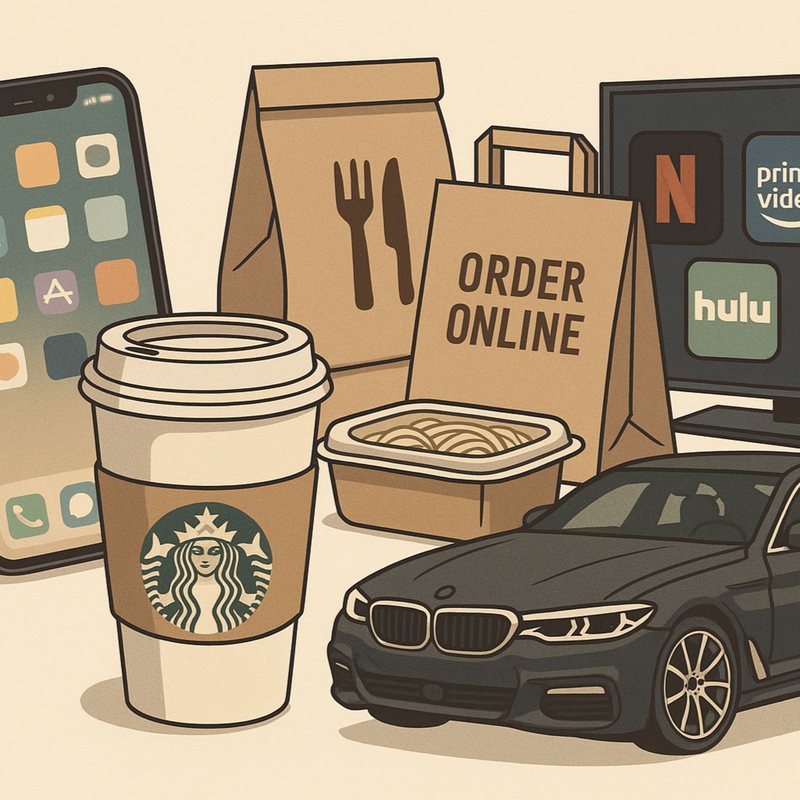
Now think about that in terms of your own life. Your personal burn rate is your basic cost of living. And the whole idea here is that for a lot of us, that baseline has gotten, well, kind of out of control. I mean, just think about how much our definition of a normal life has changed. It's pretty wild when you see it laid out like this. What used to be a pretty simple, low cost way of life has been replaced by a baseline that's just packed with expensive services and gadgets that we now see as totally standard. OK, so let's get into the weeds here. Let's actually look at the numbers behind this new normal. What does it really cost to live a life that, let's be honest, most of us wouldn't even think of as fancy? Let's start with something easy, entertainment. It used to be free, right?
You had ATV, you had an antenna, and that was that. Now. Now the typical household has this whole collection of subscriptions. You know the drill and each one by itself seems small, but man do they add up. Because when you actually tally them all up, you could easily be looking at 150, maybe even 200 bucks a month just on media. That's money that just vanishes from your account on autopilot. It's pure uncut monthly burn and it doesn't stop there. Next up, food.
We all love convenience, but wow does it come with a price tag. A single meal delivered to your door. I mean, after the fees, the delivery charge, a tip, it can easily hit 3540 bucks no problem. Now let's say you do that just three times a week. Suddenly you're staring at $500 a month.
That's $6000 a year just for the luxury of not having to cook. And this line of thinking extends to pretty much everything, especially things like our cars and just our general lifestyle expectations. When leasing a fancy car becomes the new normal, instead of just buying a basic, reliable used one, you end up with what the author calls a Gordon Gekko lifestyle masquerading as middle class Ouch. So we've seen all the individual pieces of the puzzle. Now it's time for the main event.
Let's put it all together. Let's actually do the math and see what the total burn rate for a normal modern life really adds up to. So just take a second and think about it. Based on what we've seen so far, what do you think that number is? We're not talking about a life of luxury here, just the baseline modern lifestyle. And get this, this is before you even pay to keep a roof over your head.
OK, here it is. Look at this. When you add up the subscriptions, the phone, the food, the car payment, the insurance, some basic online shopping, and just a little bit for fun, you're already over $2500. That is the hole you have to dig yourself out of every single month. But wait, we're not done. You still have to live somewhere, right? So let's add a pretty average rent to that, say $2000 a month. All of a sudden, your annual burn rate is over $54,000. That's the cost just to exist in this new normal before you've saved or invested a single penny. So that's a pretty heavy number.
What's the take away here? Well, it's not about making you feel guilty. It's about understanding a cold, hard choice that you're making every day, whether you realize it or not. The point of all this isn't to judge anyone for wanting a nice car or ordering takeout. Not at all. The argument is simply that you can't have it all. There is a direct mathematical consequence for every single lifestyle choice we make, and this right here is the final trade off.
It's the whole argument in a nutshell. On one side you've got the high burn rate lifestyle full of all the modern conveniences, and on the other side you have the things that lifestyle might be costing you. Investing a safety net, Saving for big goals, Achieving real financial freedom. The hard truth is, for most people, you can probably have one or the other, but it's incredibly difficult to have both. So in the end, it's not about the latte.
It's about this whole ecosystem of expenses that we've just accepted as normal. And it leaves us with a really powerful and, yeah, maybe a little uncomfortable question. Is our modern definition of a normal life the very thing that's preventing us from building a secure one? It's definitely something to think about.