Read the full transcript (3,632 words, machine made)
Welcome to the deep Dive. We take your sources, your research, your notes, and we boil them down, giving you the key insights without you having to wade through everything yourself. Today we're diving into something pretty heavy, a topic that for most people really kicks off in February 2022. You know, the images of Russian tanks crossing into Ukraine and the story we often hear, especially in the West, paints it as the sudden, almost random act by Vladimir Putin. He gets compared to, well, all the usual suspects, Hitler, Stalin, Mussolini, or sometimes, maybe conveniently, he's painted as this weak, dying leader.
But those portrayals, they often clash, don't they? It's a bit confusing, but maybe that simple story is just easier, easier to accept. But that's not what we do here. Our mission today is to peel back those layers. We got these fascinating, maybe even challenging source excerpts called How the West Lit the Fuse in ukraine.pdf.
And just to be absolutely clear upfront, we are not taking sides. We're not endorsing a political view here. Our job is to unpack what this specific source says, to dig into the history it presents. We want to look hard at that idea of an unprovoked war by exploring while decades of warnings and actions that the source claims have been ignored or maybe even deliberately sidelined. So this is about giving you, our listener, a fuller, maybe more complex picture of the history behind this major global conflict.
Exactly. And the author of this material, well, they don't mince words, they flat out argue. This conflict was, and I'm quoting here, 1 long in the making, nurtured by Western arrogance, short sightedness and a refusal to take Russia at its word. It's really strong language. And again, our role here is just to lay out their argument, how they build their case using specific events, specific warnings.
It's not about US agreeing, but about understanding their perspective and some of the points they raise, some of the connections they make, might genuinely surprise you. They definitely challenge that standard narrative. OK, let's get into it then. That common story, like we said, starts the clock in February 2022. But the source immediately hits back saying quote history did not begin in 2022. That's not just semantics, is it? It's saying the real roots, the seeds of this war, as they put it, go way, way back.
Decades even. Precisely. And this is where the author starts laying out this chain, this pattern of warnings about Russia's red lines, specifically regarding NATO moving E. The argument is these weren't secret whispers, they were explicit. Russia stated them clearly, repeatedly, and the West, according to this source, just consistently ignored them.
And they bring up some heavy hitters to back this up. Take George Canon for example. Canon Yeah, the architect of Cold War containment. A huge figure in US foreign policy. The very same in 1997, as NATO expansion was really getting going, Canon warned publicly that expanding NATO into Eastern Europe would be quote the most fateful error of American policy in the entire post Cold War era.
Wow, from Canon himself that's that's a heavy warning. It really is coming from the guy who basically wrote the playbook for dealing with the Soviets, The source argues. That should have stopped policymakers in their tracks, but they claim it didn't. OK, so that's Kenan in 97. What else? Fast forward about a decade to 2008. You get this incredibly blunt cable from William Burns, who was the US ambassador in Moscow at the time, later CIA director. Of course.
Burns, right? Highly respected. And he sends this message back to Washington, it apparently said. And this is direct language here, yet means yet Ukraine's accession is the brightest of all red lines for the Russian elite. Yet means yet can't get much clearer than that.
Exactly, the source emphasizes this wasn't guesswork. It was a clear signal about how intensely Russia felt about Ukraine joining NATO. A non negotiable issue for. Them So warnings from a Cold War strategist, A top diplomat on the ground. And from Putin himself, publicly, the source points to the 2007 Munich Security Conference. Big international stage and Putin gets up and as the source puts it, declared, not whispered, declared that NATO's relentless eastward expansion was unacceptable, a threat to Russian security.
So he said it point blank to Western leaders. According to the source, yes. Loud and clear. No room for misunderstanding. The message was out there.
OK, here's where it gets really interesting then, because you have Kenan, you have Burns, you have Putin all saying whoa, hold on with NATO expansion, especially towards Ukraine. But the source says the West essentially quote ignored him, meaning Putin, but also the broader warnings for what, nearly 3 decades? That's the timeline they trace. They point to the actual NATO expansion that followed these warnings. Right, let's stick them off.
Poland, Czech Republic, Hungary and 99. Yep. The first big wave into the old Soviet sphere. Then 2004. That was huge. The Baltics, Estonia, Latvia, Lithuania plus Romania, Bulgaria.
And the source stresses that at every stage Russia protested, they weren't happy. They voiced security concerns. But according to the author, at every stage the West waved those protests away as paranoia just dismissed them. So a pattern emerges. Russia objects.
The West ignores or dismisses. Exactly. And this brings us to what the source calls a really critical moment, the 2008 Bucharest Summit. Bucharest. What happened there?
Up till then, expansion had been former Warsaw packed countries mostly. But in Bucharest, the official NATO statement went further. It said, quote, Ukraine and Georgia will become members of NATO. Wow. Not if, but will.
Precisely. The source identifies this as the moment Russia understood that the West had no intention of honoring its red line. It was a public commitment to bring these two former Soviet republics right on Russia's border into the alliance. Even after Burns's net means yet cable that same year, right? And the source argues that Western leaders then acted surprised in 2014 when things really kicked off after Ukraine pivoted sharply away from Moscow. But Bucharest, in this view, set that collision course. It leads directly into 2014.
So if 2022 wasn't the start, and 2008 was this major turning point in perception, then the source says the real break came not in 2022, but in 2014. That's their core argument about the timing of the rupture. And they challenge how 2014 the Maidan uprising was portrayed in the West right, The idea of it being just a spontaneous popular revolution. Very much so. The standard narrative was, yes, a spontaneous, organic revolution of the Ukrainian people, purely grassroots. But the source claims what Washington was involved. It claims it was assisted, shaped and in some ways orchestrated by Washington.
That implies a much more active, deliberate US role. OK, that's a big claim. What evidence does the source offer for that? Well, the most explosive piece is probably that leaked phone call Victoria Nuland. This isn't Secretary of State at the time.
The infamous Nuland call. The very one she was apparently caught on tape Conley handpicking Ukraine's post Yanukovych government saying things like yachts. Is the guy referring to Arsena yachts. And Yoku did become Prime Minister right after. And wasn't that the call where she said something about the EU?
That's the one. The source highlights the phrase F the EU dismissing Brussels role. The author's interpretation is stark. This was not the language of neutrality. This was the voice of an empire arranging its pieces on the board. Strong words, but it wasn't just phone calls, right? No, the source also points to Senator John McCain physically going to Kiev standing with protesters in Maiden Square. Very visible support for the anti government movement. And the source uses an analogy there, doesn't it? To sort of highlight the perceived interference. Yes, a deliberately provocative one, they say. Imagine a Russian senator on the ground in Ferguson during the Black Lives Matter protests.
Americans would have called it foreign subversion, and they would have been right. Putting the shoe on the other foot, it definitely makes you think about how interventions are perceived. It forces you to consider that perspective, yes, that this wasn't just internal politics from the viewpoint presented in the source. So what does this all add up to this Western involvement? And the source goes into the money and politics side too, right? It does.
It talks about what it calls the naked entanglement of political power and private gain, specifically mentioning Hunter Biden joining the board of Burisma, the Ukrainian energy company. Well, his. Father Vice President Biden was the point person on Ukraine policy. Exactly. The source presents this as a clear example of blurring lines potential conflicts of interest. And beyond that specific.
The source details how organizations like USA and the National Endowment for Democracy Ned poured billions into Ukraine since independence. Billions for. What? According to the source for Cultivating Ng OS media outlets and political operatives, they even mentioned Newland herself boasting about $5 billion in US assistance since 1991. OK, so the source acknowledges you could argue this was just democracy building.
Right, they say you can debate if it was benevolent democracy building or covert influence, but their conclusion is the effect was undeniable. Which was quote. Ukraine's politics shifted decisively westward with Washington's hand on the scale. Regardless of intent, the sheer weight of involvement pushed Ukraine towards the West. And at Russia's perception of all this?
For Moscow, the source says, the message was crystal clear. This was not an organic revolution, it was regime change dressed in popular protests. Western backed coup essentially. That's the perception the source argues Russia had. And that perception, that conclusion, had immediate and violent consequences inside Ukraine.
Which brings us to the war before the war. Right, because the fallout from Maidan in 2014 wasn't peace and quiet, according to the source. Start from it, they state. Eastern Ukraine immediately descended into civil war right from 2014 onwards, a. Civil War?
That's not how it was generally framed leading up to 2022, no. It often wasn't, but the source describes how the Donbas region declared independence right after Maidan Keys response Kiev sent in the army. And the result. Brutal fighting, shelling, rocket fire and snipers followed. The source paints a picture of an active deadly conflict zone in eastern Ukraine for years.
And the human cost of that? This is the part that's often missing from the story. It really is. The source cites UN and OSCE figures. Those are official tallies, estimating some 14,000 people were killed between 2014 and 2021. 14,000 before February 2022 even happened. 14,000 dead in those eight years.
It's a shocking number. Which leads the source to argue. That the war had already begun, plain and simple. By the time tanks rolled in 2022, the Don Boss had been a battlefield for eight years. So calling Feb 2022 the start is misleading. According to the source, profoundly so. Their conclusion is blunt.
To call February 2022 the start of the war is to erase nearly a decade of blood. That reframing, that insistence on the 20/14/2021 conflict, it really does challenge the whole unprovoked narrative, doesn't. It fundamentally it suggests the 2022 invasion wasn't an eruption out of nowhere, but an escalation of an existing bloody conflict. It forces you to redefine provocation. Which leads us to how Russia itself is portrayed.
The source mentions books like Provoked, which apparently got slammed for being Kremlin property propaganda. Yes, but the author argues the discomfort with such books isn't because they invent things, but because they repeat things. Repeat what? Repeat what? Ken and foresaw, what Burns warned, what Putin said in Munich, and what Newland revealed on tape.
It's presented as a reminder of inconvenient, ignored facts, not some new revelation. The author says they saw enough themselves, studied enough, to know these warnings were real, and ignoring them is dishonest. And this connects to the contradictory ways Putin is depicted. Exactly. The source calls the Western narrative almost absurd in its contradictions.
Is he a weak man dying of stage 6 cancer? Or is he Hitler reborn, ready to conquer Europe? Right. Is he Trump's lap dog? Or the master puppeteer behind Trump.
The source just asked which is it? How can he be all these opposing things simultaneously? It suggests the portrayal is an analysis. It's caricature. And does that extend to Russia as a whole, the paper tiger versus existential threat idea?
Yes, the source highlights that contradiction to Russia is derided as a paper tiger with an economy smaller than Italy's but also painted as an existential threat to global democracy. So weak, but also terrifyingly strong. It doesn't add up, the source argues, and they point to open source intelligence from the war itself, all the documented losses, the drone footage. What does that show according to the source? That Russia is not the unstoppable juggernaut of Western nightmares.
They fought with brute attrition, not blitzkrieg, A grinding war, not a lightning conquest. And their goal isn't world domination. The source concludes Russia's ambition quote is not to roll to the Atlantic but to hold the line in the Donbas and to stop NATO from planning itself on its border, a more limited defensive aim in their analysis. To understand Russia's mindset, the author includes some really personal stories. Right, but the post Soviet years?
Yes, very powerful ones. They were called flying over the Soviet Union in 1990, seeing fields littered with the carcasses of dead plains, the hollowed out relics of a military industrial empire just ruined. A visual of collapse. Exactly and then being in Saint Petersburg in 96 the Hermitage Museum guarded by Mafiosi Nevsky Prospect, the Main St. Glittering but everywhere else scaffolding banner saying things like restored with funds from the European Union or funded by the government of Japan.
Rebuilding national treasures with foreign money. The source really emphasizes the humiliation of that. Deeply, they ask you to imagine the humiliation and say America would never tolerate such public dependency. Yet Russia dead because it had no choice. So that period of weakness and humiliation is crucial context for leader actions. That's the strong implication, a drive to regain dignity, independence after feeling subjugated. And what about the whole energy weapon narrative? Russia constantly threatening to turn off the gas. The source actually counters that quite strongly. They argue that Russia rarely turned off the tab, even when insulted, even when punished with the sanctions. Really.
Even during tense periods. The author recalls living in Germany in the 2000s amidst sanctions and harsh rhetoric, yet the gas kept flowing. It suggests more reliability than often portrayed. And the contrast is with. With the US being eager to cut off Nord Stream and when the pipelines blew up in 2022, the source notes, Western commentators all but cheered, despite no clear proof of who did it. So the conclusion there is what?
The truth is awkward. Russia showed continuity. The Wasp showed sabotage, a direct flip of the usual narrative about who weaponized energy. This reassessment of Russia then leads to looking critically at Ukraine's role in all this. Yes, and the source uses a really striking metaphor here. The Dorian Gray one explain that. Right, like Oscar Wilde's character, whose portrait aged and showed his sins while he stayed young, the source suggests Ukraine became the West's Dorian Gray, that it absorbed the corruption, The Dirty work, the secrets the West wanted kept out of sight.
So Ukraine became a place to park uncomfortable activities. That's the implication. The source lists examples of this exported rot, as they call it. Like what? Well, they bring up the Biden family and Burisma again framing it in this context.
They mentioned tech Bros turn Kiev into a cheap back office for Silicon Valley. Exploding cheaper labor, maybe looser regulations? Essentially. And that hackers and programmers turned Ukraine into a cyber Gray zone, a place for activities maybe not permissible elsewhere. And there are more serious allegations to.
Yes, the source claims US linked labs study pathogens and facilities that would never pass political muster in Maryland or Virginia conducting risky research away from US oversight. And even CIA black sites. They claim the CIA parked black sites there when it needed legal limbo, using Ukraine to bypass legal constraints. So why Ukraine? What made it valuable to Washington, according to this source? It wasn't just a pawn, the source says. Ukraine has wheat minerals.
Genius programmers and a kind of entrepreneurial hustle rare in Europe. Real assets. It's a tangible value. Exactly which leads to the author's core claim about this relationship. Which is precisely why Washington needed it.
America stayed clean by exporting its rot. Ukraine bore the stains. That's a pretty damning assessment of the dynamic. It is, It suggests a very calculated transactional use of Ukraine beyond just supporting democracy. And this critique broadens out into US foreign policy generally.
The author talks about the personal cost of even questioning the mainstream narrative back in 2022. Yes, very personally about being harangued, called a stooge a bot of Benedict Arnold just for questioning the unprovoked war line when every Twitter bio flew the Ukrainian flag. A real pressure cooker of conformity. Total conformity, they say. And while the hysteria has cooled, now, maybe shifted to Gaza, they say, I will not forget how total the conformity once was.
It clearly left a mark. And this experience leads to a bigger point about. About what the author calls the cycle of manufactured adversaries. That's what really unsettles them more than Russia itself. Manufactured adversaries. Like how every 18 months the United States hands the public a new Emmanuel Goldstein, the perpetual enemy figure from Orwell's 1984.
A rotating villain. Exactly. Putin, She, Khamenei. Assad. Gaddafi. Saddam.
Noriega. Ortega. The names change. Iran was the threat, then ISIS now Putin endlessly tomorrow maybe someone else. And the point isn't consistency. The source argues the point is perpetual outrage, keeping the public angry, maybe justifying constant intervention rather than addressing real, consistent threats. And while this cycle is happening, what's shifting on the world stage?
A huge shift, the source argues. What has emerged in the meantime is a multipolar world the West pretended could never exist. The unipolar moment is over. And the evidence for that. Bricks, mainly. What was once the Goldman Sachs acronym is now a block, with Russia, China, India, Brazil, Saudi Arabia and more aligning outside the dollar.
So more than just an economic label, now a real geopolitical force. That's the argument. And while Western economists might sneer at their GDP's, The Source stresses that commodities and energy matter more than spreadsheets. Real resources, real power. Like Saudi Arabia and China trading oil outside the dollar.
Exactly. Yeah, the source says. When that happens, the global order shifts. It challenges the dollar's dominance, the foundation of the Western financial system. It's a fundamental rebalance.
The punch line, according to the source, is the irony of how this came about. Yes, the conclusion is that the very outcome Washington feared, Moscow and Beijing aligned, has been hastened by Washington's arrogance. So Western actions actually pushed them together. Paradoxically, yes. That's the sources final take on the unintended consequences of ignoring warnings and insisting on a unipolar world. It brings all these threads together. So wrapping this all up, where does the source leave us? It's not saying Putin is blameless, right? Absolutely not.
The author is explicit. This makes Putin a St. or Russia an innocent. They acknowledge Russia uses espionage, manipulation and brutality. That assets remain in the West. That's a given.
But the author insists none of that erases the West provocations. The core message, repeated forcefully, is the Western narrative is a lie because the war was not unprovoked. It was cultivated, warned against, and made inevitable by decades of provocation. That's the central thesis. OK, so let's quickly recap the key provocations highlighted in this deep dive, according to the source. Ignoring Kennon Burns Putin on NATO's red lines meddling in Kiev in 2014, the Newland call, the funding shaping the political shift and arming one side of a civil war in the Donbas that killed 14,000 people before 2022 even started. All leading, the author argues, to this Western fairy tale about democracy under siege, which ignores all that prior history, that blood already spilled.
And the author expects pushback expects to be called names. Yes, they basically say if the only rebuttal is to call me naive, an appeaser, A stooge, so be it. Call me Chamberlain if you like, Defiant. That sticks to the conclusion. Sticks to it firmly.
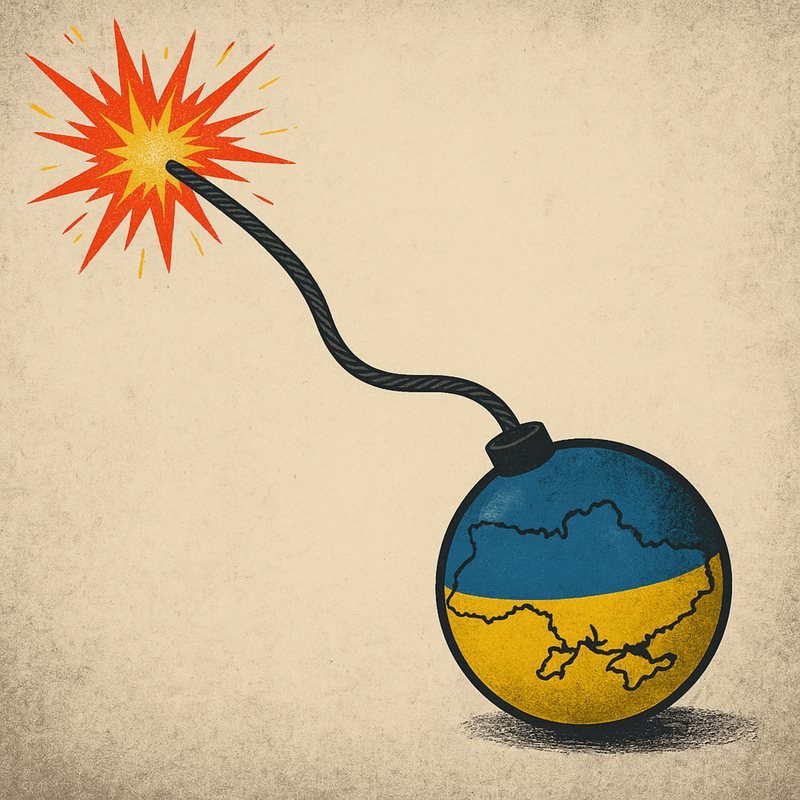
History is what it is. And history in this view shows this war was not unprovoked. It was provoked, cultivated, and foreseen. That leaves us with a really challenging final thought from the source. The West lit the fuse in Europe's most dangerous powder keg, and now the world lives with the fire.
It really makes you wonder, doesn't it? How much of current conflict is the result of history we haven't fully acknowledged? How much is blowback from past actions ignored warnings? Thinking about that might change how you see not just this conflict, but maybe the next one too. Definitely something to chew on.