Read the full transcript (8,501 words, machine made)
This is the brief on Meshtastic infrastructure deployment. So we're looking at a personal story, right? It's about someone who took a cheap off the shelf Meshtastic Laura device and figured out what it really takes to make these off grid networks actually work. OK, first up, physical placement is everything for Laura Radio. This person was on the 8th floor and they found that just being up high with a totally clear line of sight was the biggest deal. You know that clean path for the radio signal? It's called a Fresnel zone and keeping it clear is just crucial.
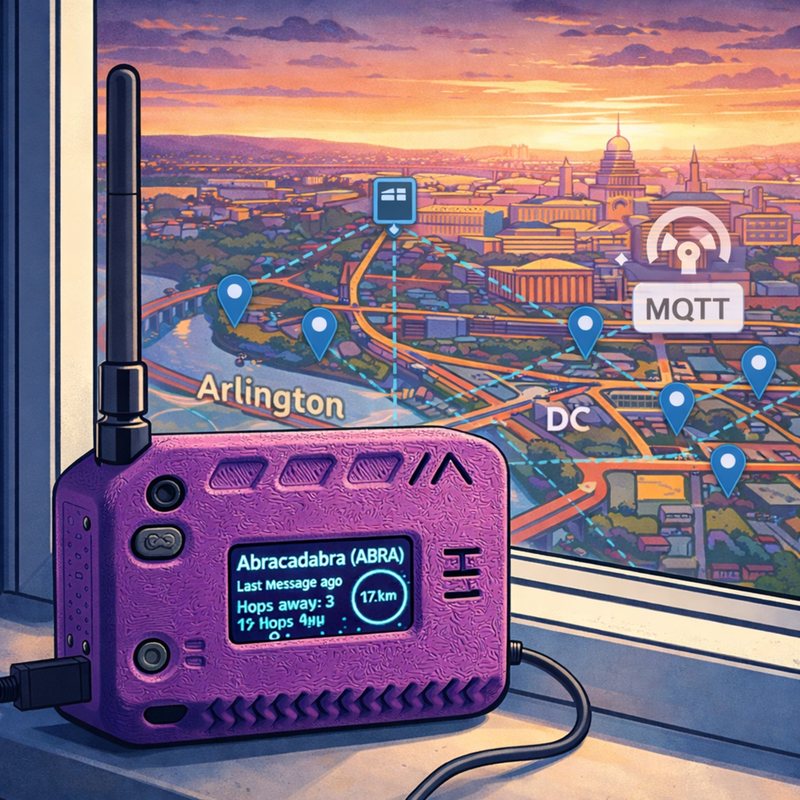
Basically, where you put the thing matters more than any fancy settings or expensive gear you could buy. All right. Second, once you've got the placement sorted, it's all about stability. You have to treat the device like permanent infrastructure, not a personal gadget. So it's role was changed from a sleeping node to a dedicated always on router.
This meant disabling settings like deep sleep, since it was always plugged into the wall anyway. It was even given a neutral name, Abracadabra, to show it was a community asset. And finally, the last lesson is, well, the goal is to be boring. Meshtastic is at its best when the whole system is so stable you just forget it's even there. It's that quiet, consistent up time where the node is just doing its job routing traffic in the background.
That's what really makes the whole network stronger for everyone. So really stability, placement and uptime are what truly transform a simple gadget into resilient infrastructure. Welcome to the deep dive. The place where we, you know, we really try to cut through the noise and deliver the critical insights you need to truly understand the mechanics of the world around us. Today we are setting aside, well, everything we normally talk about 5G fiber optics. We're going to explore something radically different, a fascinating world of decentralized off grid communication built on low power radio technology. A technology called mesh tastic.
Exactly mesh tastic. And this is, I think, a really perfect deep dive into resilience. We're tracing the journey of one specific user, someone who bought a cheap gadget purely out of curiosity, and we get to watch them almost transform. Into what exactly? Into a critical permanent piece of their local communities, digital infrastructure. The sources we have today, they just chronicle this entire evolution, mapping the shift from, you know, a $55 purchase to an essential network backbone. And that's the core mission today for you, the listener. We're analyzing this fundamental shift, how a minimal initial investment combined with a crucial insight about the physics of radio and, well, the nature of network needs, turns a personal experiment into a public utility. Yeah, our focus will be on the technical details behind this transformation, tracing the user Chris Abrahams experience from the moment he first powered it on to, well, stabilizing a permanent routing node in the busy mesh DC area. And the underlying concept here is so critical for for a modern communication resilience.
We're exploring how small accessible hardware can let you just circumvent these fragile centralized systems like cell towers or Wi-Fi hubs. But it's not just about the tech. No, not at all. To make this work, there's this required and I'd say often uncomfortable shift in mindset. You have to move from thinking about individual convenience to prioritizing network wide stability, communal presence. OK, let's unpack this starting at the absolute beginning. The user, as you said, wasn't a prepper, not a licensed ham radio operator.
It was just a low buying curiosity spurred by how accessible the technology has become. He bought a cheap purple Meshtastic device off Etsy for about 55 bucks. That's the key, that price point. That's the open door for this whole experiment, right? So what exactly is Meshtastic, and why is it structured to be so approachable for someone who isn't, you know, a radio expert? Mesh Tastic is fundamentally an open source system. It's designed to facilitate a short text messaging and location sharing over something called Laura Radio. OK, the genius of the project isn't just the hardware, which is usually cheap off the shelf components like ESP 32 microcontrollers.
The genius is the open source firmware that wraps it all up. It makes it simple. It makes setup as easy as pairing a Bluetooth device to your phone. And critically for local operation, it requires absolutely no centralized external services, no cellular, no Wi-Fi. It's entirely self-contained.
So let's dig into the core technology that's powering this, which is Laura. This is the bedrock. We use Wi-Fi and 5G everyday. Why is Laura the right choice for this kind of decentralized resilient application, even though it's, I mean, painfully slow compared to the alternatives? That slowness is its superpower.
It really is. Laura stands for Long Range and it uses a technique called Ship Spread Spectrum or CSS modulation and this is a deliberate, highly effective trade off. A trade off of what? For what? It sacrifices high bandwidth and you are definitely not sending photos here.
You're sending maybe what, 20 bytes of text at a time? OK. And in exchange it maximizes 2 things, distance and efficiency. Because the data rate is so incredibly low, you can pull the signal out of the noise floor over vast distances. We're talking far exceeding typical line of sight limits for other radio types at the same power level. So if I'm understanding this correctly, the network designers, they looked at the requirements, you know, sending a basic text message or location update during an emergency and they said we don't need a massive digital highway, we just need a robust low energy trail.
Exactly. It's optimized for minimal data transfer and maximum resilience. These devices can run for weeks, sometimes a month, on battery power, because they only need to transmit these tiny little packets of data every now and then. And that efficiency, that's what makes the network sustainable and cheap to maintain. It's perfect for status updates and critical short communication. Now we have to move to the concept that really defines the utility of the system, which is the mesh. This is the crucial architectural difference that provides all that resilience.
Let's compare this structurally to the centralized model most of us are used to. Right. So as you said, standard cellular or even your home Wi-Fi is centralized. It follows a hub and spoke model. One to many.
One to many if that central hub, the cell tower or your router. If it fails the spoke, your phone or computer is just completely disconnected. Game over. The mesh concept is, well, it's anarchic in the best possible way. Every device, every node communicates directly with its neighbors.
And here's the key feature mesh Tastic enables. Every node can act as a fully autonomous relay. So my device isn't just talking to the network, it's actively being the network for other people. Precisely, if you send a message and the destination node is too far away for your radio to reach directly your closest neighbor node, it just grabs that packet, stores it for a millisecond, and then forwards it to its neighbor, and so on. So messages can take multiple hops.
Multiple. Hops and Machastic manages all this through an adaptive routing protocol. It automatically builds and maintains a table of known neighbors and what it thinks are the most efficient paths. I get the resilience advantage. Redundancy means no single point of failure. But here's question if every node is constantly relaying traffic, isn't that a massive drag on the battery life of the average person who's just carrying this device in their pocket?
How does the network stop the core relay nodes from getting overwhelmed? Or you know, just draining all the mobile users power. That's a highly relevant technical challenge and it goes directly to the resource management strategy of the firmware. OK, mesh Tastic firmware is built to manage this intelligently. First, because Laura transmissions are so incredibly power efficient, the energy cost of forwarding a small text packet is minimal.
It's often far less than the cost of you trying and failing to reach the destination directly with a higher power broadcast. So it's actually more efficient to whisper to your neighbor than to shout across the valley. That's a great way to put it. Second, the network limits the number of hops a message can take. This prevents infinite loops and just uncontrolled flooding of the network with junk packets. Sure, makes sense.
And 3rd Meshtastic uses this intelligent neighbor discovery. It prioritizes strong stable links, which inherently favors stationary powered nodes over the mobile transient ones. And that dynamic prioritization that sounds critical, it really sets the stage for our users journey. So if the network itself favors stability, the core value proposition for you, the listener, isn't about replacing anything. It's about insuring against failure. Exactly.
This technology acts as a resilient complement. It's not about high throughput, it's about guaranteed message delivery. When traditional infrastructure fails during a localized power outage, a communications blackout, a natural disaster, anything like that, it provides this crucial layer of communication independence, ensuring those essential short messages, are you safe, where are you can get through regardless of what's happening with a utility grid. It effectively transforms communication from a centralized, paid service into a decentralized, collaboratively built utility. That's a profound shift in control.
It really is. So let's pivot now to the user specific experience, because that really highlights this philosophical shift from being a user to being a component of the utility when the user first activated their cheap purple gadget. The source material describes this initial sense of, well, disappointment. It worked, but it didn't feel like a functioning network. Yeah. Why was there that disconnect?
The disappointment? It stemmed entirely from centralized expectations. He paired it, sent a few test messages, and just watched the node list fluctuate wildly. So people were just popping in and out. Constantly nodes would appear, transmit maybe once, and then vanish. Traffic was sparse.
The user observed that most activity just look like people checking in, not sustained routing behavior. It felt ephemeral. Right. It felt like a collection of individual experiments rather than a true network fabric. I mean, if you're used to checking your Wi-Fi status and seeing 20 neighboring networks, this quiet inconsistent behavior, it feels like a failure. The technology was doing its job, but the critical mass of of community presence wasn't there yet to make it feel robust. And then the user made this tiny, almost trivial decision that changed absolutely everything. The first meaningful decision, uptime, is everything. He just left it on.
He simply left the device plugged in and running indefinitely, and he admitted this decision didn't feel consequential at the time. You know, he was busy, he forgot about it, but it stayed on. And that single act was the catalyst for his transformation into an infrastructure component. And this action embodies that key, almost paradoxical insight about decentralized systems like Mesh Tastic. The network doesn't reward active interaction, it rewards continuous stable presence.
This is a critical technical insight wrapped in a simple behavioral choice. It's so important in a mesh. Unstable nodes, those that turn on for 30 minutes and then disappear. They actually create friction. How so? They cause what we call route flapping. The network learns a route through that node, it starts sending traffic that way, and then the node vanishes. This forces the entire network to waste energy recalculating the path and retransmitting the message. It's inefficient.
Highly inefficient nodes that stay up and maintain constant presence. They become statistical anchors. They're reliable hops. They increase increase the successful hop count across the mesh, confirming the network stability and over time. Other nodes actively prefer routing through them because they know that connection will be maintained. So stability minimizes inefficiency for everyone else. By simply existing reliably, the user began reducing the power consumption and increasing the reliability for every other mobile user in his region.
Precisely. He went from being a consumer occasionally checking in, to being a foundational, silent contributor to a public utility. And this is where the identity shift came into play. Right. The name he initially used Abra, which was short for his name Abraham, But he realized it felt too personal for what was becoming a public resource. And that realization is the final cognitive leap. It's the one you have to make to transition from user to architect.
Infrastructure can't be tied to an individual's identity. So what did he do? He kept the identifier abra, but he redefined it. He changed it to abracadabra. Abracadabra. And this name choice is perfect.
It's abstract, it's memorable, it's playfully neutral, and most importantly, it communicates that this node is autonomous. It's not subject to the personal whims of the operator. It's a signal to other. It's signals this is a permanent stationary relay point ready for community use. The device itself was telling a story of commitment even before he really optimized the physical setup.
But commitment only goes so far without physics backing it up. And here's where it gets really interesting. The source material emphasizes that the physical location determined the device's success more than any software setting. Oh. Absolutely.
You just can't. Software patch badge geography. That is the absolute truth of radio frequency communications, especially when you're using Laura's low power. The user lives on the 8th floor in Arlington Heights. His windows face southeast. Which turned out to be critical.
Critical. He quickly realized, just through simple observation, that he had an entirely unobstructed line of sight. His view cleared a golf course and a significant stretch of low rise terrain projecting all the way toward the Gaylord MGM area. That elevation in Clearview, I mean, it's worth thousands of dollars in commercial radio equipment upgrades, but here it was just the reality of his lease agreement. It's the ultimate geographical advantage for Laura. Placing is paramount because you're trying to overcome the Earth's curve and ground level obstructions. And this brings us to a key piece of jargon we really need to unpack, which is the Fresnel zone. The Fresnel zone OK, it's often confused with simple line of sight, but you're saying it's far more complex. It is so Tell us what a Fresnel zone is and why was that golf course so important to its success? OK, so think of a radio transmission not as a single thin laser beam of light, but as an expanding ellipse, like a football shape around the Direct Line of sight between two antennas.
The Fresnel zone is this required elliptical area, the first Fresnel zone specifically. That has to be kept clear of obstructions to ensure you get maximum signal strength. If 60% or more of that ellipse is obstructed by something, signal quality degrades dramatically. Even if you can still visually see the other antenna. Exactly. That's the counterintuitive part. So even if the user could see the Gaylord MGM, if they had a dense tree line or small hill just below their Direct Line of sight, even though it wasn't blocking the view. The radio waves that are traveling in that football shape around the direct pass would still be degraded. Precisely.
Objects like buildings, dense foliage, even the surface of the ground, they cause reflections and phase cancellation. We call it multipath interference. The golf course and the low rise terrain provided the ideal, almost pristine clearance required for that Fresnel zone. So the signal could just propagate smoothly over vast distances. The environment was doing the vast majority of the heavy lifting.
The user had cheap hardware but $1,000,000 RF location. Once that physical reality was recognized, the logical conclusion was that the device could no longer be treated like a casual gadget. Correct. When the user cemented the nodes stationary status, you know the purple box the whip antenna always powered basically bolted down metaphorically in the window. He realized treating it as a standard node was just wasted potential. Because a standard node is designed for portability and sleep.
Right. A device in such a prime RF location that is allowed to sleep to save power even for a few hours is just fundamentally misaligned with its physical advantage. Then drove the functional change in the software, switching the device role from a standard node to a dedicated router. And this was the functional declaration of its new infrastructure identity. The Router role ensures the device is awake and actively forwarding messages, maximizing its contribution to stability and range for the entire Mesh DC community.
It signifies that the operator has accepted that responsibility. Yes, they've accepted the responsibility of maintaining a key network relay, moving beyond just personal use to community service. But switching to router mode introduced a significant friction point. The device's internal behavior changed in ways the Phone A didn't really explain well, and this led to a lot of frustration for the user. What was the core technical conflict that emerged here?
The conflict was architectural, and it all stemmed from power management. When you designate a node as a router, the firmware scheduler, it aggressively prioritizes the core mission. Which is maintaining the radio link and processing packets. Exactly, and to achieve this reliability and conserve power in the general case for a battery device, it de prioritizes non essential functions, particularly the control plane access via Bluetooth Low Energy or BLE. So the device was doing its job perfectly, routing traffic silently and efficiently, but the human operator trying to connect with their phone suddenly found the device inconsistent and hard to manage.
Exactly, from a phone centric perspective it just felt buggy. You try to connect via the app and it would time out or fail because the BLE control plane was scheduled to sleep or delay interrupts to give the radio stack priority. And this also minimizes potential self interference, right? Right. Any processing power diverted to maintaining a constant BLE connection is power not available for radio transmission, or it might induce noise into the RF chain.
The device was maximizing network utility at the expense of user convenience. And this really highlights why troubleshooting these decentralized tools so often requires bypassing the simple app interface and digging deeper. You have to. The user access the device over USB to view the console and the actual configuration settings. What are that technical deep dive reveal? It confirmed the scheduling conflict. The control plane was indeed sleeping or being heavily deferred while the radio link remained continuously active. The user realized that while this aggressive power saving was essential for a battery powered device out in the field. It was completely unnecessary for his permanent wall powered setup.
Totally unnecessary. He had unlimited power but was suffering the usability consequences of a power constrained configuration. So since power was no longer scarce, the device was permanently plugged into a USBC wall wart. He was free to compromise efficiency for stability and convenience. This is a fascinating trade off using an abundance of power to solve a human interaction problem.
It is. What were the three specific configuration adjustments he made to stabilize that control plane? The three investments were highly targeted. They were specifically aimed at just over ruling those power saving defaults. First, he explicitly disabled deep sleep entirely.
The node would never enter a low power state, ensuring instant responsive. OK, that's a big one. Second, he significantly increased the Bluetooth wait time or the BLE advertising interval. This just extended the window during which the device's control plane remained available to accept connections from the phone. Mitigating those intermittent connection issues. Yep and 3rd he just left the display on full time showing status information.
Let's look at that first change for a second. Disabling deep sleep while they have unlimited power, Are there any negative consequences for the hardware or the surrounding environment, like excessive heat or reduced component lifespan? That's a crucial technical nuance the sources imply but don't really dwell on. And yes, disabling deep sleep means the microcontroller is running at a higher clock speed and duty cycle constantly. This generates more heat.
Of course, and in these cheap mass produced enclosures like the $55 purple box, this continuous heat can absolutely reduce the lifespan of the internal components, particularly the capacitors and the SO itself. So for a cheap router, this might just be acceptable wear and tear. It's a trade off. You maximize lifetime stability at the potential cost of component longevity. He chose maximal operational stability, now accepting that the device might fail earlier than if it were managed more conservatively.
And the result once these changes were implemented was stabilization. Yes, the device stopped oscillating between states, the BLE access became reliably instant, and crucially, none of these adjustments compromised the device score routing function. In fact, keeping it fully awake arguably improved its routing responsiveness. So he successfully molded the aggressive, power constrained router architecture into a stable, convenient piece of permanent infrastructure. And once that stability was achieved, the user noted, the ultimate goal was reached. The device became boring.
Boring is best for infrastructure. Absolutely. When a router is stable, doing its job well, you should never have to interact with it. If you are constantly troubleshooting your relay node, it is failing its primary purpose. The abracadabra node settled into its optimal state.
Silent, reliable, consistently forwarding traffic and just radiating its signal perfectly from that 8th floor window. So while the user was busy taming their individual router, the surround surrounding local network in the Arlington and Mesh DC area was simultaneously maturing. The user noted an increase in traffic and stability that was coinciding with his adjustments. This was a synergistic effect. The stabilization of key relay nodes like abracadabra created this positive feedback loop. The local network began converging on a preferred configuration standard.
The long fast preset. The long fast preset and this preset is a critical middle ground in the Laura settings. OK, So what exactly does long fast balance and how does it compare to other choices like long slow? So Meshtastic let's operators choose different combinations of spreading factor or SF bandwidth and coding rate. Long slow, which prioritizes maximum range, often uses a very high spreading factor. This makes messages extremely slow. We're talking seconds to transmit a single text packet and it consumes a lot of airtime. Clogging up the frequency.
Right long fast sacrifices a tiny bit of that maximum theoretical range by using a slightly lower F and a higher bandwidth. This results in much faster transmissions, reducing the time the radio occupies the airwaves. Reducing the duty cycle. Exactly which is crucial in congested urban or suburban areas. It's the sweet spot for a functioning medium speed mesh.
And the maturation of the network was visible not just in the volume of messages, but in key performance indicators like increase hop counts and improved ACK frequency. Let's define those for the listener. Sure, an ACK is a simple acknowledgement. It's a confirmation signal sent back to the originating device that the message was successfully received by the intended recipient. So it's a delivery receipt.
It's a delivery receipt, and in a robust mesh, a high ACK frequency confirms that messages aren't just being broadcast blindly into the void. They're traversing the mesh, being successfully relayed through multiple hops, and reaching their destination reliably. And the increased hop counts. Increased hop counts mean messages are successfully traveling four or five or even 6 nodes deep. That shows the physical range and depth of the network has increased significantly.
It's using stable nodes like the 8th floor Abracadabra node to bridge previously unreachable gaps. So the local RF network was humming along quietly proving its decentralized resilience. But then the user decided to connect the node to the Internet via MQTT. This is a critical point where the local physical network touches the global digital map. And this step is purely for visibility and legibility. He enabled MQTT, the Message Queuing Telemetry transport protocol, which is perfect for publishing small pieces of data over the Internet.
What date is it sending? The node sends metadata about itself, its identity, its location, its last act of time, and its known neighbors to a centralized public broker. This data then appears on the global Meshtastic map. Now, it is absolutely crucial to clarify the distinction here. Enabling NQDT does not mean your text messages are suddenly being sent over the Internet. Absolutely not.
Local messaging remains 100% over the Laura radio waves. The message content itself is not compromised by the Internet connection. It's just a status update. It's just a status update. MQTT simply provides global visibility to the nodes metadata.
It abstracts that physical purple box in the window into a legible digital icon on a map, which allows the wider mesh tastic community to understand where coverage exists. It's an operational status report, not a communication conduit. So if the power grid failed locally, the radio communication would continue completely unedated, but the icon on the global map would simply go offline. That's the precise functionality. The local resilience is maintained. The Internet connection is strictly a convenience for meta level coordination and mapping.
And this leads us to a fascinating paradox which was highlighted by the user's experience. These two distinct layers of operation, you have the physical decentralized radial layer and then you have the meta human coordination layer. It's the centralization of decentralization. It's a great term for it. The user noted that almost all the meta work coordinating which preset to use, like long fast troubleshooting community wide outages, debating optimal node placement, and generally managing regional awareness. It all happens entirely off network. Primarily this happens through platforms like the Mesh DC Discord server.
Right, the RF layer is decentralized, silent and passive. It's just route and traffic based on physics and programming, but the human element it requires coordination, discussion and consensus, which by human nature centralizes onto a platform like Discord. So you need a centralized place to discuss how to optimize the decentralized system. It's a paradox, but it works. This is where the community decides, for instance, that abracadabra is a critical relay and should always be configured to use the fastest possible long fast preset to maximize the benefit for the whole community.
So the technology offers total independence, but the human requirement for efficiency and coordination pulls the community back toward a centralized virtual space to make decisions about that independent network. It proves that even when the means of communication are decentralized, the organizational structure of the people using it will often centralized just to be effective. The Discord server acts as the essential non decentralized command Center for managing the decentralized RF infrastructure. This journey from a skeptical purchase on Etsy to a key infrastructural node has provided some really profound technical and philosophical insights. So what does this all mean? The central lesson learned by Chris Abraham wasn't just about radio settings, it was a lesson in effective contribution. Meshtastic works best when the operator sheds the mindset of a personal user and embraces the commitment of being stable, reliable infrastructure.
And we learned that real infrastructure success hinges on three simple factors. Stability, optimal placement driven by physics, and most importantly, continuous uptime. The user didn't need specialized training or massive funding. He simply left a cheap device plugged into a strategically high, well placed window. The network stability, the community's range, the overall functionality, it all flowed naturally from that single persistent act of presence.
It's a remarkable testament to the power of low effort, high impact commitment in a distributed system. It fundamentally reframes what contribution means. In a digital, decentralized age, sometimes the most valuable thing you can contribute isn't active work or complex interaction, but simply existing reliably in a good spot for the benefit of the collective. And this contrasts so sharply with the tragedy of the Commons, where individuals act selfishly to the detriment of the group resource. In Mesh Tastic, we see the rewards of the consistent contributor. By prioritizing continuous stable presence, the Abracadabra node didn't just help its owner, it increased the efficiency and resilience of every other node, thereby rewarding the entire community.
Which raises an important question for you, the learner, to consider as you move forward. If a reliable resilient network can be quietly built piece by piece by individuals who prioritize persistent presence over momentary interaction, what other types of decentralized resilient systems could benefit from the exact same set it and forget it commitment? It's a powerful idea. What local infrastructure, whether a digital relay node, a physical community resource, or even just consistent positive participation, could you contribute to just by staying reliably present? Think about the power of boring stability in a hyperactive world. OK, so this critique is about the journey of taking a $55 Laura Meshtastic device and turning it into a stable, always on piece of infrastructure.
A router? Yeah, from an eighth floor apartment. Exactly. And the core discovery here, which I think is just brilliant, is that Meshtastic rewards presence more than interaction. So let's just dive right in on how to make the material around that idea even stronger for the community.
First off, that conclusion you wrote the node became boring, and boring is the goal. Oh, that's the best line. It's just, it's gold. It perfectly captures that shift from a gadget you're fiddling with to, you know, real infrastructure. It really does.
It's so relatable. I mean, anyone who's ever run a server knows that exact feeling of relief when things just go quiet. Right. But, and here's the thing, how does the community measure your success? That feeling of boring is great for you, the operator, but for the mesh network itself it's not really verifiable. Yeah, that's the tension right there, and it's our first point. While boring is the goal is a perfect narrative ending, defining what makes it boring could turn this personal insight into a measurable standard for everyone. Because right now success is just defined as it stopped needing attention.
Exactly, which for a new person setting up a router, that's not a target they can really aim for. You need proof you're actually helping. OK, but let me push back on that for a second. We are talking about a volunteer hobbyist network here. True. Is there a risk that if we start enforcing, you know, rigid performance metrics, KPIs and all that, we might actually scare people off?
We don't want to turn running a node into a high pressure IT job. That's a really valid concern and we absolutely have to keep it light. We're not talking about like enterprise level SL as or anything, OK? The suggestion is more to just codify what that boring state looks like. Maybe two or three high level objective things that show the routers doing its job. A checklist.
So less of an operational metric for the owner and more of a contribution metric for the mesh. Yes, exactly. OK, I like that distinction. So what if what if we focused on visibility? Since you mentioned seeing more long, fast traffic sticking around, right? Let's propose something like a minimum consistent neighbor count.
Just a simple metric that tracks how many other nodes reliably see ABRA day in and day out. That proves persistence without getting too granular. That is super actionable, and to build on that we could also track the data it's forwarding that isn't its own data. So a. Forwarding rate, A sustained packet forwarding rate, Yeah.
It doesn't have to be some specific number, just something that shows it's actively passing traffic for other people. It makes its contribution totally undeniable. And the beauty of those two specific KPI is that they would perfectly visualize the story you're already telling. How so? You could create a simple graph, just a mock up, show how unstable the neighbor count and forwarding rate were in the beginning that whole gadget phase. Right, all over the place.
And then show how flat and reliable the lines are now in the infrastructure phase. That visual makes the whole point of the documentation concrete. It's powerful. Making the invisible work visible. I love it.
That gives every operator a real target to aim for. OK, so let's shift gears a bit from network metrics to the actual device mechanics. The troubleshooting. Yes, because there's one section in here that needs to be like, shouted from the rooftops. That whole process of switching to router mode and dealing with the Bluetooth weirdness that is such a vital counterintuitive knowledge. 100% it's where everyone gets stuck. And what I appreciate is the honesty. You really detail that friction.
You know the clash between phone centric expectations and the reality of a radio centric device. Oh, that's exactly the friction point. The device is designed by default to save battery, right? So it's sleeps, it pauses Bluetooth, it's meant to be interactive, but stable infrastructure needs to be present, it needs to be always listening. And that feeling when you can't even connect to your own router to check the logs is just. It's mad.
I've been there, right? So the narrative of finding the fix is great, but the risk here is that the actual solution gets buried in the story. If someone's looking for a quick technical fix, they have to read through the whole saga to piece together the checklist of what you did. That's true. You should probably isolate it, but I do wonder if you pull it out completely, do you lose that crucial teaching moment? The why is almost more important than the what. How do you mean?
Well, if you just give a checklist that says disable deep sleep, people might lose the context that the only reason that's OK is because the device is now permanently plugged in. The normal power saving rules just don't apply anymore. That's a very sharp point. OK. So we need a hybrid structure. The suggestion is to pull out the fixes into a dedicated actionable section like a router stability recipe, but we have to build that context right into it. I like that a recipe.
Yeah, and it reinforces the core message. Stable infrastructure needs non default settings that kind of defy portable logic. OK, so let's make it a super visible 3 point checklist. Lay it out for me. Number one, power management override.
You know, disable deep sleep 2 control plane access, increase that Bluetooth wait time and three visibility keep the display on. And the key part? Pocket of title for that section. Oh yeah, something like the paradox of router stability. Why you must override power management?
Oh, that's excellent. The title itself tells the story. It elevates those steps from just a personal anecdote into like a community best practice. Yeah, it tells the reader that the pain they're feeling is normal. It's part of becoming an infrastructure steward, not just a device owner.
OK. So that moves us to our final critique, which is all about physical advantage location. Prime real estate. Absolutely. I mean 8th floor Arlington Heights, unobstructed view over a golf course towards the Gaylord MGM.
You can't buy that. The environment is doing half the work. It's a critical, scarce asset. Seriously, in a dense area like DC or Arlington, a high up vantage point with a clear line of sight is so rare. So the node is doing a great job routing traffic, but just having it be a passive relay feels like an underutilization of that spot. It should be an active reference point for the whole local mesh DC network.
So the opportunity here is an evolution of Aber's role. Shift it from just a reliable router to a reference node. A benchmark. Yeah, a benchmark used for standardized testing, feeding actionable data back to the community on Discord. Given the stability we just talked about, it's perfectly positioned to be an anchor.
Exactly. If you have the best, most stable location, you shouldn't just be a relay, you should be the measurement stick. To leave it passive is to miss the chance to turn it into a living piece of diagnostic equipment for everyone. O What are the concrete, actionable steps to make that happen, to make it an active reference node? Okay, a few options.
We can start simple. The first suggestion is to coordinate structured signal checks in the Discord group. So that's just a social thing, no new hardware. Zero new hardware, it's just coordination. You get people who are driving or walking around to try and hit Abra from known geographic points.
Abra's telemetry then serves as the consistent benchmark and the community can actually map the real world limits of the network in the region. That's brilliant maximizing the location for 0 cost, but we could push it further. You could. Since it's permanently installed and power is no object, what about suggesting adding some simple low power environmental sensors? Like air quality or barometric pressure?
Yeah, and publish that telemetry over MQTT. Now, Abra isn't just a message relay, it's a consistent, stationary data rich resource for the area. And and importantly, since the documentation mentions the identity shift from the personal abra to the more abstract abracadabra, right, you should lean into that. Frame the node as an official beacon or anchor in the community docs. It totally cements its role as a communal asset, not just someone's personal gadget.
So yeah, we've covered a lot of ground here, but it's all about taking this already strong documentation and just maximizing its value for the whole mesh tested community. The foundation is absolutely there. You built the stable piece, which is what a decentralized network desperately needs. These next steps are just about visibility and accountability. To quickly summarize the three main areas for growth, then first operationalize that idea of boring success into community KPIs.
Focus on packet forwarding and neighbor count to prove its contribution right. Second, pull out those critical router configuration fixes into a clear, actionable router stability recipe for maximum utility. The paradox of stability. Love that. And third, evolve the Aber node from a passive router into an active data rich reference node by using its premium 8th floor placement for community wide benchmarking.
You implement those changes and this goes from being great documentation to setting a high value community standard. We are really looking forward to seeing the update. And if you're listening and working on similar infrastructure docs, or really any project that could use a sharp, constructive lens, we invite you to submit your work for a future critique. Welcome to the debate. We are diving into a a really crucial paradox that's coming up with the deployment of Meshtastic networks.
Does success in decentralized communication hinge more on smart geography or on smart engineering? We're going to use this case study of a single node in the Arlington Mesh DC area, a personal gadget that really became a piece of core network infrastructure, to explore whether it's the physical laws of radio or the conscious human layers of configuration that deserve the credit. And that case study is perfect because it really highlights the tension, right? When a low power mesh network, something relying on lower radio, actually becomes reliable, like this Abracadabra node. Did we have to ask why? What allowed it to stop being, you know, just a curiosity and start being a real utility?
The physical environment is obviously a prerequisite, but I'm going to argue that the decision points, the moments of deliberate human choice, are what ultimately unlocked that stability. So the central disagreement is pretty clear in the success of a system like mestastic, what holds primary important I'm going to argue for the primacy of well physical infrastructure physics and share presence. The material we're looking at even states that the system doesn't reward interaction as much as it rewards presence. And I have to challenge that entirely. For me, it's the abstracted human and configuration layers that are the true determinants of utility.
They're what transform passive, well placed hardware into active, reliable infrastructure that a community can actually depend on. Without that deliberate technical choice, that well placed radio is just, well, it's wasted potential. OK, let's start with the evidence for physics. The most critical factor in this nodes transformation was simply placement. The owner's location, 8th floor in Arlington Heights facing SE gave it a completely unobstructed line of sight, specifically over a golf course toward the Gaylord MGM mean.
That is a massive inherent physical advantage. The owner didn't have to, you know, study radio theory. They just benefited from geography that delivered clean Fresnel zones. For listeners who might be less familiar, that just means the critical space around the line of sight path was clear. The material says it plainly.
Elevation and clean Fresnel zones matter more than intent that physical environment. It does most of the work. Then the second factor, continuous uptime, follows from that. The device only became truly consequential after the decision to leave it permanently plugged in and switch its role to router. The consistent traffic, the message traversal that all followed directly from optimizing that stable physical base, and this model success is when things get, well, boring.
That's a compelling argument for the necessary conditions, I'll give you that. But necessity is not sufficient. Pure presence is just not enough. The network only gains utility through deliberate human intervention, configuration and this abstraction away from the idea of it being a personal device. Let's focus on what the material calls configuration necessity.
Once a device was switched to router mode, it introduced a lot of friction. The device felt unreliable. It clashed with phone centric expectations. And why? Because it defaulted to power saving modes. It required the owner to actively intervene to physically access the device over USB to stabilize it. This meant manually disabling deep sleep and increasing the Bluetooth wait time.
These were specific technical choices made only because power was not scarce. If the owner had just plugged it in and walked away, it's unreliability would have socially negated it's perfect physical placement. OK, but. And furthermore, the human layer is also crucial for just managing the concept. The initial handle Abra felt, and I'm quoting, too personal for something that was supposed to function as infrastructure.
The deliberate choice to reinterpret it as abracadabra shows that even the identity has to be abstracted to fit an infrastructural role. This is sociological work. And finally, the utility didn't just appear in a vacuum. The crucial meta work, the coordination, troubleshooting, it all happens off network on the centralized mesh DC discord. That external human layer is what dictates the network's effective utility, not just the radio waves.
I understand the importance you're placing on configuration, but I think you're confusing alignment with ongoing management. I would argue that the core stability is inherited from the physical environment. Elevation, unobstructive paths. These are the fixed heavy duty variables. But they're not enough on their own. The configuration fixes you described, disabling deep sleep, were simply one time adjustments. They were needed to align the firmware's default battery saving behavior with the established physical reality of continuous wall power.
That intervention was only necessary because that physical reality was already guaranteed. You're describing a single technical decision. I'm describing the immutable physics that made that decision both possible and effective. Once the power was wall socket stable, the real heavy lifting of network resilience was already done. But that is precisely my point about human agency.
The device defaulted to being a poor piece of infrastructure. If we define infrastructure by its reliability, then the owners active USB required intervention to override that default state was the act that created the stability. The device initially behaved like a gadget. It was isolating between connected and asleep. That unreliability is the antithesis of infrastructure.
You're suggesting The success was passive, but it was achieved by technical mastery overriding the hardware's default constraints. That requires A deliberate, conscious human choice, not just a lucky apartment. But if the owner was living on the ground floor with patchy power, no amount of configuration would fix the physical limitations. The configuration merely optimized an already ideal physical situation. If the physics don't cooperate, the configuration is pointless.
Physics is the prerequisite. The physics is the foundation, but the configuration is the structure. Think about the social failure implied by unreliability. If neighboring nodes see this one constantly dropping out because of default power settings, they might actively route around it, or worse, stop using the mesh altogether. The human choice to disable deep sleep didn't just fix a technical glitch, it fixed a systemic social reliability problem that would have doomed the node regardless of its 8th floor view. This puts the human layer as the ultimate point of failure or success.
And let's pivot to visibility to the psychology of it all. I'd argue that the network's adoption is reinforced by abstraction and external legibility. Connecting to MQTT, which lets the node show up on that global map, was a key step in transforming the owner's mindset about what the node even was. I'm not so sure about that. Seeing the node as abstracted and detached, as more legible, it validates and encourages that infrastructural mindset.
This metadata bubbling up to the web, confirming the nodes existence to the whole world. It solidifies its collective purpose. Now the data link itself, it does not affect local radio operation, I get that. But it's the psychological link that confirms the note is part of something larger, and that encourages the continued investment in management. I'm just not convinced that visibility is essential for the network score function.
Local messaging still happens entirely over radio. The real metric of success was the change in local behavior, the shift from, you know, occasionally detectable to continuously present. That was dictated by continuous power and physics, not whether the owner saw a blue dot on an Internet map. But you can't disconnect the tech from the community. MQTT is a display layer.
It's optional Mendo dressing. The mesh layer is the utility layer, and that utility is defined by the physics of Laura propagation. If the local network fails to route packets reliably, no amount of Internet mapping will save it. The infrastructure exists to forward data locally autonomously. Its ability to do that without the Internet is its primary measure of success. But infrastructure is only infrastructure if it's used and maintained.
The abstract view from MQTT is a necessary feedback loop for the people who build and maintain these nodes. It gives them a sense of participation, of impact beyond their immediate radius. Without that validation, the motivation to keep that wall power on, or to do that difficult USB configuration in the 1st place, it starts to diminish. You have to acknowledge the human behavioral inputs that keep the physics optimized. Which leads us right to the final point.
The true locus of utility and the centralization paradox, I argue, be the observation that the RF layer does its job quietly while the human layer centralizes on discord is actually a resounding testament to the mesh's success. How do you figure that? Because the mesh's utility is defined by its ability to route traffic consistently and reliably, allowing it to become boring. The bull is not interaction, The goal is forwarding. When the system just sits there quietly routing traffic successfully when messages weren't just appearing, they were traversing. It means the fundamental physical and configuration decisions are stable enough that they don't need continuous human interaction on the RF side.
That functional independence is the ultimate measure of successful infrastructure. The fact that humans centralized on discord just proves the hardware is doing its job, freeing up social energy for high level coordination. That's a very efficient framing, but it ignores the fundamental fragility of the system as a whole. If coordination, troubleshooting, and regional awareness must live on a centralized Internet required platform like Discord, then we have to see the local radio mesh as just a robust but ultimately limited transport pipe. It's a very successful transport pipe.
Yes, but the network as a complete system, the community, the governance, the ability to adapt to new firmware, it all depends heavily on that external human layer. If every time a new protocol is rolled out or a piece of firmware needs an urgent update, the coordination has to happen on a centralized server, well, how can we truly call the resulting system decentralized? The physical routing is decentralized, yes, but the glue that transforms individual nodes into a coherent functional network is completely centralized and human driven. That is a dependency that to me eclipses the local physics. My thesis remains firm.
The primary value of that Arlington Heights node stem directly from optimizing for physics, high placement, clear line of sight, continuous power. That is a hard prerequisite. The technical decisions followed from that physical reality. Success is achieved when the network becomes boring, when it just fades into the background. And I still maintain that the physical layer is merely the necessary foundation, the ultimate utility, the stability, the adoption.
It was all unlocked only through complex, deliberate human choices, conceptual abstraction for identity, technical mastery to override flawed default, and the reliance on external channel for coordination. The stability is the result of human will and engineering, not just fortunate geography. The journey of this one node really does perfectly illuminate that complex interplay between robust, decentralized physical tech and the the necessary centralized human elements required to make them functionally persistent. It forces us to recognize that even in systems designed for autonomy, long term success often depends on thoughtful and dedicated human operators making conscious, non default technical and social decisions. We're still left to weigh whether that core stability rests on passive presence or on active mastery. Indeed, thank you for joining us for the debate.