
Inside the Empire: Why the Holy Family Were Never Refugees

Episode 445 of 455 · · 5:13
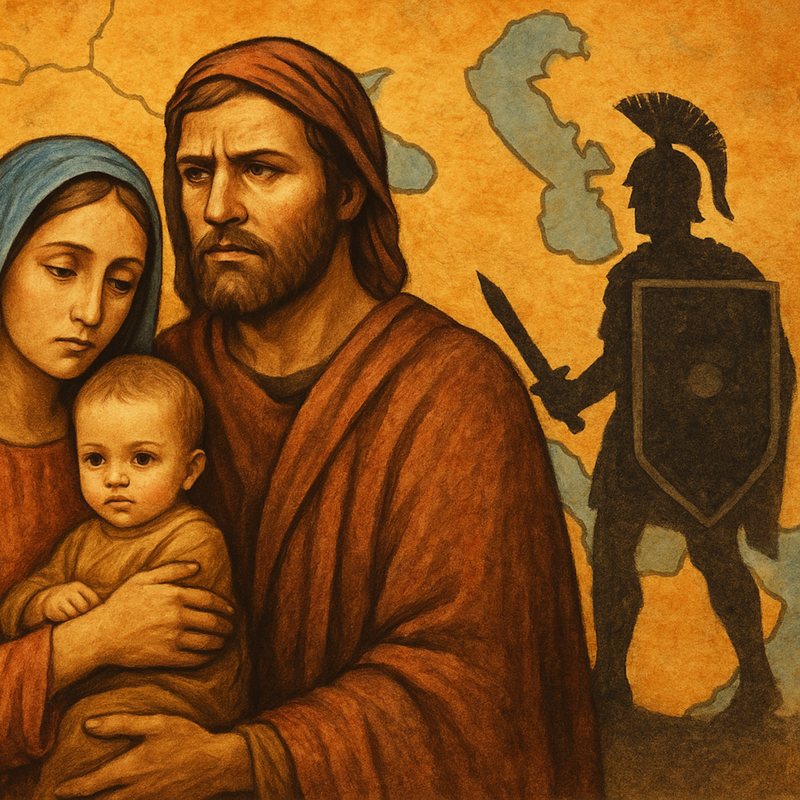
Painting of Mary and Joseph holding the infant Jesus beside the dark silhouette of a Roman soldier.

Play this episode on Spotify, or subscribe: Apple Podcasts · Overcast · Pocket Casts · RSS

Share: X · Facebook · LinkedIn · Reddit · Bluesky · Threads · Email ·

Today, I want to talk about a claim that shows up every Christmas season, especially online: the idea that Jesus, Mary, and Joseph were refugees — that they were undocumented migrants escaping a hostile government, and that the Nativity somehow maps onto modern U.S. immigration politics. It’s an idea repeated so often that it feels unquestionable. But once you look at the world they actually lived in, the analogy collapses instantly.

To understand the Flight into Egypt, you have to understand Rome. Not Rome as a distant city, but Rome as a system — the political world the Holy Family lived inside. Rome wasn’t divided into separate nations with visas and passports and immigration systems. It was a unified empire, more like the continental United States than anything else. Judea and Egypt weren’t foreign countries. They were Roman jurisdictions. Moving between them was internal movement, not crossing a border.

That’s the first thing modern people miss. The Holy Family didn’t leave their country. They didn’t enter a foreign state. They didn’t become stateless or undocumented. They were Roman subjects everywhere they went, protected by the same imperial authority that governed the entire region.

Now yes, Rome had borders — real borders, violent borders. When people tried to enter the empire from the outside, Rome enforced those boundaries with an iron fist. Caesar’s armies blocked outsiders, pushed back tribes, and made sure that entry into the empire happened only on Rome’s terms. In that sense, Caesar actually behaved more like a modern head of state than people realize. He controlled who entered the empire. He didn’t control internal movement.

And that’s exactly where the analogy to modern refugee policy breaks. When Joseph took Mary and the infant Jesus to Egypt after receiving the angel’s warning, they didn’t present themselves at a checkpoint. They didn’t apply for refuge. They didn’t cross into a sovereign foreign nation. They simply went from one part of Rome to another part of Rome.

If you want a modern parallel, you don’t look at asylum seekers crossing into the U.S. You look at internal displacement inside the U.S. itself. Think of the Dust Bowl migrants who fled drought and famine by heading west. Think of the Great Migration, when Black Americans fled Jim Crow violence and resettled in northern cities. Think of families uprooted by hurricanes and moving across state lines for safety. These were dramatic, traumatic movements — but they weren’t refugee movements. They were internal migrations.

And that is exactly where the Holy Family fits. Their flight was driven by danger, but it didn’t change their political or legal status. They weren’t outsiders. They weren’t undocumented. They weren’t in violation of any law. They were moving within their own world.

So why do we keep reframing the Nativity as a refugee story? Because it serves a modern narrative. It gives people a moral shorthand. It lets contemporary political debates borrow the emotional power of a sacred story. But the history doesn’t support the analogy, and neither does the geography.

This isn’t about rejecting compassion or undermining anyone’s convictions. It’s about accuracy. The Holy Family’s flight isn’t an ancient version of modern asylum. It’s an internal relocation under threat, inside the same empire.

As we hear the familiar Christmas commentary this year, we can appreciate the moral impulse behind the analogy — but we should also acknowledge the reality. Jesus, Mary, and Joseph were not refugees. They were Roman subjects reacting to a local threat, not crossing a foreign border into a foreign country. Their story is dramatic, moving, and sacred — but it isn’t a blueprint for modern immigration policy.

Transcript

Read the full transcript (916 words, machine made)

So every Christmas, you've probably heard this really powerful comparison that the story of Jesus, Mary, and Joseph is actually a story about refugees. It's a way to connect this ancient story to some very modern and often very heated political debates. In this explainer, we're going to unpack the history behind that very claim. You've likely seen some version of this argument before. I mean, it's a really sharp, compelling claim. It frames the whole nativity story as a case of asylum seeking with King Herod playing the part of a border agent. It's a super effective rhetorical tool, for sure. But the question is, is it historically accurate? Let's take a look.

All right, so if we're going to test this analogy, we can't really start with our world and our laws. No, we have to start with theirs. We've got to understand the political and legal reality of the world the Holy Family actually lived in, and that world, for all intents and purposes, it was the Roman Empire. And look, this isn't just some random background detail, it is the single most important piece of context for understanding their entire journey. This right here is the foundational point.

Joseph, Mary and Jesus were not leaving 1 sovereign nation and trying to get into another. They were moving between two different regions, Judea and Egypt, but both of them were firmly inside the same massive political system, Rome. This comparison really gets to the heart of it. A Roman subject living in Judea was not considered a foreigner in Egypt. They belong to the system.

So all these modern ideas like unlawful presence or illegal entry, they just didn't apply to someone moving within the empire's own boundaries. So you see, once you understand this, that it was all one single empire, it completely reframes the nature of their flight. This analogy is just incredibly clarifying, isn't it? They were fleeing a local tyrant, Herod, by moving to a different jurisdiction that was under the same big overarching authority. It was an internal relocation. Yeah, it was driven by a terrible threat, but it wasn't an international border crossing. Now, this doesn't mean Rome was a world Without Borders. Oh, no.

It absolutely had them. And they were often violently enforced. You had legions patrolling the Rhine, the Danube. But, and this is so key that enforcement was pointed outwards at non subjects, at outsiders trying to get in. So the crucial point is that the Holy Family never had to face that kind of external border guard. Now, if they had been fleeing from the neighboring Parthian Empire into Roman Judea, that's a whole different story. Then they would have been treated as foreigners trying to get in.

But they were already inside the club, so to speak. All this historical context actually points us toward a much more precise modern legal category to describe their situation, one that actually helps clarify things instead of confusing them. Let's look at the modern, internationally accepted definition of a refugee. You see that critical part? You have to cross an international border. You have to leave your country and enter another one. OK, now compare that to this category, the internally displaced person, or IDP.

And IDP is someone who flees for the exact same reasons, Persecution, violence. But they do it without ever leaving their own country. They just relocate within its borders. And these American examples, wow, they really illustrate the concept perfectly. People who fled the Dust Bowl or the horrific violence of the Jim Crow South were absolutely escaping life threatening conditions. Their suffering was immense.

But legally, because they moved from, say, Oklahoma to California or from Mississippi to Chicago, they were considered internal migrants, not refugees. So when you apply this modern legal framework to the historical facts, the conclusion is pretty direct. The Holy Family's flight from Herod perfectly fits the definition of internal displacement. They were fleeing a threat from within their own political system. Now you might be thinking, OK, refugee IDP.

Are we just splitting hairs? What's the big deal? Well, this distinction is actually crucial if we want to have a clear conversation about what the story means for us today. Think about it like this. Our modern debates about immigration are built on this huge, complex legal architecture.

We're talking asylum, deportation, sovereignty. None of that really existed for someone moving from one Roman province to another. So trying to impose these modern ideas onto the nativity story is, well, it's like trying to fit a square peg in a round hole. We're projecting our world back onto theirs, and that really gets to the heart of the matter. This isn't about diminishing the suffering of the Holy Family or the moral power of their story at all. It's about insisting on historical accuracy so that we can have honest debates using precise terms, rather than using analogies that are emotionally powerful but historically just don't quite fit.

Ultimately, this brings us to a bigger question. The Holy Family's Flight is, without a doubt a powerful story about surviving a violent threat. But by grounding it in its actual historical context, it forces us to think a little more carefully about how we use the past to talk about the present. What changes when we swap out a flawed metaphor for a more precise history? Now that's a question worth thinking about.