Read the full transcript (8,885 words, machine made)
OK, so every December, you see it. It's almost like clockwork. This, this really powerful narrative starts making the rounds online, on the news everywhere. Oh. Absolutely, it's unavoidable. The argument that Jesus, Mary and Joseph, when they fled to Egypt, that they were basically refugees or, you know, undocumented migrants, asylum seekers, they use all these modern political terms.
And it's almost never just a simple historical observation, is it? It's usually wielded as a kind of rhetorical hammer. Exactly. It gets sharpened into a direct accusation. Right. The implication is if you support modern immigration enforcement, if you believe in national borders or, you know, deportation procedures.
Then you're on the side of Herod. You would have been against the infant Christ. It's an incredibly compelling, a very emotionally powerful argument. It tries to draw straight line from a 2000 year old sacred story right into the middle of one of today's most heated debates. OK, let's unpack this because, I mean, you can't deny the emotional weight of that analogy.
It's powerful. But our whole mission here on the deep dive is to chase down conceptual precision. And when you look at the sources you share, they argue that this whole attempt to sort of draft the nativity story into modern politics just completely collapses. It does, and not because the flight wasn't terrifying or traumatic for them. Of course it was.
It collapses because the historical, the legal and frankly, the geographical facts just don't line up with our modern world. So we're essentially taking a 1st century event and trying to force it into a 21st century legal box. The box it was never designed to fit in. The entire exercise fails because the ancient world didn't have the modern nation state that structure, that idea of sovereign borders the way we think of them. It just didn't exist.
So when we make that analogy, we're collapsing some really critical distinctions. We are we're mixing up ancient internal movement with modern international migration. They are not the same thing. We're treating Roman imperial subjects, people who had a specific legal and political status, as if they were modern non citizens, as if they were foreigners with no right to be where they were going. Exactly. And maybe the biggest leap of all is that we're replacing a divine warning narrative, a story about prophecy and God's protection, with the language of international refugee law. Right.
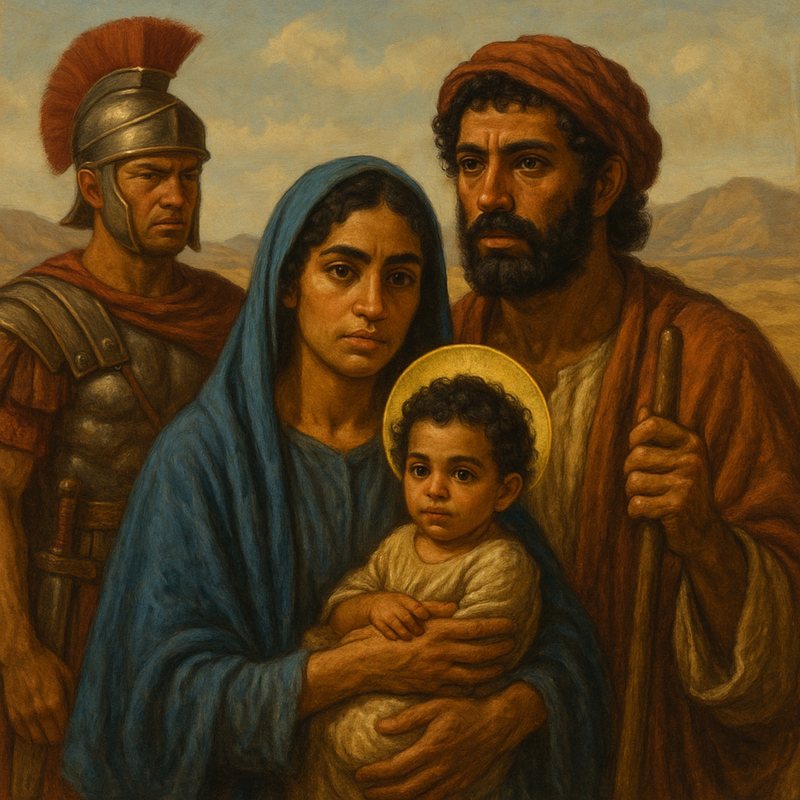
So we're imagining them crossing this hard, hostile border between two separate countries. When in reality, that is the core historical mistake. They did not leave their country. They did not cross a national border. They never entered a foreign nation state. Because they lived, traveled, and fled entirely inside the Roman Empire.
As lawful subjects, they were never outsiders, and once you grasp that single political and geographical fact that they were just moving around inside one massive unified imperial system, it changes everything. The whole refugee analogy just falls away. OK, so that's our starting point. Let's dig into that because it seems like everything else hinges on understanding what Rome actually was. Here's where it gets, I think, really interesting. It does.
To understand the Nativity, you first have to understand Rome, and the sources suggest that Rome is probably the closest ancient equivalent we have to a modern continental scale nation state. It's not a one to one comparison. Of course, we have to be careful. Rome was an empire. It was built on conquest. It wasn't a democracy.
Right? But if you're looking for an analog in terms of, say, governmental structure, a clear political hierarchy, and just sheer unbroken territorial control, it's a helpful comparison. Think of something like the modern United States, or maybe the EU if it had a single all powerful federal government. That analogy is so important for just recalibrating how we see this. We're talking about an empire of the time Jesus was born that stretched from Spain.
To Pillars of Hercules. Yeah, all the way across the Mediterranean, deep into Syria and then all the way across North Africa, it was this gigantic political entity. All ruled by one single authority in the end, Caesar, the emperor in Rome. And that huge scope is the absolute key to the Holy Family story. The land they were on from Judea all the way to Egypt, it wasn't split between two different countries.
Not at all. Both places, though they were run a bit differently, fell squarely under Roman authority. So let's talk about those administrative differences because I think that detail really matters. Judea at that moment was ruled by Herod the Great. He was a client king. What does that actually mean?
A client king was a Lobel ruler who was allowed to manage internal affairs. Herod had a lot of autonomy in that sense. He could build these huge, magnificent temples, he could run the day-to-day government, and he could certainly issue terrible decrees like the one that prompted the flight. But he wasn't a truly independent, sovereign king. Not even close.
His rule was entirely at the pleasure of Rome. His power was granted by Rome and it was sustained by Roman military might. If Caesar had wanted to, he could have removed Herod in an instant. His sovereignty was, you could say, borrowed. He was basically a regional governor who got to wear a crown. OK, now contrast that with Egypt. When Joseph and Mary get to Egypt, what kind of place are they entering in Roman terms?
Egypt was different. It was one of the most important provinces in the entire empire. They called it the bread basket of Rome for a reason. It fed the capital. It fed the capital, so it wasn't a client Kingdom with a local king. It was a directly governed imperial province. In fact, it was considered the emperor's personal property. In a way.
It was ruled by a Roman official, a prefect appointed directly by Caesar. So the Holy Family was moving from a region with a powerful local administrator, Herod, to a region under the direct, unmediated control of the central government in Rome. That's a perfect way to put it. It's almost like they weren't moving from, I don't know, Mexico to the United States. It's more like they were moving from a semi autonomous territory like maybe Puerto Rico.
Or a state with a very powerful governor? Yeah. And they were moving into, say, Washington, DC itself, where federal control is absolutely. Precisely, And because of that, the entire system was unified in the ways that mattered for their travel. There is a unified system of law, of taxation, of military protection and, most importantly, a shared political identity as subjects of the Empire.
And the census mentioned in the Gospel of Luke is a perfect example of that unified system at work. It absolutely is. That whole detail about Mary and Joseph traveling for the census, it just reinforces their status as internal subjects. So let's pause on that. Why did Joseph, who lived in Nazareth in Galilee, have to travel all the way to Bethlehem and Judea just to be counted?
Well, this Roman census, the apography, it wasn't just a simple headcount, it was a massive administrative tool for figuring out who owned what and where, mostly for tax. Purposes. Of course, it always comes back to taxes. It always does. Joseph had ancestral ties to Bethlehem, the city of David, so the Roman requirement for him to go back there to register, even though we live somewhere else, it just shows you how organized Rome was at tracking its subjects across these huge distances. So both of their big journeys, the one to Bethlehem for the census and the flight to Egypt to escape Herod, were movements dictated by or made possible by the Roman system itself. Exactly.
The trip to Bethlehem was them complying with a Roman order. Their flight to Egypt was them using the geographic unity that Rome provided to find safety. They were never outside the system, they were moving within it. Which brings us to the core question. Why was someone from Judea not a foreigner in Egypt?
Because in the Roman world, for people inside the Empire, the lines between provinces were administrative, not national. In our world, you cross a border and boom, you're a foreigner. Your legal status changes instantly. You need a visa, a passport. But someone born in Galilee, which was Roman territory, did not suddenly become an immigrant just by walking into the province of Egypt, which was also Roman territory. OK, but hold on, there was still a huge difference between being a Roman citizen and just being a provincial subject, right? They weren't citizens in the way that, say, the Apostle Paul was later.
That's an excellent point, and we absolutely have to be precise about that. No, they were not citizens with a capital C They didn't have the full package of rights. They couldn't vote in Rome's elections. They didn't have the legal protections, like the right to appeal directly to Caesar that Paul famously used. They were subjects. But that status, just being a subject, was still a world away from being a true foreigner.
A world away. Being a subject meant you were under Roman jurisdiction. You were part of the system. You were taxed by it, yes, but you were also theoretically protected by it. It gave you a kind of lawful presence across the entire empire.
So the modern idea of being an illegally present person. It just couldn't apply to them when they were moving internally. That concept only makes sense when a foreigner and outsider crosses a sovereign border without permission. They were insiders from the start. So their journey really was like a family moving from California to Nevada today.
It's the best modern analogy we have. The laws and local government might be different in Nevada, but you're still in the United States. You're still AUS citizen. You're not crossing an international border. The difference is like driving from LA to Vegas versus driving from Tijuana to San Diego.
The 1st is just a domestic trip. The 2nd involves 2 sovereign nations, international checkpoints, and a whole legal process where you are officially classified as an alien seeking entry. The Holy Family story is clearly the first war. So the very thing that made Rome so powerful, its scale, its unity, is the same thing that protected them. Exactly.
The threat was local. It was from Herod, a Roman client. The solution was to simply relocate to another part of the same vast Roman system, Egypt, where Herod's local authority couldn't reach. It was the empire size that offered them a safe haven, not the legal mercy of a foreign country. The moment you see Rome is 1 big political space, the whole refugee analogy just dissolves. It has to They weren't stateless. They were subjects of the most powerful state on Earth, and they used its internal geography to escape a local problem. OK, let's shift gears a little and talk about enforcement, because the other part of this analogy is this image of Caesar as this, you know, ruthless border enforcer. Right, the ancient executive cracking down. And the sources are clear that Rome did take its external borders very, very seriously.
Oh, absolutely. Rome was the ultimate sovereign power in that sense. It knew exactly where its territory ended. If you look at the empire's external frontiers, what they call the limes like the Rhine River, the Danube, the eastern desert frontier with Parthia, Caesar enforced those lines with extreme prejudice. Those were the real borders in our modern sense.
Those were the borders. So what did that enforcement look like? How did Rome treat actual outsiders, real foreigners who tried to get in without permission? It was organized, it was militarized, and it was often incredibly brutal. Roman legions patrolled those frontiers constantly.
If a group of people, often you know a whole Germanic tribe, tried to cross into the empire without permission, they were usually met with force. They were repelled. They were repelled. Rome dictated all the terms of entry. They would expel groups that snuck in, and if they did let foreigners settle the peregrini, they did so under very strict conditions.
They would control where they lived, what they did. Their status was always conditional and closely monitored. So in that very specific role, defending the external border against foreigners, Caesar does kind of look like a modern head of state enforcing immigration law. In that one function, yes. But here is the critical distinction we have to keep coming back to. That entire framework of external enforcement has nothing to do with the Holy Family.
Because it was all aimed at keeping outsiders out. Exactly. The whole system of patrols, violence and refusal of entry was for foreigners, and Jesus, Mary and Joseph were never foreigners. They were internal subjects. The Gospel of Matthew has them moving completely inside the borders of the Roman world.
Entirely within. They never came close to one of those fortified external frontiers. I noticed the sources brought up a very specific term, the pomerium. Could you explain what that is and why it's a useful idea here? Yeah, that's a great detail.
The pomerium was the sacred, ritually defined boundary of the city of Rome itself. It wasn't a wall, but a line on the ground. Crossing it had huge legal and religious consequences. For example, a general was forbidden from leading his army across the pomerium into the city. It was the line between the military and civilian world. In a sense, yes.
And while it technically only applied to the city, you can think of the entire empire as having a conceptual pomerium. There was a clear line between the inside the Roman world, where Roman law and authority operated, and the outside. The entire journey from Judea to Egypt took place deep inside that imperial boundary. So all the enforcement mechanisms that Caesar aimed at outsiders. Expulsion, violence, turning people away at the border.
None of that was ever directed at people like the Holy Family. Their drama was local, not international. It was. Now let's run a quick thought experiment. What if the Holy Family had been fleeing from, say, the rival Persian Empire of Parthia and trying to get into Rome and Syria?
OK, so then they would be foreigners trying to cross the external border. Exactly, and in that case, the Roman soldiers on the frontier would have absolutely functioned as the equivalent of modern Border Patrol agents. They would have stopped them, questioned them. They would have asked where they were from, what they wanted, if they had permission. They might have turned them away, they might have arrested them.
That scenario would fit the modern debate, but that is explicitly not the story the Bible tells. Their flight was inward, not inward bound. And for subjects just moving around inside the Empire, travel must have been pretty common and relatively unrestricted. It had to be Think about it. The empire's economy, its military, its administration, it all depended on people and goods moving between provinces. If every provincial line was a hard international border, with checkpoints and visas for its own subjects, the whole system would have ground to a halt.
Which again reinforces that idea of belonging. They belong to the society whose overall structure protected them, even if a local official within that society was the source of the danger. They had a defined political status. They were Roman subjects that gave them a right to be within Roman territory. They weren't stateless people begging for entry into a country that wasn't theirs. They were just relocated inside their own country to get away from a dangerous regional governor. So the whole refugee analogy really depends on pretending that the administrative line between Judea and Egypt was the same as the heavily guarded Rhine frontier between Rome and Germania.
And that's the fundamental conflation. Caesar's enforcement was aimed outward at foreigners. It was not aimed, in a word, at his own subjects moving from place to place. The difference there is legally everything. It's the difference between international migration and a domestic move.
Which brings us right to the legal core of the argument. And this is tough, I think, because we're just so conditioned to think in modern terms, words like refugee, asylum, deportation, they depend on a whole legal scaffolding that just wasn't there in the 1st century. That's the whole problem. Our modern system is built on concepts that would have been completely alien to them. Before we even get into it, just think about what it takes to be a refugee today under international law.
You need to have a well founded fear of persecution. And this is the key part. You have to have crossed a sovereign international border. You have to be outside your own country because it's unable or unwilling to protect you, and you're seeking protection from a different foreign country. Right away you can see the problems that depends on a clear line between citizen and non citizen.
It does. It also depends on the idea of lawful versus unlawful presence. And most of all, it depends on those sovereign borders separating different nations, none of which applies here. The whole modern infrastructure is missing. Think about what deportation involves today. It's an administrative process.
It requires immigration courts, databases, ID cards, a whole bureaucracy built around the concept of national sovereignty and who has permission to be within the national territory. Rome had none of that for internal movement. OK, so let's break down the specific legal terms the sources say are misapplied. Let's start with undocumented person. There was no such thing as an undocumented person moving from Judea to Egypt.
The very idea of being undocumented or illegally present only makes sense if you are in a sovereign states territory without its permission. Which again, only applies to foreigners who cross the border illegally. Exactly since Jesus, Mary and Joseph were already lawful subjects moving inside their own country's territory, the concept was meaningless. At worst, they were new arrivals in an Egyptian town who hadn't registered with the local clerk yet. That's an administrative issue, not an international crime.
It's like forgetting to update your driver's license after you move. It's not the same as sneaking across a border. It's the difference between moving to a new room in your house and climbing over the fence into your neighbor's yard, a completely different category of action. OK, second term illegal entry. Same problem really. For Roman subjects, moving between provinces was just relocation.
There was no law or legal category that defined that movement as illegal entry. They were moving through a political space. They had a right to be in. And the laws that apply to the external borders, the limes, it just weren't in effect on the road from Bethlehem to Alexandria. No.
For them, no. And the third concept, deportation. Could a subject be deported from one province to another? Not in the way we think of it now. Rome could certainly punish people. They could exile political enemies. They could forcibly relocate entire populations after a war, but there wasn't an administrative system for, say, the governor of Egypt to round up subjects from Judea and deport them back home just for being there. Their status as Roman subjects gave them a right to be on Roman soil.
So it all comes back to this one central fact. They were always operating with what we'd call lawful presence inside the Roman. Always they belonged there. Which means the story in Matthew is not about stateless people begging a foreign king for safety. It's a story of internal relocation to escape a very specific local threat. And it was guided by divine warning. A divine warning that led them to a safer part of their own political system where the local Tyrants Authority ended. You know the fundamental requirement for asylum, that your home country has failed to protect you, so you need a foreign country to step in.
It's completely absent. In a strange way, their home country, Rome, did protect them. It protected them by being so large and unified that moving a few 100 miles put them completely out of Harrods reach. It's so ironic the argument only works if Rome wasn't a unified empire. If the region had been a bunch of small independent countries, then they would have been refugees crossing a border.
Exactly. We're arguing against the analogy precisely because of the historical fact of Roman unity and power. The analogy requires you to ignore the most important political entity in the entire story. It really shows you how much our modern political thinking is trapped by the idea of the nation state. We hear migration and we automatically think international borders.
It's an intellectual reflex, but asylum is about 1 sovereign state protecting you from another. Since Rome was the only sovereign state involved in their story, the legal dynamic just isn't there. So we firmly established what their journey was not. It wasn't international migration. But the sources then suggest if you want a real parallel for their experience, the fear, the flight, the displacement, you should look at something else entirely, yes.
You should look at cases of internal displacement within large unified countries. IDP's as they're called today. Internally displaced persons, and this is such an important shift in thinking because internal displacement can be just as traumatic and morally urgent as an international refugee crisis, but legally and politically it's a completely different situation. OK, let's look at the first American example. The sources give the Dust Bowl migration in the 1930s. This seems like a perfect parallel for the legal status of the Holy Family.
It's a fantastic analogy. The Dust Bowl was a huge catastrophe. Hundreds of thousands of American citizens, the Okies, were forced off their land by environmental collapse and economic depression. They were starving. So they Fred W mostly to California looking for work. Right.
And they're suffering the way they were treated, the poverty in the migrant camps, it looked for all the world like a refugee crisis. But they were Americans moving from Oklahoma to California. They were in Colonel Migrants. You were always as U.S. citizens.
They never crossed an international border. They never had to ask Mexico for asylum. Their suffering was immense. Their flight was forced. But their legal status never changed.
They were citizens relocating within their own country. And that perfectly mirrors the Holy Family moving from one Roman province, Judea, to another Egypt, to escape a local crisis. Precisely. I think the second example, the Great Migration, is also incredibly powerful because it adds that element of fleeing targeted violence and oppression which is so central to the Nativity story with Herod. The Great Migration is maybe an even better moral parallel. You have, over decades, millions of black Americans leaving the Jim Crow S for northern cities like Chicago and Detroit. And they weren't leaving for purely economic reasons. No, they were fleeing systemic terror. They were escaping lynchings, political disenfranchisement, and a brutal economic system designed to keep them down. It was a massive coerced movement of people seeking basic human dignity and safety for their families. That is persecution.
They were fleeing a system that was actively trying to harm them and their children, just like the Holy Family was fleeing Herod. Yes, they were internally displaced people fleeing an organized hostile subjurisdiction. The reasons for their flight, the fear, the coercion, the persecution are morally identical to the reasons people seek international asylum. They were leaving places that were unwilling and unable to protect. Them.
And yet, once again, legally, they were not refugees under international law. No, they were American citizens moving within the United States. Their journey, as profound and morally significant as it was, was legally a matter of internal relocation. They were using the geography of their own country to escape a failed and hostile regional government. This distinction is so important because it allows you to fully acknowledge the suffering and the terror of the Holy Family's flight without twisting the legal and historical facts. They were internally displaced persons. The source material is really clear on this. These examples show that displacement can be horrible and on a massive scale, but it doesn't automatically trigger the specific laws that govern international refugees. Those laws require borders and different countries and asylum claims.
The Holy Family story fits squarely in the IDP category. And I think it's important for you, the listener, to realize that getting the legal category right doesn't diminish the moral weight of their story one bit. Not at all. In fact, it helps clarify where the moral responsibility lies. The failure of the Great Migration was a failure of the American federal system to protect its own citizens in certain states. The Holy Families flight was a failure of a local Roman administrator, Herod, which required them to rely on the stability of the broader Roman system. So let's bring it all back to the biblical text itself, to the Gospel of Matthew.
If we take off these modern political glasses, what is the actual drama of the flight to Egypt about? The drama is not about borders, it's not about immigration papers. The drama is about Herod's paranoia and his monstrous violence, and it's about divine protection. Dreams. Warnings from an Angel. Exactly.
It's about God intervening to ensure the survival of this child to fulfill ancient prophecies. The whole focus of the story is theological. It's about God's plan working out within the political realities of the day. So when we try to force this story into our modern immigration debates, we're really just setting a rhetorical trap for ourselves. We're slapping modern labels onto an ancient story that was never about those things. And it works so well as a rhetorical trap, because our modern discourse loves simple emotional analogies. It's so much easier to say Jesus was a refugee so open the borders than it is to have a complex, nuanced discussion about policy.
So why is it so important to get this right? Why does this precision matter today? Why not just let the analogy stand if it promotes compassion? Because the modern debates are about real, specific and complex legal systems systems. When you talk about asylum processing or migrant caravans or national sovereignty, you are talking about things that have immense real world costs and responsibilities, and if you use the wrong labels, you confuse the debate. So how does mislabeling the Holy Family muddy the waters of today's policy debates?
Well take refugee resettlement under international law that imposes very specific legal duties on the country that accepts the refugee. There are costs, processes, legal statuses. Deportation is an administrative action taken against non citizens. All of these things are designed to manage the presence of foreigners inside a sovereign nation. And since none of that exists in their world, the story of the Holy Family can't possibly give us a direct policy answer for our world. It can't.
To say that their internal relocation within the Roman Empire should tell us exactly how to handle, for example, an asylum claim at the US southern border. A situation involving two different sovereign countries and international law is just a rhetorical sleight of hand. It's using a motion to bypass the hard work of actual policy making. So let's just state it one more time. If someone absolutely insists on making an analogy between Rome and a modern state, what is the only one that actually holds up? The only valid analogy based on the history is this. Caesar enforcing Rome's external borders against foreigners is like a modern state enforcing its borders against foreigners. Rome absolutely did control who got in from the outside. They did.
From Perthia, from Germania, from Arabia. They, like any sovereign power, decided who could cross their external frontier and on what terms. The Holy Family was never in that category. They were insiders. To call them refugees is, ironically, to assign them the legal status of an outsider trying to sneak in, which is the exact opposite of what the text and the history tell us. So demanding this kind of historical precision isn't just an academic game.
It's necessary if you want to have an honest and productive debate about these incredibly difficult issues today. It's the only way to figure out who is responsible for what. If you blur the line between internal displacement and international migration, you lose the ability to say which government or which entity owes a duty to the people who are suffering. The two situations trigger completely different sets of legal and moral obligations. And that distinction is the real insight here, isn't it?
It's the thing that gets lost in all the political noise. It is, and that's why we do these deep dives to remember that history is complex and that simple analogy is no matter how good they feel, often hide more than they reveal. OK, so let's try to wrap this all up. The core argument from the sources we've looked at is really twofold. First, the Holy Family were lawful subjects of the Roman Empire.
Yeah, they were insiders. And second, their flight to Egypt was an act of internal relocation to escape a local threat, not an international flight to seek asylum in a foreign country. And rejecting that refugee analogy, as the sources argue, isn't about a lack of compassion. It's about a demand for historical and legal clarity. The Nativity story is about God's protection playing out inside a single political world.
That's a great way to put it. We spent a lot of time on what they weren't international refugees, but let's end by focusing on what they were internally displaced persons. And thinking about them that way as IDP's, leads us to a really provocative final thought for you, the listener, to take away from this, If we accept that the Holy Family's flight is best understood as internal displacement, as a coerced move within a single country, what does that tell us about the moral duties a country owes to its own people who are displaced today? We see this all the time, people forced to move by local violence, by economic collapse, by natural disasters, all within their own national borders. A crisis that happens deep inside a country not at its edge. Exactly.
So what is the responsibility of a sovereign state when it fails to protect its own people in one of its own subjurisdictions? Is that obligation different from the one we have to foreign refugees under international law? And if a state consistently fails to meet that internal obligation, what's the solution? It's a question that puts the moral responsibility squarely back on the sovereign state itself. A question that is incredibly relevant today, reminding us that some of the greatest human tragedies happen far from any international border.
Welcome. Thank you for joining us on this. Deal Today we're diving into a sharp piece of analysis that really takes on the political narrative around the nativity story. Right, it argues the Holy Family weren't refugees at all, but we're actually internal Roman subjects just relocating. Exactly. So let's get right into how we can make this already compelling argument even stronger.
The core seizes here. It really hinges on this legal distinction between a refugee and an internally displaced person, an IDP. And the material makes an exceptionally precise case for it, showing they never crossed a real sovereign border. Yeah, but what I like is that the author seems to know this precision. It risks sounding a bit academic, maybe even cold.
Well, that's the thing. The defense against that, against the charge of lacking compassion, it only shows up way at the end in Section X. And by then it might be too late. They might just, you know, shut down before they get to your real point. So here's the thought. While the legal distinction between refugee and internally displaced person is central to the essay's precision, the material could more proactively redefine the moral obligation associated with IDP's to secure the argument against charges of lacking compassion.
Yes, that's a huge weakness right now. We don't want the reader thinking the author believes the suffering was somehow less important just because the legal term is. Different. Of course not. The weakness is that by delaying that moral defense, you let the reader frame it as just intellectual hair splitting, and that's not fair to the argument.
Because the author knows that things like the Dust Bowl or the Great Migration, those were profound moral crises. Exactly. So the suggestion is immediately pivot the moral weight of the IDP status right after you establish the legal point. Use those American crises not just as legal parallels, but to show the huge, demanding moral obligations that internal displacement creates inside a single state. OK, So you establish the legal difference and then you immediately assign this new, maybe even heavier moral weight to that IDP category.
That's a powerful move. It is. So let's talk concrete examples. If we're going to put this idea that rejecting the refugee analogy isn't rejecting compassion right up front saying Section 2, what does that look like? Well, you use those incredible modern analogies the author already has.
The Great Migration. The Great Migration. Millions of people weren't crossing international borders, but they were absolutely forced to move, fleeing state sanctioned violence, deep economic oppression. That movement, even though it was internal, created a massive moral and political obligation on the government. That connection is key. It immediately grounds this sort of abstract Roman legal status in a painful, very relatable modern crisis. Yes, it lets the reader accept your legal point without feeling like they have to sacrifice their empathy. So concretely.
Concretely, the author should use the moral weight of the Great Migration to show that fleeing Herod's threat compels an equally powerful but internal obligation on Rome. It immediately redirects the reader's focus from border crossings to internal protection failures. It shows that IDP status isn't a lesser moral category. Not at all. It's a different one that demands accountability from within, and framing it that way right up front protects the entire argument.
That is a fundamental reframing. It really tackles the arguments vulnerability head on. OK, so now let's talk about the structure of the historical evidence itself, the foundation that Rome is the closest ancient analogue to a continental scale nation state. That's in Section 2. It's exceptionally strong, but the full punch of that idea feels a little delayed. I agree the impact is fractured right now. So the crucial distinction between internal movement and external border enforcement, which underpins the entire argument, could be presented earlier and more seamlessly woven with the Roman analogue to maximize the reader's immediate understanding of the ancient legal landscape. Yeah.
The weakness is that the key evidence, Caesar's strict external border enforcement in Section 3 and then the legal status details in Section 5, they're separated from that core analogy in Section 2. Which means the reader doesn't immediately grasp the full weight of the argument. You know, the idea that the Holy Family never behaved like modern migrants crossing a guarded sovereign line. Precisely. You need to create an immediate, powerful contrast. The structure should feel like a quick historical reveal. You say Rome is unified, then you immediately show how terrifyingly serious they were about keeping people out. Only to then show that this mechanism never applied to the Holy Family, right?
But right now we state the unity and then we wait two whole sections to talk about the violence of that external perimeter. So the suggestion is clear, consolidate the historical evidence. Bring it all together, both it's unified internal law, taxation, political identity, all that, and it's violently enforced external border. Put it all into one powerful early section. And use that external enforcement to create this really dramatic contrast with the Holy Family's internal movement.
For concrete examples, just move the core points from Section 3. The details on Caesar enforcing the Rhine, the Danube, the Eastern frontiers, how he repelled groups from Parthea or Novatea. Move that stuff directly into Section 2. That would create a much more powerful statement. Right after the intro, you clarify that Rome governed from Spain to Syria, and crucially, that the enforcement mechanism Caesar used on outsiders were never applied to internal subjects like Jesus, Mary and Joseph. Yes, it frames the entire rest of the analysis. And it means the author can then deploy that killer analogy. The one about moving from Judea to Egypt being like. Moving from California to Nevada, Not crossing from Mexico into the United States.
And when that analogy hits, it's not just a clever comparison, it's an historically verified claim. Because you've already laid the groundwork. It just streamlines the whole narrative. Maximum efficiency. That's a very effective structural adjustment. It helps the pacing immensely.
But to truly, you know, lock the argument down, we need to address the historical nitpickers. Yes, the ones who will try to complicate the idea of a lawful subject. Right. The piece makes this bold assertion that the family were always lawful members of the imperial world. That claim is vital. It is necessary, yeah, but I do worry that a knowledgeable reader might pause there.
The author clearly has deep expertise, and they know that historical status often comes down to the difference between a full Roman citizen and a mere subject in a client Kingdom like Judea. OK, so maybe. To solidify the claim that the Holy Family were always lawful subjects, the material needs to briefly address potential nuances in Roman political status that might complicate or challenge the monolithic view of guaranteed internal freedom of movement. I see the risk by just ignoring that citizen versus subject distinction, you're kind of leaving an opening. You're allowing a counter argument to imply there's a Gray area in their freedom of movement. Even if it's just a technicality, it could be used to dilute the main point.
Exactly. It doesn't actually change the core argument that they weren't refugees, but not addressing it gives critics an unnecessary point of entry. The weakness is that a savvy reader could imply the family was in some kind of precarious legal purgatory. Which might start to sound a bit like modern border issues. Which is exactly what the piece is arguing against.
So the suggestion is just to acknowledge those distinctions, citizen versus subject, and then immediately clarify why, for the purpose of the modern immigration analogy, those differences are immaterial. Because their status as protected members of the Imperial world is what really matters here. That's it. For a concrete example, we're discussing the legal status in Section V. Just introduce a sentence or two acknowledging the hierarchy of rights.
Between a Roman citizen and a local subject in Herod's Judea. Yes, and then pivot fast Clarify that regardless of whether they had full citizen rights, their legal status as insiders meant they were never subjected to the legal mechanisms like non entry or expulsion that were reserved solely for outsiders trying to breach the external border. That's critical. You're basically showing that you've considered the most complex legal angle, and that your central claim about border integrity still holds up. It's being pre emptive, closing off that historical escape hatch for critics.
You demonstrate mastery over the material when you can address the nuance while still maintaining the force of your main point. And that's exactly what this small adjustment does. This is fantastic. I mean, the author has such a clever hook, and these adjustments really push the argument from just being correct to being, well, unassailable. It's an excellent piece of work with a really sharp objective. So the actionable opportunities here are all about maximizing resonance and robustness.
I think the key takeaways are threefold. First, place that moral argument for internal displacement early. Use the Great Migration analogy to get ahead of any charges of lacking compassion. 2nd Consolidate the historical framework of Rome's internal unity and external enforcement. Put it all in one early section so that geographical analogy lands with maximum force. And finally, just briefly account for those internal Roman status distinctions, citizen versus subject to preemptively show how robust your central legal claim really is. These adjustments should absolutely help your argument achieve maximum impact and clarity. We invite you to submit your revised material back to the critique once you've implemented these suggestions. Every year we hear the Nativity story, and almost immediately we see its use in modern political commentary. Specifically, the Holy Family's journey from Judea to Egypt is often equated with the experience of modern refugees or even undocumented migrants.
It's a very. Powerful analogy that gets used a lot. It is. And so today we have to ask, does the Holy Family's movement, which took place entirely within the Roman Empire, really justify using these modern legal categories? Or, you know, are we imposing a kind of historical and legal incoherence onto the story? My position is that the analogy completely collapses because they were lawful Roman subjects moving inside a single unified system.
And I'll be arguing that while we have to acknowledge that legal structure of Rome, the the functional reality of their journey, a desperate flight from political violence, alliance conceptually with the suffering and moral urgency we associate with the term refugee, or perhaps more accurately, an internally displaced person. Well, my position really demands historical and legal precision. To claim the Holy Family were refugees is to collapse these essential categories separating ancient internal movement from modern international migration. And this distinction is critical because all of our modern law and policy is built on the idea of the nation state border, a structure that was just wholly absent from their world when Jesus was born. Rome functioned as this this continental scale unified political system.
You could call it a proto super state, I suppose, governing territory from Britain all the way to the Levant. So movement from Judea, which was, you know, governed by a Roman client, King Herod, into Egypt, a direct imperial province that was entirely internal. They didn't leave their country, they didn't cross a national border, and they certainly didn't enter a foreign nation state. And that distinction matters because modern refugee law, the 1951 Convention, is based on crossing an international frontier to escape persecution. The Holy Family were never stateless.
They were always subjects of Rome. The concept of an undocumented person moving between Roman territories just it didn't exist. To insist otherwise is to introduce modern legal burdens like asylum processing or deportation, where they simply can apply. OK, I see why you're demanding that level of historical specificity. I do. But I'm coming at this from a different angle, from the perspective of human necessity.
We agree on the legal reality. Egypt was Roman. But that legal status alone can't just nullify the functional experience of their flight. The narrative as it's written is fundamentally a story of immediate coerced relocation under the ultimate threat of death. I mean, this wasn't some clanned economic migration. It was a survival strategy driven by Herod's political purge, the massacre of the innocents, this forced migration shaped purely by terror.
It's morally analogous to the crises we see today. But what kind of crises? Well. If we want to find modern parallels inside a unified state, history gives us perfect examples. Think about the mass movements during the Irish potato famine or the Great Migration in the United States, where millions of black Americans fled systematic violence in the South for the North. Legally, those were internal movements, but they were traumatic, they were morally profound, and they required finding sanctuary.
The story's power is in that flight for survival, not in Joseph's presumed paperwork. That's an interesting point, though I would frame it differently. I'd actually double down on the integrity of Rome as the the continental nation state analog. Because you see, the moral conclusions you're drawing depend entirely on where we place the vulnerability. Let's just look at how Rome actually treated its borders. The sources are pretty clear that Caesar strictly enforced Rome's external frontiers, the Rhine, the Danube, the eastern lines against Parthia.
Now those borders function precisely as modern international borders do. They were there to repel unauthorized external migration. The Holy Family never went near those boundaries. They were moving from one administrative zone to another inside the secure perimeter of the Ox Romana. Right.
I'm just not convinced by that exclusive focus on the external Roman walls. You're making the analogy hinge entirely on where the violence came from. Was it from outside the wall or inside? And while yes, legally they were protected by Rome overall, the most immediate brutal threat came from a hostile government official inside the system, Herod. A client king, yes, right. So the disagreement here is really about jurisdiction versus function.
Yes. Rome was the overarching legal umbrella, but the threat was localized and deadly for a family in Bethlehem. Herod's soldiers were agents of execution. Their flight was functionally identical to fleeing a state terror group, even if their destination was technically within the same empire. That 400 mile journey was an immense trauma.
It is the very definition of displacement. But that functional trauma, while it's undeniable, is exactly why we have to be precise with our terms. The distinction between an internationally recognized refugee and an internally displaced person and IDP? It exists for a reason, because the legal remedies are different. An international refugee crosses a border, meaning their original state has failed them.
An IDP, like the Holy Family has fled within their own state's borders, meaning that state, in this case Rome, retains the primary legal obligation for their protection. To blur this distinction and just call them refugees is to dismiss the specific responsibilities Rome held, and it really muddies modern discussions. If we accept they were IDP's, the analogy is powerful and it's sound. If we insist on calling them international refugees, we are imposing modern international obligations on an ancient empire. OK, that refinement is helpful. Classifying them as IDP's.
That does capture the legal reality while still acknowledging the coercion. But the emotionally powerful claim that they were refugees, that often serves as a kind of shorthand for their vulnerability, for their statelessness before the immediate threat. The narrative shows a family seeking true sanctuary from a hostile local authority. So to just dismiss this moral drama by saying they were lawful subjects or ID. PS It misses the immediate crisis when Herod's assassins are at the door. Does Joseph's theoretical right to appeal to some Roman consul in Alexandria truly mitigate the terror of that night, or the necessity of just running?
I see why you focus on that vulnerability, I do. But let me offer a different perspective, rooted in the consequences of the language. We use modern policy debates about immigration and asylum. They involve immense infrastructure, huge administrative costs, legally binding obligations. You have resettlement programs, asylum courts, border agencies, and these systems only function because the distinction between citizen and non citizen, sovereign territory and foreign territory is absolutely clear.
Sure, but. And so to insist they were undocumented or asylum seekers is to confuse internal displacement with external crossing. It imposes the modern administrative machinery of international law onto a world where those frameworks just didn't exist. This lack of precision has serious consequences. Today.
It uses Scripture to demand policy solutions like open borders or a specific asylum processes that are only applicable to international migrants, not internal ones. We risk diluting modern asylum law by overextending the analogy. I understand the concern about diluting specific legal categories, but that line of reasoning suggests the only vulnerability that matters is the one validated by a modern International Convention. My argument is that the text itself provides the moral validation. When we read the narrative, we don't find a discussion of travel documents, we find an event driven by fear and the search for security.
The vulnerability wasn't just lacking a safe place to stay, it was the lack of protection from the state mechanism that Herod was using. But the source of the coercion matters. The distinction you're pressing between an IDP fleeing internal tyranny and an international refugee fleeing the same is, from a moral standpoint, administrative. The imperative placed upon the host community remains the same. Welcome those fleeing violence.
This narrative instructs on the sacred nature of sanctuary, not on the correct application of a visa stamp. I appreciate the focus on sanctuary, but we have to return to the source of that coercion or we misinterpret the history. If we must draw parallels, we have to be precise Caesar's enforcement of external borders. That is the correct historical analogy for modern border control. The Holy Family's flight was motivated by Harrods internal political violence against his own subjects.
Confusing Harrods tyranny with a modern immigration official enforcing border law is the fundamental error here. Their problem was a tyrant, not their immigration paperwork. That is a compelling argument, but have you considered the theological function of their journey, which I would argue matters more to the listener than the fine print of Roman law? The flight establishes this profound connection between the divine and the vulnerable. Whether they are legally IDP's or international refugees, the story is still one of flight for survival.
It highlights that even the Messiah must rely on the compassion of strangers. We can't ask the text to answer our specific administrative questions, like how they'd fare under current asylum rules. But it provides essential moral context about our obligation to all who are fleeing violence, regardless of which legal box they happen to fall into. So for me it comes down to this. The claim that the Holy Family were refugees is a historical and legal confusion.
They were Roman subjects relocating within the empire. It's a story of internal displacement under political threat. Using it as a blueprint for modern international immigration policy just confuses 2 very different things. And for me, the narrative is about suffering and flight coerced by violence, and that reality connects the Holy Family's experience directly to the moral urgency of modern crises. So while legal precision would classify them as internal movers or IDP's, the moral weight of their plight, the necessity of sanctuary, remains central to the story's power.
And I think both perspectives really illuminate the material by demanding we be clear about the difference between legal categories, historical context, and and the moral implications. Exactly, and recognizing that complexity often requires us to integrate both the legal fact and the moral function to really appreciate. The truth and modern refugee analogies. You hear it all the time, right? That Jesus, Mary, and Joseph were refugees or undocumented.
But The thing is, the actual history of the Roman Empire tells a, well, a totally different story. First, you got a picture of the Roman Empire as basically one huge unified country. Judea, where the family fled from, and Egypt, where they went, were both inside of it. So they never actually left their country or crossed a national border. It was more like moving from, say, California to Nevada today. Second, let's talk about their legal status. Since they were moving inside Roman territory, they were always lawful subjects.
They were never outsiders. All these modern labels we use, like refugee or asylum seeker, they just they just didn't apply to internal movement back then. Sure, Rome was super strict about its external borders, but that wasn't the Holy Family situation at all. Finally, if they weren't refugees, what's a better way to describe them? Well, their flight was an internal relocation to escape violence from Herod. The best modern analogy isn't international refugee law, but more like Americans fleeing the Dust Bowl or Black Americans relocating during the Great Migration. You know, these were massive, traumatic moves, but they happened entirely within one political system. So the Nativity story is fundamentally about divine protection and survival under a political threat, not about contemporary immigration debates or legal status in a foreign country.