
The Holy Family’s Journey: A Historical Look Beyond Modern Refugee Language

Episode 443 of 455 · · 5:25
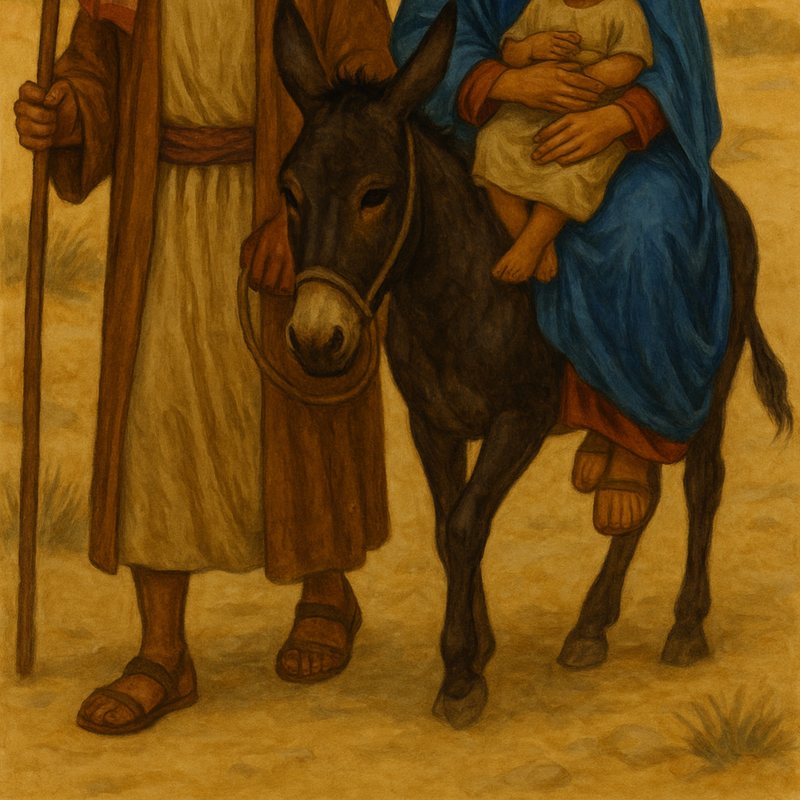
Painting of Mary holding the infant Jesus on a donkey, Joseph walking alongside with a staff.

Play this episode on Spotify, or subscribe: Apple Podcasts · Overcast · Pocket Casts · RSS

Share: X · Facebook · LinkedIn · Reddit · Bluesky · Threads · Email ·

Discussions about the birth of Jesus often include the assertion that Jesus, Mary, and Joseph were refugees fleeing persecution. This framing is intended to connect the biblical story to contemporary global crises and highlight empathy for displaced people. While the intention may be understandable, the historical circumstances of the Holy Family do not align with the modern category of refugee status as defined by law, borders, and international recognition.

In the first century, the Eastern Mediterranean was not divided into nation-states. It operated under one imperial authority: Rome. Judea, the birthplace of Jesus, was ruled by Herod the Great as a client king under Roman oversight. Egypt, where the Gospel of Matthew records that the family traveled, was a Roman province governed directly by imperial administration. Movement from Judea to Egypt was therefore not a departure from one country into another, nor did it require permission, documentation, or protection from a foreign sovereign power.

The journey to Bethlehem, prompted by the census described in the Gospel of Luke, was not migration at all. It was internal travel for administrative purposes, a reality familiar across the empire for those subject to taxation and bureaucratic recordkeeping.

The subsequent flight to Egypt described in Matthew was a response to danger, specifically the threat posed by Herod’s directive to kill infant boys in Bethlehem. This reflects urgency and real risk, but urgency alone does not make the Holy Family refugees in the modern sense. A refugee, in contemporary legal terms, is a person who crosses an internationally recognized boundary and receives acknowledgment or protection from another state. Many people flee danger without ever being recognized as refugees; they are displaced, endangered, or in flight, but not legally categorized under that term.

Another key element distinguishing this narrative from typical migration or displacement is the presence of explicit spiritual and supernatural agency. Herod’s actions are portrayed as a response to prophecy. Joseph’s decision is directed by a dream in which an angel provides instruction. The narrative presents a specific threat against a specific child, rather than a generalized persecution of an entire population. The movement was personal, not collective. It was prompted by divine warning, not legal petition, social negotiation, or state-to-state appeal.

Understanding these distinctions does not diminish the gravity or significance of the story. Instead, it preserves the historical and spiritual context in which it occurred. Using modern terminology to describe ancient events may blur rather than clarify the meaning of the narrative, substituting contemporary categories for ancient realities.

The account of the Holy Family’s journey remains important without translation into the language of modern policy. It is a narrative of faith, danger, obedience, and protection. It illustrates vulnerability met with guidance, threat met with trust, and uncertainty met with action. Its power does not depend on its alignment with contemporary refugee frameworks; its significance rests in the world it emerged from and the faith it continues to inspire.

Transcript

Read the full transcript (1,005 words, machine made)

You've probably heard it a lot, right? The idea of the Holy Family as refugees. It's a really powerful image that connects an ancient story to our world today. But is it actually historically accurate? Well, that's what we're here to find out. Let's peel back the layers.

So we're going to start with a question that you've almost certainly heard before. It's one that takes a 2000 year old story and puts it right into today's headlines. And there it is. We're Jesus, Mary and Joseph, refugees. It sounds like such a simple question, doesn't it? But you'll see the answer is, well, it's complicated. It forces us to dig into history, politics, and even what our words really mean.

And you can see why the parallel is so strong. A family fleeing A murderous tyrant to save their child. I mean, that resonates with all of us deeply. But to really get what was going on, we need to put away our modern maps and, you know, pull out one from the 1st century. OK, so let's jump back in time to get to the bottom of our question. We first have to understand the world the Holy Family actually lived in.

And spoiler alert, it was a very different place from the world we know today. What's really crucial to see here is the political setup. By the time Jesus was born, both Judea and Egypt were firmly under the control of one single superpower, the Roman Empire. So you got to stop thinking of them as separate countries. It was more like they were different states, you know, all under one big federal government. And this chart just spells it out perfectly. Today, when we think of international travel, we're thinking about passports, visas, border control, the whole deal. But back in the 1st century Roman Empire? Nope, none of that existed.

Moving from Judea to Egypt was a lot more like driving from, say, California to Arizona, than it was like flying from the US to Mexico. So here's the key take away. Yes, they were leaving the area controlled by King Herod, but they were never leaving the Roman Empire. They were just moving from one administrative zone to another, all under the same Roman umbrella. And that brings us to the most important historical distinction. Their flight, and believe me, it was absolutely perilous, was technically an act of internal relocation. They were moving inside one single massive empire, and that little detail becomes a very big deal when we start looking at the words we use.

OK, now let's get into the words themselves, because the specific terms we throw around today, they carry a ton of legal and historical weight, and we really need to unpack that. The big concept we need to wrap our heads around is this anachronism. It's basically a fancy word for when we take a modern idea, like our very specific legal definition of a refugee, and we try to force it onto a pass that played by a completely different set of rules. Just look at this breakdown. The term refugee isn't just about running away from danger. The really critical part is that it involves crossing a recognized international border, and in the modern legal sense, it requires you to be formally recognized by another country or an international group.

Now terms like flight or exile, sure they describe the act of leaving, but they don't have that specific legal status attached. Actually, our whole legal system for what makes someone a refugee is pretty new. It was really born out of the chaos of the world wars in the 20th century. So back in the Roman world of the 1st century, this specific legal category, it just flat out didn't exist. Now moving beyond the politics and the legal definitions, the story in the Bible itself presents a situation that's, well, it's pretty unique.

It doesn't really follow the usual patterns of people fleeing danger. If you look at the narrative, every single major move they make, the reason Herod is angry, the warning to get out of town, and even the all clear signal to come back is kicked off by a direct supernatural message. Joseph isn't acting on rumors or political news. He's following divine instructions from an Angel in a dream. And that really sets their situation apart. The story describes a very specific threat aimed at one particular child that was communicated through a personal warning to one single family.

This is way different from, you know, a mass exodus of people fleeing A widespread famine or a war that's affecting everybody in their community. So after all that, looking at the Roman world, the meaning of our words, the specifics of the biblical story, you got to ask, why does any of this matter? Why is making this distinction so important? What's the big deal? And let's be crystal clear about something. The point of all this is absolutely not to downplay the danger they were in.

Fleeing a violent king who wants to kill your child is a terrifying life or death situation, no question about it. It doesn't matter what label you put on it. The goal here is simply precision. It's about being careful with our language so we can get a clearer, more accurate picture of their real journey and the real world. At the end of the day, it's about respecting the past for what it was, not trying to force it into our modern day boxes. And that leaves us with this final, really critical thought. When we apply our modern labels to events in the past, what do we gain in that emotional connection? And what crucial details, what important nuance might we be losing in historical truth?

It's a powerful reminder that the words we choose don't just describe history. They actively shape how we understand it and how we decide to use it today.