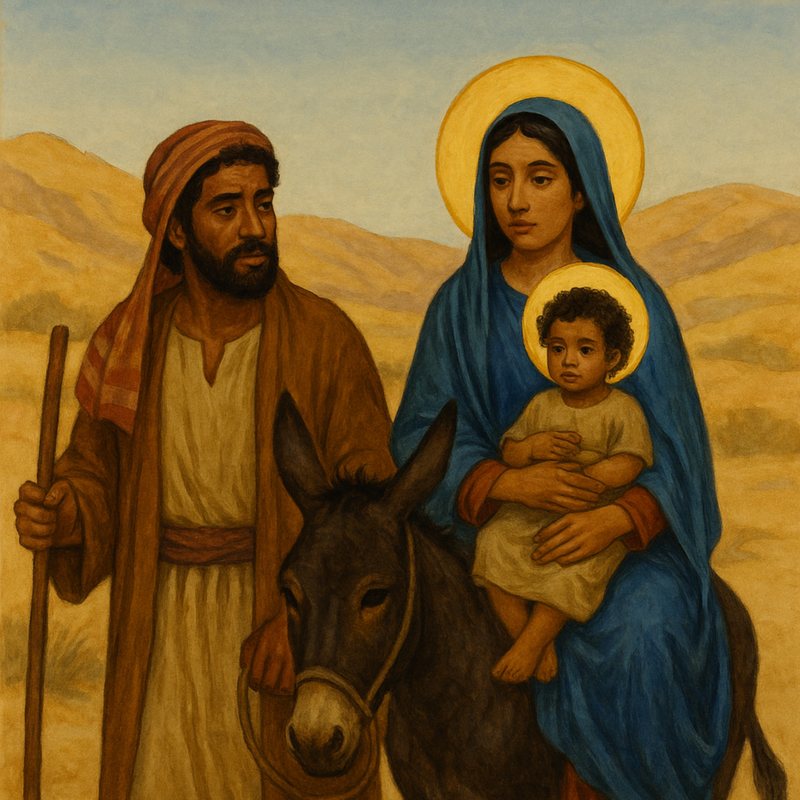
Read the full transcript (9,230 words, machine made)
Welcome back to the Deep Dive. Our mission here is, well, it's pretty simple. We take a stack of dense sources, strip away all the noise, and really pull out the insights that help you get better informed. And today we are taking on one of history's most familiar stories. I mean a story that almost everyone knows on some level. Absolutely the flight of Jesus, Mary and Joseph. It's such a powerful narrative, isn't it? It resonates across cultures and it's been interpreted in, gosh, countless ways theologically, morally, and, and especially in recent years, politically and.
That political interpretation is really our starting point for this deep dive. It's become very common. You see it in rhetoric all the time to label the Holy Family as refugees or migrants. It's a very powerful analogy. It is because it creates this immediate, visceral connection to contemporary global crises, makes an ancient story feel intensely relevant to today. But is it accurate?
And that's the question we're here to explore. Our deep dive is going to analyze the historical, the geographical, and what we could call the legal realities of the early 1st century Roman world. Our whole goal is just clarity and precision because if we apply a modern term like refugee, which is, you know, a very specific legal category that was only formalized in the 20th century, we risk committing a major historical. Error. Exactly. We're imposing our current political vocabulary onto a world that simply did not have the corresponding administrative structures.
It's like trying to explain e-mail to a Roman senator. The framework just isn't there. OK, let's unpack this then, because what you're saying is we're dealing with a system that's completely alien to our modern understanding. Completely. We're talking about a world with no nation states, no, you know, internationally policed borders, no established asylum law. None of it.
So if those foundational elements of our modern world are missing, then applying modern legal labels seems, well, it seems not just inaccurate, but maybe even misleading about what their journey was actually like. Precisely, We have to set the stage, we need to understand the geopolitical reality of the Eastern Mediterranean around the time of Jesus birth, which historians, you know, generally date somewhere between 6:00 and 4:00 BC. OK. And the sources are very clear on this. The entire region was politically unified under the overarching power of Rome. So step one for the listener is to just mentally erase the modern map of the Middle East.
Throw it out. And instead picture 1 enormous multi jurisdictional administration. Absolutely. Now let's get specific and look at the two territories involved in the story. First, Judea, their starting point.
Judea was not an independent state. This is critical. It was what we call a client Kingdom and it was ruled by Herod the Great. A client Kingdom. So what does that mean in practical terms? It means that while Herod was called a King Rex in Latin, his authority was completely derived from and subject to the Roman Emperor.
He governed at Rome's discretion. So he's like a local strongman has been given a crown, but his job description is ultimately written in Rome. That's a great way to put it. His power was immense events on a local level. He could tax, he could build massive projects. And critically for this story, he had the power of life and death.
He could execute people. But that power was fundamentally contingent. Always his client status meant that, you know, while he had this huge amount of autonomy over internal affairs, his legitimacy, his very position, depended on his loyalty to Rome. So leaving Herod's territory didn't mean you were escaping Roman control. Not at all. It just meant moving to a different Roman jurisdiction. You were still in the system.
You couldn't escape Roman identity or Roman control. OK, so that's Judea. What about the destination Egypt? Egypt had a completely different administrative setup, which is just as important to understand. Egypt was conquered much earlier, back in 30 BC, and it was so strategically vital they often called it the granary of Rome because of its immense grain supply that it was treated as something special. It wasn't just another province.
No, it wasn't administered by the Roman Senate, which was typical for many provinces. Instead, it was designated as the personal demand of the Emperor himself. The Emperor's personal property. Essentially, yes. Yeah. And it was governed by a man who wasn't a senator. An appointee called a prefect or a prefect is a gypti. So moving to Egypt wasn't just moving to a different region, it was moving into a territory under the emperor is direct, immediate control.
And specifically because of its economic and strategic value. That's the key difference. Herod had some local legal and cultural flexibility in his Kingdom. The prefect in Egypt, on the other hand, was a military and economic viceroy. His main job was to ensure the uninterrupted flow of grain to Rome.
So the implication of this whole setup is huge. Moving from Herod's client Kingdom in Judea to the emperor's personal province in Egypt, It was a relocation within the boundaries of a single, unified imperial power. That's the core of it. It's basically an internal transfer. It's almost like moving from a state with its own specific local laws to a federally administered district like Washington DC or something.
That analogy helps a lot. It wasn't crossing a recognized national boundary in any way that would trigger our modern concepts of international law or visas or border controls designed to stop people from a foreign country. OK, so the administrative stage is set. We have one empire, two different governing styles within it. Now let's look at the actual movements. And I think we need to start with the first one, the one in Luke's gospel, which often gets mixed up with the flight itself. Yes, the journey to Bethlehem.
This is so crucial for getting our definitions clear, isn't? It absolutely. The journey to Bethlehem was not migration. It wasn't driven by fear or economic opportunity or anything like that. The text says it was about one thing.
Compliance. It was about compliance with a bureaucratic mandate ordered by Roman authority, a census. The famous census of Corinius. Now, we should probably mention that the historicity of that specific census is well, it's hotly debated by scholars. It is mainly about the timing.
Luke places it around Jesus birth, but the historical census of Corinius in Judea is usually dated to around six AD, which would be after Herod's death. But for our purposes here, that debate is almost secondary. It is. What matters is the underlying reality that the text is portraying, which is an Imperial administration frustrative act. So whether the census was dated precisely or whether Luke was using the idea to frame his narrative, the purpose of the journey was internal travel for bureaucratic reasons and most importantly for taxation. The sources are clear.
This was mandatory travel. So the family was traveling to be counted and taxed, all under the Roman system. This movement fits entirely within the normal mandated functions of the Imperial administration. Exactly. Census movements were a common, if very burdensome, part of life in the Roman world.
There's nothing in the text that suggests this travel involved crossing into foreign territory or seeking a new political identity or changing their legal status. It was just a mandatory journey. It fits none of our modern categories of refugee or even voluntary immigrant. The administrative nature of it defines it. It does. OK, I have to push back a little here though, because while the Bethlehem journey was bureaucratic, the flight to Egypt was clearly driven by terror. No question.
I mean, even if they stayed within the Roman Empire, their motive was fear of violence, so doesn't that fear, regardless of borders surely align with the moral reality of the modern term refugee? That is a necessary challenge, and it gets to the heart of why this is so complex. We have to separate the moral truth from the historical legal category. OK, So yes, the motivation for the flight to Egypt, which we write about in Matthew's Gospel, was acute danger. They were fleeing Herod's intent to kill infants. The family was absolutely fleeing persecution. That is the moral truth.
But the crucial distinction remains the legal mechanism that was available to them, or more accurately, the complete lack of 1. So tell us more about the practical mechanics of this How did a Carpenter, his wife, and a newborn baby actually move across 2 significant jurisdictions without any formal paperwork? This is where we need to talk about something called the ISIS Gentium, which was a kind of law of nations used within the Roman framework. It governed relations between Romans and non Romans and it generally facilitated internal movement. So Roman policy actually encouraged travel. To a degree, yes.
Travel for trade, for commerce, for settlement across the Mediterranean, it was all essential for maintaining the Pax Romana. Great Roman peace. Exactly. So for a subject moving between, say, Julia and Egypt, both under Roman control, there were no official customs posts demanding passports or visas like we have today. The travel was essentially open, but, and this is a big but, that freedom was often conditional.
Conditional what? Well, conditional on safety, money and patronage, travel was expensive, it was slow, and it could be very dangerous because of bandits on the roads or pirates at sea. Right? So if you were a subject, particularly a Jew, there were established Jewish diaspora communities all across the Empire, You would have to rely on that existing network. You'd need letters of introduction from a local patron or a religious leader to make sure you'd be welcomed and have shelter when you arrive arrived in a place like Alexandria.
And Alexandria had a massive, well established Jewish population at the time. Huge. One of the largest in the world. So their safety when they arrived in Egypt wasn't guaranteed by some formal asylum process, but by leveraging existing community and family ties? Yes, and by the general freedom of movement that the Roman Empire itself guaranteed.
Exactly right. Egypt offered a different governing authority, the prefect, who was physically and politically distant from Herod, that provided the necessary physical safety, but it did not offer a different national legal category. It was, as we said, relocation within Empire. So if we connect this to the bigger picture, the modern refugee definition requires fleeing persecution from one sovereign entity to seek protection from a completely different sovereign entity. Yes, that's the key. And what's so fascinating here is a complete absence of that crucial political mechanism.
The family fled a local ruler, Herod, but they fled into the wider administrative territory of the very same empire that authorized that local ruler in the first place. The overarching power structure remained constant. There was no international law for them to appeal to. There was no second sovereign state that could grant them asylum against the first. Their movement was a lateral shift in jurisdiction, not an escape across international lines. Which brings us squarely to Section 2, this whole problem of anachronism.
It really seems like we're trying to transpose a 20th century legal framework onto a 1st century imperial reality just because the moral weight of the story is so compelling. And that is precisely the historians challenge. Applying modern terminology imposes our contemporary, non equivalent concepts onto these ancient systems. Anachronism, even when it's well-intentioned, just obscures history. It doesn't clarify it.
Let's actually list those specific modern frameworks that were fundamentally missing in the 1st century, because I think seeing the list is essential to really understanding the distinction. The lack of these frameworks is the foundation of the entire argument. So the 1st century simply did not possess national passports. You need a nation state to issue a passport. Right. No nation state, no passport.
It didn't have immigration quotas, which are designed to regulate the flow of non citizens, and it didn't have formalized codified deportation procedures as instruments of international law. And, most relevantly for this discussion, the entire apparatus of asylum adjudication was missing. Completely the systems where a sovereign nation or an international body assesses a claim for protection against the claimant's home government that just didn't exist. Those concepts are so much more recent. They post date the event by centuries the modern state system with its defined impermeable boundaries and the international treaty apparatus that governs refugee status that only really started to come together with the Treaty of Westphalia in the 17th century.
And it didn't really reach his full legal maturity until after World War 2. With the 1951 Refugee Convention, exactly that convention is the cornerstone. That's where the formal legal definition of refugee that we use today comes from, isn't it? It is The convention was designed specifically to address the unprecedented displacement and statelessness that was caused by two world wars and the political upheavals that followed. It defines A refugee as someone who is outside their country of nationality or habitual residence.
Outside their country. Yes, and who is unable or unwilling to return because of a well founded fear of being persecuted? So if they never left the boundaries of their habitual residents, which was the Roman Empire, they cannot technically meet the foundational criteria of the modern definition. Correct. While they certainly fled danger, the legal category of refugee is not historically or legally transferable to their status within the Roman imperial system.
They lacked the necessary external sovereign entity to recognize and protect them against their own sovereign entity, because at the end of the day, Rome was ultimately both. OK, let's dedicate some serious time here to just dissecting the specific terms, because the way language is used rhetorically today just collapses these really critical differences. We have to. I mean, the distinction between these terms is crucial for intellectual integrity. So let's start again with refugee. We've established it's a modern legal category. Yes, a legal status formalized in the mid 20th century. It requires recognition by a receiving state or an international body, and that recognition grants specific rights and protections.
Many, many displaced people throughout history who fled persecution were never refugees in this sense, because no sovereign entity recognized their status under these terms. OK, Next up, the word flight. Flight is purely descriptive. It's just the act of departing specifically to escape danger. That danger could be a local crime, a natural disaster, or state violence. Mary, Joseph, and Jesus definitely undertook flight. This is the morally true and historically accurate descriptive term.
And how's that different from exile? Exile usually implies a degree of political or communal coercion. It describes a removal or departure from a homeland, often for ideological or punitive reasons. Think of the great historical exiles of the Jewish people, like the Babylonian exile. So it's often a mass event. It often is, and while the family's departure was involuntary and driven by political violence, the scale and the very individualized nature of their flight makes it slightly distinct from those mass state mandated exiles. Got it.
And what about migration? Migration is the most general term of all. It just describes movement. It's often for economic or environmental reasons, and it doesn't inherently imply danger or coercion. A Roman merchant moving to Alexandria for Better Business is a migrant. A person fleeing localized violence is also technically a migrant, but the term lacks the specificity we really need for this historical analysis.
OK, finally, let's tackle asylum. You said earlier that formal asylum didn't exist, but surely there were ancient forms of sanctuary or protection they could seek out? That's a crucial point, and we have to elaborate here. While the modern legal mechanism of asylum, which presumes a receiving state capable of legally protecting A foreigner against their home state, did not exist, ancient societies absolutely had concepts of sanctuary and protection. So what did those ancient forms of protection look like? Well, they often relied on the religious law or local patronage.
For instance, seeking sanctuary often meant literally fleeing to a temple or a sacred precinct. Ah, so it's religious protection, not a state one. Exactly. It was not state granted asylum, it was temporary protection granted by religious custom or priestly authority. And that protection often ended the moment the local authorities decided it was time for you to leave.
So if Joseph and Mary entered Egypt, they weren't walking into a government office and filling out a form to seek state protection from Herod. Not at all. They were relying on physical distance, the fact that Egypt's prefect operated independently of Herod and, crucially, the shelter provided by that thriving Jewish community in Alexandria. Precisely. They were leveraging the pre-existing stability and infrastructure of the Jewish diaspora community, all within the Roman system. The move was successful not because a legal mechanism offered them asylum, but simply because the local authorities in Egypt had no reason or motivation to cooperate with Herod's localized political purge. It was a bureaucratic transfer, not a legal status change. And if we connect this to the bigger picture, this distinction matters because when we use precise language, we preserve the unique moral and historical challenges that ancient people actually face.
We avoid giving historical weight to modern institutions that just weren't part of their reality. We avoid confusing a moral imperative. The family was in danger and needed safety with a specific legal definition that is entirely anachronistic and requires a completely different geopolitical setup. OK, let's pivot now to Section 3, because even if we set aside all the technical legal points, the narrative context itself, the actual story as it's recorded in Matthew, it diverges from a typical historical or political flight in a really crucial way. It does.
And this is the supernatural dimension. Here's where it gets really interesting. The biblical narrative frames this entire episode not as a generalized political upheaval, you know, a collective response to some social injustice. It's framed as a direct, divinely guided response to a very specific, localized threat. Right. The family didn't react to rumors spreading across the country or to a political decree that was posted in Town Square. No, the sources highlight that the entire chain of events was precipitated and guided by supernatural revelation. Herod's actions are driven by his own paranoia and his response to a prophetic claim, the arrival of the Magi signaling a future king.
And Joseph's decision making. It's entirely dictated by angelic guidance delivered in a dream. An Angel tells him where to go and just as importantly, when to return. Which makes this flight unique, doesn't it? Joseph's actions are dictated by personal obedience to a perceived divine command.
He's not petitioning A bureaucrat or making it administrative decision or even taking counsel from his community. That is the defining characteristic of the story. You contrast this with historical precedents for political exile, like the mass flight of Jews after the destruction of the Second Temple in 70 AD. In that case, safety depended on community coordination, on strategic negotiation with Roman legions on mass flight paths. Joseph's flight is hyper individual. He didn't consult a map to find the safest route. He followed a divine instruction to go to Egypt and stay there until he received a second, equally divine instruction. Exactly.
The source material is really pointing out that this was not a generalized ethnic flight or some kind of population level displacement. The danger was incredibly specific. It was targeting one child, Jesus. The warning was personal, it was given to Joseph and the instructions were directed to a single household. This really forces us to think about the theological precedent here.
If the family's safety relied on divine intervention, how does that change our understanding of protection in a world that didn't have state codified asylum? It changes everything. It suggests that in the absence of formalized state mechanisms for protection, safety reverts to other things, individual obedience, local relationships, or divine will. The narrative implicitly positions God as the provider of safe passage, overriding all the political and geographical constraints. And Matthew's Gospel is very explicit about this, isn't it?
He frames the flight and the return as the fulfillment of prophecy. Yes, out of Egypt, I called my son. The narrative's main function isn't just historical reporting on migration patterns, it's a theological assertion about the identity of this child. So it's both. It's a historical account of events, but it's also a theological commentary on.
Them it is by emphasizing divine instruction, the narrative becomes less about the politics of displacement and more about destiny and the fulfillment of scripture. Joseph wasn't seeking asylum, he was executing a divine travel plan that was designed to circumvent Herod's malice. OK, let's move on to the scale of the event, which is equally important in contextualizing why this was not a refugee crisis as we understand the term today. Modern crises involve mass demographic shifts. And the scale of this event is often dramatically inflated in modern rhetoric.
When we discuss modern refugee crises, we are often talking about millions of displaced people spilling across multiple national borders. 1st century Judea simply did not have the population density to support that kind of displacement. Can you give us some demographic estimates just to ground us in the reality of the time? Well, estimates vary, of course, but the entire population of Judea and Galilee combined was likely in the hundreds of thousands, not millions. Jerusalem itself was densely populated for an ancient city, but Bethlehem, the site of the massacre, was a minuscule settlement. It probably only housed a few 1000 people at most. So the massacre of the innocents, while horrific and absolutely a state sponsored crime, would have impacted a very unlimited, very local population. Precisely.
If we accept the historicity of the event, the number of infants killed would have been relatively small, reflecting the size of the village. The source material emphasizes that this was not a nation scale demographic displacement event. It was a highly localized atrocity that resulted in an individualized flight for safety. And this context of scale is so vital, it allows us to view the event with the gravity it deserves. It was a terrible act of localized political violence without distorting it into an analogy for a 21st century mass migration crisis. It allows us to maintain the moral clarity of Herod's brutality without sacrificing historical and demographic accuracy.
The Holy Family's journey, therefore, was a singular, divinely directed internal relocation for personal safety, impacting a small community. Which brings us to our final section, the implications and final thoughts. Why does this precision matter so much? I mean, if the moral lesson is the same, that we should show compassion to those fleeing violence, why spend all this time correcting the terminology? It matters because historical accuracy is paramount. This discussion is emphatically not meant to diminish the severity of Harrah's actions or the very real danger that Mary and Joseph faced.
The moral imperative to offer welcome and aid to those fleeing violence remains incredibly powerful. But the goal is linguistic integrity. Yes, the goal is to maintain precision in our historical language. When we apply modern legal frameworks, we inadvertently project the institutional conflicts of the 20th and 21st centuries, things like nation states, border conflicts, international law, onto an ancient context where those conditions just didn't exist. Historical language must reflect the operational reality of the time being discussed, not our current political reality.
So what does this all mean for the listener who's trying to grasp the legal and identity context of the time? Can you give us a final synthesis of the travel reality in the Roman Empire? I think we can synthesize it into a few key takeaways. First, the absence of modern state controls meant that travel was generally open and free between provinces and client kingdoms. Within the Roman sphere. This was facilitated by that concept of Ekis gentium. Second, movement was primarily restricted by practical factors, the cost of travel, safety from brigands, and the need for reliable local patronage or letters of introduction to secure lodging.
It wasn't restricted by national borders or international immigration statutes. And most definitively, the entire movement from the mandatory census journey to the flight to Egypt was an internal relocation within the Roman imperial structure. That is the ultimate legal summary. They moved from a Roman client Kingdom to an imperial Roman province. They never ceased being subjects within the Pax Romana.
Their identity remained constant, and their ultimate legal authority, Caesar, remained exactly the same. We've established this strong clear distinction between the theological or moral interpretation of the flight and the legal and historical reality of the relocation. We've broken down the missing frameworks and the necessity of precision. So now it's time for our final provocative thought for the listener. OK, building on the narrative's reliance on specific divine instruction, the angelic dream, rather than on political negotiation or communal flight, we want to propose this question for you to think about. If the movement was purely theological and internal to 1 overarching empire, how does the narrative specific choice to emphasize divine command change how we understand the nature of protection and safety in the ancient world? It seems to suggest that where state mechanisms were localized and unreliable, as Herod's power clearly was, safety wasn't found in some higher legal authority because that didn't exist. It was found in an appeal to a supernatural one. It forces us to consider that in the absence of formalized international mechanisms like asylum, safety was viewed as entirely dependent on factors outside the political sphere, individual obedience, local community consent, or divine intervention.
So the story of the flight to Egypt is maybe less a statement about migration law. And more a profound exploration of how destiny and protection operate when the rule of law is imperfect, localized, and easily corrupted by client kings. A fascinating way to contextualize the entire story, not as a contemporary political statement, but as a statement about faith and survival within a specific, massive, ancient structure. Thank you for guiding us through this incredibly detailed and precise deep dive. It's always a pleasure to help uncover the historical facts that are sometimes hidden beneath modern interpretation.
We encourage you to reflect on how often modern frameworks can distort ancient realities and to always seek that historical precision. To the debate, we'll catch you on the Today we're focusing on, well, one of the most culturally significant and I think often contested passages in the New Testament, the count of Jesus, Mary, and Joseph's flight to Egypt as it's documented in the Gospel of Matthew. And it's a foundational narrative of displacement, which is really why it holds such resonance for us today. Absolutely. The the historical fact of their movement out of Judea to escape Herod's violence isn't really in dispute. However, in our contemporary discourse, this movement is almost universally characterized using modern legal and political terminology, specifically words like refugee or migrant. And that is precisely where the substantive disagreement lies, isn't it?
The application of these contemporary labels to ancient events introduces an immense legal and historical anachronism. Correct. So the central question we have to address today is this is the application of modern legal terminology such as refugee to the Holy Family's relocation historically and well, legally appropriate given the political realities of the 1st century Roman Empire. My position on this is quite clear. The movement was strictly an internal relocation within a unified Roman imperial system, and therefore modern refugee terminology is fundamentally incompatible with the historical context.
And I would say I accept the historical and legal limits of the ancient system. I mean, no one is arguing for 20th century asylum courts in four BC. However, I argue that focusing solely on that legal precision obscures the the substantive reality of their situation. They were engaged in a life or death flight from targeted state violence. So the rhetorical use of refugee or, you know, related terms, it attempts to capture that political and moral severity, a severity that transcends the technical definition of a modern border.
OK, so to understand why the term refugee fails, we really must first establish the political geography. My core argument is rooted in this idea of the unity of the Roman world, the relocation from Judea to Egypt. It occurred entirely within the administrative boundaries of a single imperial power. Let's let's just clarify the jurisdictions involved. Judea at this time was a client Kingdom ruled by Herod the Great, and a client king was, well, highly autonomous domestically, but absolutely subordinate to Rome's strategic and foreign policy goals.
Which is a key distinction. It is, yes, but the distinction doesn't create an international border. And crucially, Egypt was not another client Kingdom or some independent entity. It had been a Roman imperial province since the defeat of Cleopatra and 30 BC. It was governed directly by a Roman prefect acting explicitly on behalf of the emperor, and was treated essentially as Rome's bread basket, a vital piece of internal infrastructure. So therefore, when Joseph moved his family, they were simply traveling between two different administrative subdivisions of the same supreme governing authority. Travel between these two zones, a client Kingdom and a province. It just did not involve crossing a foreign national border, because that concept, as defined by modern international law, simply did not exist.
There was no mechanism for granting asylum from one sovereign nation to another. The family retained their identity and their legal category as subjects of the Roman Empire, merely moving from Herod's jurisdiction to the provincial jurisdiction of the prefect in Egypt. For safety. This is internal relocation. Full stop. I grant you every point on the administrative structure I do. I agree that classifying them as having achieved refugee status, which is a creation of post World War 2 international legal conventions, is historically indefensible. But the question is whether historical accuracy should always trump moral and political clarity. I mean, focusing solely on the lack of a modern legal status ignores the terror of the substantive reality they were fleeing State sanctioned violence, the execution of infants ordered by a head of state. You know, the source material itself gives us a critical intellectual tool here, the distinction between the modern legal status of refugee and the historical reality of flight, which is simply departure to escape immediate danger without any need for legal recognition.
The family was engaged in flight driven by a very specific, personalized and lethal threat. And the fact that the entire Roman Empire was technically a single space for movement, that actually illustrates the lack of agency the family had. When they moved for the census in Luke, it was because of a Roman mandate. When they fled in Matthew, it was to escape a local Roman client ruler. The political severity of the coercion is undeniable, and that political severity is what modern terminology, however legally and accurate, is trying to capture.
I see why you emphasize the moral imperative of flight. I do. But let me give you a different perspective on why that definitional precision is so necessary. The modern term refugee isn't just descriptive, it's prescriptive. It's tied to the 1951 Refugee Convention and it requires formal recognition, non refuelment, protection, and often resettlement. The failure to use precise language, choosing refugee over, say, political exiles or maybe those in flight. It imposes A contemporary bureaucratic infrastructure onto the ancient world.
When listeners hear refugee, they immediately conjure images of border checkpoints, asylum applications, immigration quotas and, you know, perhaps even debates over deportation. This fundamentally misrepresents how people moved and were governed under Roman power. No 1st century person, no matter how dire their situation, could appeal to an external sovereign entity for refugee status. By insisting on this inaccurate term, we commit a serious categorical error that prevents us from truly analyzing the unique mechanisms of Roman administration and the relative power of client kings like Herod. Of the legal infrastructure.
But I would argue that intellectual rigor does not require us to abandon the rhetorical power of the term entirely, especially when it clarifies the nature of the oppression we are debating. Labels, yes, but those labels resonate because they speak to a timeless human experience of displacement due to state tyranny. And consider the distinction between Herod, the client king, and the Roman prefect in Egypt. Herod had the executive latitude to engage in personalized, localized acts of mass murder. As the narrative describes, While he was technically a Roman subject, his power allowed him to act as an unconstrained tyrant in his territory. So moving out of Judea was moving away from that specific form of power.
The moral resonance of refugee captures this vulnerability. They were powerless subjects fleeing a governing body that sought their extermination. Should we really privilege the technical administrative boundary over the life or death situation it represented? We must, because the nuance of that administrative boundary is exactly what made their journey successful. And that brings us to contention too, the significance of the political geography.
You correctly point out that they withdrew from Herod's specific lethal jurisdiction. But this functional distinction, it has to be kept within its proper legal container. Look Roman subjects throughout the empire, whether they were merchants, officials, or laborers, they had the legal right to travel widely for safety, commerce, or trade without needing visas or border admissions. The fact that moving from Judea to Egypt offered safety actually proves my point. It demonstrates the unity of the imperial legal system and its administrative stability despite local variation in governance. They were moving from one part of the Roman world that had a localized problem, Herod's paranoia, to another part that did not.
They never changed their fundamental legal identity. Now, if they had fled to the Parthian Empire, Rome's great rival across the Euphrates, then we would be discussing international asylum. But moving 400 miles within the Roman dominion makes them, by historical standards, internally displaced persons, not international refugees. I'm not convinced by that line of reasoning, because it minimizes the practical difference between a client Kingdom and a province. A client king like Herod possessed far greater, often unchecked power over life and death than a direct Roman provincial governor or prefect who was beholden to centralized bureaucratic oversight and, you know, the emperor's political calculus.
So while you're right that they retain their abstract identity as Roman subjects, practically speaking, the administrative boundary between Herod's domain and the prefect's domain in Egypt functioned as a boundary of lethal risk. The appendix confirms that Herod's power to execute unilaterally was limited by his territory. Crossing into Egypt meant entering A jurisdiction where the local ruler was not personally invested in the infant's death. The fact that the flight worked is evidence that the boundary, though technically internal to Rome, was functionally external to that specific zone of mortal danger. The misleading part is equating a subject's abstract Roman identity with the practical lack of protection from localized tyranny.
That brings us to a crucial element that distinguishes this narrative from, well, from virtually all historical examples of flight, and that is contention 3 the role of the supernatural and the specificity of the danger. Most historical patterns of flight involve generalized ethnic persecution, mass population displacement, or organized political resistance seeking collective asylum. The biblical narrative is unique because the entire event, the necessity of the flight, the timing, the destination, it was all precipitated and guided by supernatural revelation. An Angel warns Joseph in a dream, and the motivation is explicitly linked to Messianic prophecy. This element fundamentally removes the event from the standard human paradigm of seeking asylum or political refuge. They weren't petitioning a foreign state for protection, they were following a divine private strategy for protection directed to a single household.
This reinforces the idea of a targeted withdrawal planned not by human political actors, but by a higher power, which further isolates it from the category of refugee status, which inherently requires human political negotiation. I come at it from a different way when assessing the impact of that theological dimension. Because regardless of the mechanism of the warning, whether Joseph receives a dream or obtained high level political intelligence from a spy, the result is identical in political terms. Flight from an act of state ordered murder. The theological context dictates the why of the escape, sure.
But the political. Context dictates the ACT. Carrot's reaction, the massacre of the innocents, was a purely political response to a perceived dynastic threat. The state treated the flight as a political threat requiring a violent, repressive response. The fact that God intervened to give the warning does not negate the political reality of the displacement, nor does it diminish the tyranny they were resisting. To suggest the supernatural guidance somehow makes their flight less real or less severe than if they had fled based on a rumor is, well, it's to confuse theology with political science. But it's not about severity, it's about category. If they were seeking asylum in the modern sense, they would be engaging with the structures of the receiving state. Their divine guidance meant they didn't need to ask permission or fill out paperwork, or rely on the charity or policy of the Egyptian prefect.
They simply went relying on the administrative openness of the Roman system. So to use refugee, a term steeped in the bureaucratic complexity of international law, it just undermines the singularity of this divinely guided withdrawal. It was a strategic movement to evade a single localized threat, not a plea for collective protection. But the core vulnerability remains the same. We must not allow legal definitions to over shadow the human and political stakes, to classify this journey merely as internal relocation for safety, which is something a Roman tax collector or merchant might do routinely. It fails to capture the gravity.
Failure to relocate meant the execution of a child. We have to be able to use language that communicates both the cold administrative fact internal Roman movement and the burning political reality flight from imminent murder. When we use the term refugee rhetorically, we are speaking to the second, more profound reality. And that rhetorical application, while powerful, sacrifices precision. If we broaden the definition of refugee to encompass any historical flight from state danger, regardless of international borders or legal status, the term loses all specific meaning.
It ceases to be an academic category, and it becomes merely a synonym for any victim of tyranny, past or present. While that's understandable in modern moral discourse, this blurring is catastrophic for historical analysis. I disagree that it's catastrophic. I think it is. Perhaps clarifying it forces us to ask what is the true function of classifying displacement?
Is it to satisfy the requirements of 20th century treaties? Or is it to understand the enduring phenomenon of the marginalized fleeing state violence? It has to be both. We owe the historical figures the respect of describing their political environment accurately. And we owe the narrative the respect of acknowledging the existential reality of the danger they faced.
Conclusion Our discussion today really centers on this tension between historical precision and moral resonance. I must reiterate the paramount importance of maintaining precision in historical language. The movement of Jesus, Mary, and Joseph was strictly defined by the realities of the Roman imperial system. It was relocation within the administrative boundaries of a unified empire. Therefore, regardless of the unique and undeniable seriousness of Herod's threat, we cannot retroactively and accurately label them with 20th century legal terminology like refugee.
Doing so sacrifices critical historical and legal context for the convenience of modern political language. They were internally displaced persons fleeing localized state violence, and acknowledging that detail allows us to understand the unique reach and structure of Roman power. And I affirm the technical accuracy of the Roman political structure and the lack of a modern international border. That is the legal frame. But I have to insist that the substantive reality of fleeing immediate, targeted violence is the essential component of the Matthew narrative, and it can't be dismissed by a hyper focus on legal anachronism.
We must recognize the category of flight from danger, a desperate move predicated on avoiding state execution. While refugee is legally inaccurate, it speaks to the moral condition of people seeking safety under duress, a condition that transcends geography. Complexity often requires multiple perspectives to fully appreciate the context, weighing the legal facts against the moral weight of the displacement. Indeed, and examining the source material through the lens of both strict legal definitions and contemporary rhetorical framing, I think it deepens our understanding not only of 1st century mobility, but also of how our modern political language shapes our view of history. Right. The legal facts speak to the lack of modern infrastructure, while the narrative speaks to the timeless immediate reality of political violence and the vulnerability of the powerless. A critical distinction and one that continues to demand careful consideration.
Welcome to the Thank you for joining us. This week we're looking at excerpts from Jesus. Mary and Joseph were Not Refugees. Right. And the peace argues that the Holy Family's flight to Egypt was an internal relocation inside the Roman Empire, not a modern refugee situation.
It's a very rigorous argument. Let's get right into it. The material makes a really strong case for historical precision. Absolutely. It highlights that 1st century Judea and Egypt were both, you know, firmly within the Roman sphere.
So there's no foreign border crossing. Exactly. And no modern asylum law to speak of. The historical foundation is impeccable, really. It is.
The research is just so solid on that point. But, and this is where I think we can push it, there's a big opportunity to maximize the impact, to really answer the So what question. OK, the material effectively establishes historical precision, but its current conclusion could maximize impact by more deeply exploring the contemporary implication and stakes of the terminological correction. Right, you're talking about Section 7, Why this distinction matters. I am. The weakness is that it's just, it's too short right now. It leans very heavily on the academic need for precision. You know, avoiding anachronism.
And that risks it being seen as just a semantic point. Exactly. A purely academic exercise. It doesn't really grapple with the fact that the word refugee today carries enormous political and emotional weight. The argument stops just short of explaining why it's so vital we protect that terms legal boundaries for, well, for modern humanitarian reasons. I see the potential trap there.
I mean, if you spend 5 sections building this incredibly detailed historical case, you have to defend why those details matter now. Right. But doesn't that risk diluting the focus the author so clearly wants to stay anchored in the 1st century? I get that, and the goal isn't to inject a bunch of modern politics into it. Not at all.
OK. The goal is to show the ethical and the legal cost of being lazy with our terms. So my suggestion is to reframe that final section Section 7 to really bridge that gap. Between the ancient history and the modern use of the word yes. To show what we actually lose when this hard won legal category of refugee, which you know was formalized after World War 2 for a very specific reasons, gets stretched too thin.
So how do you make that actionable? How do you do that without the paper suddenly becoming, I don't know, a policy proposal? You focus on legal integrity. For instance, the author could expand on how misusing the term refugee inadvertently diminishes the specific protections that are codified in international law. OK, explain that a bit more. Well, the term was created to protect someone who has to cross an international border because their own state can't or won't protect them, right?
If any dangerous journey throughout history gets labeled A refugee situation, the term loses its legal sharpness. It loses its focus on that very specific crisis at a national border. I see. That's a powerful shift. It's not just about correcting a historical mistake, it's about protecting a modern legal tool.
Precisely. It turns the argument into something that protects the most vulnerable people today. I remember the material defines other terms too, Flight, exile, migration. It does, and that's the way forward. The author could use those.
Yes, use their own precise terms to offer a better model for talking about displacement. Today show that the Holy Family situation is much closer to what the author calls flight escaping danger, but without the legal implications. And then you contrast that with a legally defined modern refugee crisis. Exactly. It operationalizes their scholarship.
It goes from you're wrong to use this word to here's a better, more accurate word, and here's why using the right word matters. So it provides a clean alternative. It answers that reader's question of OK, So what? It does. It turns a historical correction into a really useful tool for ethical and precise language. OK, that's a fantastic point.
It really raises the stakes for the conclusion. Let's shift gears a bit. Let's look at the structure, specifically section 6. The. Supernatural dimension. Yes, it's a fascinating point, the author notes. The flight was guided by, you know, a dream, an Angel. It was a supernatural revelation. A brilliant observation, truly.
And the argument is that this makes the flight unique. It was personal, not some kind of community wide bureaucratic process. It is a great insight, but it feels structurally isolated. How? So. The distinct analysis of the narrative supernatural dimension provides a powerful counterpoint to political readings, but structurally it feels isolated and interrupts the logical flow of the historical legal analysis. I mean you have 5 sections of really grounded empirical argument, administration, Roman law, terminology, and then suddenly boom section 6 is all about angels and dreams and then it goes back to the historical argument in the conclusion. Right.
It's a jarring pivot. It risks, you know, pulling the reader out of that rigorous historical mindset. It feels a bit like an appendix that got dropped into the middle of the paper. I can see the interruption. Yeah, but isn't that point so strong, so unique, that it deserves its own spotlight? I worry if it's integrated too early it might make the whole thing sound more like a theological paper. That's the challenge, but the goal is to make it serve the historical argument, not stand apart from it. So what's the suggestion?
My suggestion is to integrate it much earlier, use it not as a theological point to be debated, but is very specific evidence of the, well, the extreme specificity of the event. To reinforce the main thesis. Exactly to reinforce that this wasn't some generalized mass displacement. So you're saying fold the theological detail back into the historical context? Let's get concrete.
You can move this idea into to say Section 4 on the anachronism problem, and you explicitly connect the supernatural guidance to the nature of the threat. The danger wasn't famine or war, it was highly specific. Herod wanting to kill infants in one town, Bethlehem, because of a prophecy. The warning was personal to Joseph. And the escape was an act of individual obedience. It's a surgical threat and a surgical response. That's a great distinction, and you can contrast that with a mass displacement.
Right. The author even notes that Herod's actions were shaped by prophecy and Joseph's by a divine warning. So the whole conflict is driven by these non political, non administrative forces. Which further separates it from a typical case for political asylum. Yes.
By integrating it, you strengthen the entire architecture of the paper. You show that every single detail of the story argues against the modern refugee label. So it's no longer a stand alone point about angels. No, it becomes a point about the singularity of the threat driven by sources completely outside Rome's bureaucracy. That really tightens the focus.
I like that it. Keeps the momentum going right into the conclusion. OK. So we've talked about the stakes and the structure. Let's go back to the core historical frame.
The whole argument really hangs on the fact that Judea and Egypt were both managed by Rome. The family was just moving from a client Kingdom to an imperial province. That is the cornerstone, no doubt, but while the peace does an amazing job detailing what the Holy Family was not. Not refugees, not crossing national borders. It stopped short of really defining what they were.
Interesting. While the material meticulously details what the Holy Family was, not refugees, strengthening the argument requires explicitly defining what their legal and social status was as movers within the specific context of the Roman imperial system. The weakness is that it relies so much on negation. Not this, not that, right? It correctly says Roman subjects traveled all over the empire, but it doesn't fully exploit the specific details of their move from a client Kingdom, Judea, to a full Roman province, Egypt.
It could be bolstered with more positive terminology. Exactly. Give us the historical term for what they were doing instead of just rejecting the modern one. So the suggestion is to take all those great details from the appendix and the main body and use them to assign an active historical identity to their movement. Yes, cement them firmly with the known Roman administrative practices. I mean, think about the nuance there. They're moving from Herod's client rule to a province run directly by a Roman prefect.
That's a huge distinction that needs to be hit harder. It is. So what would the practical implications of that be for a 1st century person? Well, primarily security and predictability. OK, in a client Kingdom, your safety depends on the whims of a local ruler. And in this case, that's Herod, who's famously paranoid, right? By moving to an imperial province like Egypt, they step under the direct administration of Rome. They're under a system that was, at least in theory, much more predictable.
They weren't seeking asylum from a hostile foreign power. No, they were seeking A safer administrative jurisdiction within the same imperial power. That makes the argument so much more robust. It uses the very structure of the Roman system to explain the move, and I remember the appendix mentioned that travel was only really restricted by cost and safety. That detail is vital.
It needs to be in the main body. You think so? Absolutely. Use it to show their movement was actually facilitated by Roman infrastructure. Their problem was local safety Herod, not some imperial legal barrier. Their ability to move was a feature of the Empire, not a bug.
So since the whole paper is about terminological precision, the ultimate actionable step here is to provide a better term. Yes, you have to fill the vacuum you create by rejecting refugee. So you assign a label that captures all this complexity. You have to. I'd suggest something precise like internal imperial relocation. Internal imperial relocation.
That's strong. It's formal. Or maybe Roman subjects in localized flight from client tyranny, Something like that. I like internal imperial relocation. It immediately shifts the focus.
It's not about what the argument is against, it's about what the argument establishes. And it forces the reader to engage with that historical complexity because you've given them this robust affirmative label to use instead. It just beautifully operationalizes the entire critique. By asserting a positive historical identity for them, the author achieves both historical accuracy and protects the modern definition of a refugee. Exactly.
This is an exceptionally strong piece of work. These adjustments are really just about making sure it's argument lands with maximum clarity. Let's do a quick summary of the three main refinements first. Maximize the significance, expand that conclusion, connect the historical precision directly to why it matters today, and show the tangible stakes. Right, and use the author's own definition of flight as a constructive alternative. 2nd, we focused on structure.
We recommended strategically integrating that unique supernatural dimension, the Angel, the dream, much earlier in the flow. Using it as specialized evidence against a generalized displacement rather than leaving it as a standalone theological point. Finally, we talked about deepening the historical definition, moving beyond what they weren't, to define what their movement actually was within the Roman system. And adopting a strong affirmative counter term like internal imperial relocation. The death of expertise here is just so clear. It really is.
These enhancements are aimed at perfecting the communication of a crucial historical insight and giving your argument the powerful conclusion it deserves. We invite you to implement these suggestions and submit your revised material back to the. Historical status of the Holy Family's journey. So the sources we're looking at really question whether we should call Jesus, Mary and Joseph refugees. The main point is that it's historically inaccurate.
Because we're kind of pushing our modern legal ideas back onto the ancient world. OK, first take away. Their journey from Judea to Egypt was basically an internal move. I mean, think about it. Both places were under Roman control, so they weren't crossing a. Foreign border like we would today. It was all one big system and Roman subjects could travel pretty freely, no visas needed.
Second, that word refugee itself is a huge anachronism. It's a legal term from the 20th century to find after World War 2. It implies concepts like nation States and asylum processes, which just weren't a thing in the 1st century. So while they were absolutely fleeing danger, that specific label doesn't really fit. And finally, the reason for their flight was pretty unique.
The biblical story says it was a direct supernatural warning. An Angel told Joseph in a dream. This makes it really different from, say, a whole community being displaced. It was a specific instruction for one single family. So the key distinction here is that the Holy Family's flight was a movement for safety within one empire, which is fundamentally different from our modern legal concept of crossing international borders to seek asylum.