
The People Who Fill The Vacuum: Why Power Never Leaves A Space Empty

Episode 439 of 455 · · 6:19
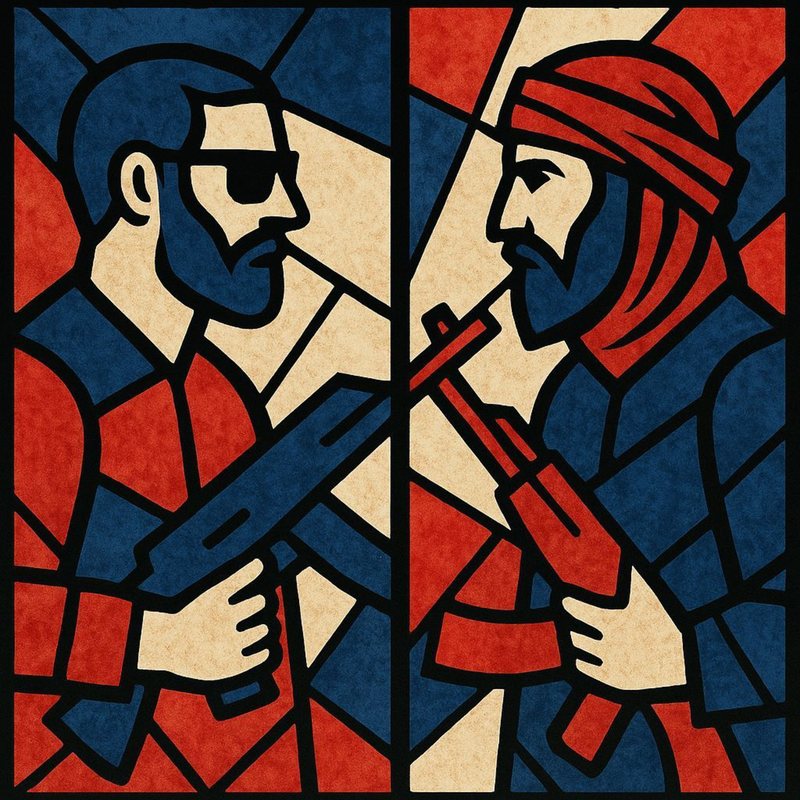
Stained glass style art of two armed bearded men, one in sunglasses and one in a red turban, in red, white and blue.

Play this episode on Spotify, or subscribe: Apple Podcasts · Overcast · Pocket Casts · RSS

Share: X · Facebook · LinkedIn · Reddit · Bluesky · Threads · Email ·

When governments fail — slowly, suddenly, or simply enough to be noticed — power doesn’t evaporate. Power reallocates. The world abhors a vacuum, and politics is physics with human consequences. Somewhere between the speeches and the streets, between the slogan and the morgue, new systems emerge to do what the old system can’t or won’t. They collect debts. They settle disputes. They hand out punishment, protection, and paychecks. They build their own justice without courts and their own economies without banks. They step in because someone must.

In this episode, we explore the phenomenon most people pretend not to see: the rise of parallel governance — the cartels, gangs, militias, and movements that become de facto institutions where the real institutions have failed their stress test. To outsiders these groups are criminals, extremists, terrorists. To insiders they are the only available infrastructure. The labels flip depending on where you stand and what you need. It’s easy to condemn until your cousin gets sick and the man with the envelope is the only one with cash. It’s easy to moralize until you have no job, no security, and the dangerous path is the only one paved.

The modern state calls itself the monopoly on legitimate force, but legitimacy is not a crown — it’s a lease. It must be renewed constantly through competence, fairness, and presence. When the state becomes distant, bureaucratic, condescending, corrupt, or simply indifferent, the legitimacy clock runs out. Into that expiration gap walk the people with guns, money, charisma, or enough audacity to organize chaos into hierarchy. That’s not an endorsement — it’s an observation.

From Bogotá to Baltimore, Kandahar to Chicago, the pattern repeats with maddening consistency. There are three layers: the official government that claims authority, the shadow structure that exercises it, and the outside force that interferes with both — whether that force arrives as peacekeepers, cartel networks, federal task forces, insurgents, or investment capital. Everyone has an angle. No one is neutral. And the people in the middle adapt because survival is non-negotiable.

What makes this conversation more volatile today is speed — narrative speed, technological speed, economic speed. Once upon a time power shifted in whispers and generational drift. Now it shifts in news cycles. A drone strike can redraw a local hierarchy overnight. A video of police brutality can flip a neighborhood’s allegiance before lunchtime. A cartel’s public works project — a road, a playground, a clinic — can secure loyalty faster than an election promises paperwork will. Democracy asks for patience; desperation has none.

We also confront the uncomfortable symmetry: the state and its rivals look more alike than either side will admit. Both collect taxes — one calls them taxes, the other calls them “protection.” Both administer justice — one through courts, the other through threats. Both recruit — one with scholarships and slogans, the other with cash and certainty. Both bury their dead and swear they died for something bigger. And both rely on stories to explain why they are necessary and why the other side is dangerous.

This is not moral equivalence. It’s moral realism. Violence isn’t random. It’s bureaucratic. It’s political. It’s economic. When an F-35 drops a precision bomb, when a cartel assassin leaves a message on a bridge, when a SWAT team raids a rowhouse, when a militia posts its manifesto — those are all forms of messaging. Force is just the punctuation. The sentence is power.

The paradox is simple and brutal: the state sees itself as the answer; the people filling the vacuum see themselves as the alternative. Each side claims to be solving a problem; each side claims the other is the problem. They are both right and both wrong — because the problem is bigger than labels and older than flags.

Transcript

Read the full transcript (1,150 words, machine made)

So today we're going to unpack a really powerful way of looking at conflict and control. You know how it actually works on the ground. The source material for this explainer calls it the three layers of power. Let's get into it. You've heard this line a million times, right? People love to drop it into a conversation. It makes them sound smart, like they're seeing both sides of a really complex issue.

But let's be honest, most of the time, it's just a way to shut down the conversation without anyone having to question what they already believe. But what if we stop treating it like some cynical conversation ending cliche? What if we actually took it literally? The argument here is that if you do that, the whole hidden structure of power just clicks into place. It shows you that legitimacy isn't some moral absolute, It's something that's constantly being fought over, negotiated, often with force. So yeah, let's use this cliche not as a dead end, but as a key. A key that might just unlock the very architecture of power itself.

OK, think about the War on Terror. The people America was fighting were technically speaking, civilians, right? They didn't wear state sanctioned uniforms, they didn't belong to a national army. They got called all sorts of things. Insurgents, extremists, narco terrorists.

And who was hunting them? The most professional, best equipped state funded soldiers in the world. This whole thing shows you a really weird asymmetry. Terrorism gets defined as civilians killing other civilians. But counterterrorism, while that ends up looking a lot like professional soldiers killing civilians who are fighting back like soldiers.

And the words, the words we use to describe all this are absolutely crucial. They aren't just descriptions, they're weapons. I mean, just look at the contrast when they commit an act of violence. It's terrorism. It's insurgency extremism.

But when we do something that is the exact same outcome, well, that's a precision strike. That was a necessity. It was justified. The result might be identical, but the label we stick on it does a complete 180, depending on who's responsible. The source material just nails it with this line. Language acts like a filter.

It sorts all the violence into these neat little boxes. Good violence, bad violence, so that we don't have to look in the mirror and see the uncomfortable reflection of our own action. So all of this brings us to the main event, the central idea of this explainer. Drawing on observations from places like Iraq, we can start to see power working on three different layers all at the same time. First, you've got layer one.

This is the official state, the government ministries, the national police, the flag you see on buildings, it's the power you see on TV. But underneath that there's layer 2, the parallel authority. These are the real local power brokers, the sheiks, the gang leaders, the smugglers, the guys whose phone call can get things done faster than any official decree. And then you have layer 3, the external power, the occupiers, the coalition forces, maybe even peacekeepers. And the crucial thing to get here is that these layers don't just sit on top of each other.

They're all there at once, constantly crashing into each other, fighting for control. And this is exactly where things get so explosive when an external power. That's Layer 3 comes in and kicks the legs out from under the official state. Layer one. It doesn't create stability, it creates a vacuum, a power vacuum, and that empty space. It's the perfect opportunity for those parallel authorities in Layer 2 to rise up and make a grab for real power. Now you might be thinking, OK, this makes sense for a war zone overseas, but what if that same structure, that same geometry of power is happening right here at home? Let's take this idea from Baghdad and see what it looks like in a city like Chicago.

See, the argument is that America talks about its own inner cities with the exact same language it uses for foreign conflict zones, as if they're these far off alien places instead of a totally predictable outcome of how power is structured. And when you actually map it out, the parallel is, well, it's pretty startling. In a major American city, Layer one is the mayor's office and the city police force. Layer 3 is the federal government, the DEA, the FBI, Homeland Security, And Layer 2, while that's the parallel authority of the street gangs, the crews, the shot callers who actually control what happens on a given block. It's the same three layer game, just with different players. So why do these layer two groups, whether it's militias or cartels or street gangs, why do they even exist? It's pretty simple, really.

They provide governance where the official state can't or won't. They offer jobs, a sense of structure protection. They become, as the source puts it, gods of small things. They're the ones you go to for help with rent or a hospital bill, or to get revenge. They act like a government, but they operate with the raw brutality of a business. And this is where the whole model gets really uncomfortable because if you follow it to its logical conclusion, it messes with our deep seated need to have clear heroes and villains. Just think about it.

The official state claims the exclusive right to use violence, it collects taxes, and it gets to define who is and who isn't a criminal. Now look at a cartel or any other powerful layer two group. It uses violence, it collects taxes through extortion, and it definitely defines its own enemies. The functions are shockingly similar. The only real difference is 1 has official permission and the other doesn't.

This leads to a really profound and kind of heartbreaking human truth. Both sides mourn their dead with the exact same sense of conviction. Both sides truly believe they were fighting for their own people, for what was right. The grief rhymes because the belief behind it rhymes too. And that's what this all boils down to, really. All our abstract labels, terrorist, soldier, extremist, patriot, they all just dissolve into a very real, very human price.

A precision strike sounds clean and surgical from thousands of feet up, but on the ground it's just a suddenly violently empty chair at a family's dinner table. Which leaves us with a final, and pretty unsettling question. If every single side is absolutely convinced of its own righteousness, then who actually gets to draw the line between the hero and the villain? And what does it mean if that line isn't drawn by morality at all, but just by who has the most power?