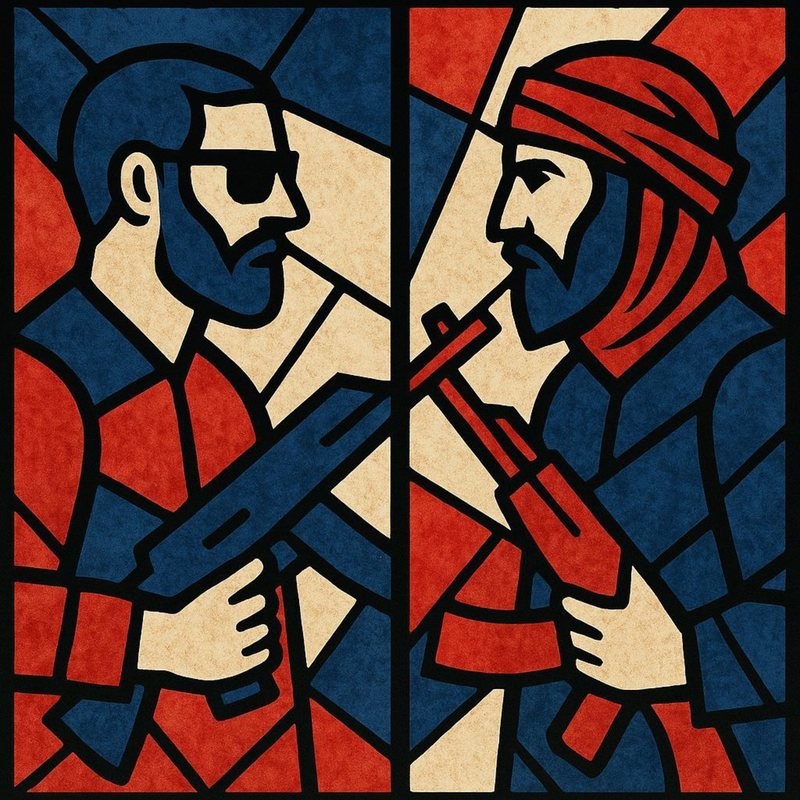
Read the full transcript (25,517 words, machine made)
You know, there's that saying, the one that gets pulled out in basically any conversation about conflict. Oh, I know exactly which one you mean. We've all used it. Yeah, one man's freedom fighter is another man's terrorist. Exactly.
And it's it's sort of the perfect conversation under, isn't it? It's this neat little philosophical shrug. It lets us acknowledge that things are complicated and then, you know, just move on without getting our hands dirty. Right. It's a weighted gesture and moral ambiguity.
But the the stack of sources we've been digging into for this deep dive, they make a really provocative argument. They say it's not just some clever paradox. No, not at all. They call it a blunt operational truth. A blunt operational truth.
And what they mean by that is that the phrase doesn't just describe a feeling or a point of view. It actually reveals the literal visible architecture of how power works, how it's won, how it's lost, and how it's maintained. And I think that's really our mission for you today. We're going to try and unpack that architecture. We're stepping away from the comfortable moral certainties and looking at material that suggests legitimacy isn't some fixed heavenly category.
Yeah, negotiated. It's totally negotiated. It's a high stakes negotiation and the currency isn't abstract morality, it's practical things. It's hunger, it's humiliation, it's the need for vengeance, and maybe most importantly, it's just pure, raw opportunity. So the core idea right from the jump is that if you stop looking at legitimacy as this absolute good versus evil thing and start seeing it as a, well, a practical contest for loyalty and resources.
Then the whole geometry of power just snaps into focus. You can see it clearly. And the sources warn us, seeing that geometry, really seeing it can be, and I'm quoting here, deeply uncomfortable. It is because it's messy. It forces you to look at governance itself as something transactional. The sources are pretty clear.
When a formal government fails to provide for its people, whether that's through corruption or just incompetence, a vacuum is created. And something always fills a vacuum. Always. And the things that fill it, they almost always involve 2 key ingredients, cash and guns. So our goal today is to analyze how that vacuum gets filled and, crucially, how language is used to either, you know, sanitize or demonize whoever steps in to fill it. OK, so let's get into that.
Let's unpack this architectural analysis using the example the material offers up as the simplest but also the most volatile. The most radioactive one? Yeah. The global War on Terror, it really does bring all these definitions into sharp relief. It's the perfect starting point because when you look at conflicts like Iraq or Afghanistan through this particular lens, all of our standard comfortable definitions like combatant and civilian, they just immediately start to destabilize. They really do.
I mean, the analysis we reviewed makes this one observation that is so stark you really have to just stop and sit with it for a second. Says that by the strict legal definitions of warfare, you know the Geneva Conventions, rules about state uniforms, ranks, formal armies. The rules of the game, so to speak. Exactly. By those rules, every single person America and its allies killed in that war was technically a civilian. And that's a statement that just sounds wrong on 1st hearing, doesn't it?
But it demands you look closer. We're so conditioned to think of war as state versus state to armies in different colored uniforms meeting on a field. Right, but that's not what this was. You had individuals who for a whole spectrum of reasons, ideology, desperation, money, revenge, chose to pick up a weapon. They chose to, yeah. They weren't conscripted into the Iraqi National Army. They were, you know, farmers, shopkeepers, engineers who joined a faction.
They joined something else, and you can see the intervening powers struggling with what do you even call them? Are they insurgents, Extremists, Foreign fighters? Militia. Narco terrorists. The label kept shifting. But their fundamental status didn't. They were non state actors.
They were operating completely outside the traditional framework of recognized nation state armies. And here's the other side of that coin, the chilling distinction the source material makes the people sent to kill them. Yeah, they were the complete opposite. They weren't civilians at all. They were the most professional, state sanctioned, highly trained killers that the modern world has ever produced.
We're talking JSOC teams, Navy Seals, Delta Force, Marine Raiders, the British S, S and SBS. And you have to include the drone crews, people sitting in a container in Nevada operating with the full legal backing and protection of a superpower state. So you have these professional state soldiers, paid and protected by their governments, sent to hunt and kill people who are by definition, civilians. Civilians who lack any of those state protections, but whom the state has conveniently relabeled as enemy combatants to, you know, make the whole thing legally possible. And that right there is the anatomy of modern conflict. When you strip it down to its operational parts, it's not 2 armies fighting, it's one very powerful state army facing what the analysis calls a distributed ecology of grievance, ideology, desperation and opportunity.
That's such a great phrase, an ecology of grievance. It is because it's not a monolith. It's a multi headed, decentralized, constantly shifting reaction to a catastrophic failure of local governance. Which brings us to the role of language. Because you can't fight in ecology with traditional military terms, so you have to invent new ones. Language itself becomes a tool, a weapon even. It becomes a tool of categorization. The sources call it language triage. Language triage.
I like that. Yeah, it's the idea that violence is sorted and labeled based on one simple metric. Who is wielding it and whose interests does it serve? So it's not about the ACT itself, it's about the actor. Precisely. And I think it's worth walking through the examples they give because it makes the mechanism so clear. If we can for just a moment step back from the gut level moral reaction and just look at the raw action and the label that are recognized, layer one authority would apply to it. OK, let's do it.
Scenario 1A Civilian walks into a crowded market and detonates a bomb. The intent is to kill other civilians for a political cause. The label is immediate, it's universal. That is terrorism, no debate. The ACT is civilian on civilian violence.
OK. Now same person, different scenario. He doesn't go to the market. Instead, he takes a rifle and fires at a foreign military patrol that's rolling through his neighborhood. A patrol that, let's say, just last week, bulldozed his cousin's farm to clear a line of sight.
Suddenly the language shifts. The state aligned media, the military press briefings don't call it terrorism anymore. Now it's insurgency, maybe rebellion. The ACT is still a civilian attacking people with guns, but the target has changed. The target has changed, and the motive is now framed as grievance, not just pure ideology. It's seen as an attempt to fight a state actor, not terrorize a population.
The label changes the moral weight of the ACT. And it gets even messier, right? Way messier. OK, so picture a group of local guys. They set up an illegal checkpoint on a key smuggling Rd. They've got guns and they're forcing every truck that passes to pay a tax.
So armed robbery, extortion. Well, it depends. If that checkpoint is, say, Prime, disrupting A rival smuggling group that happens to be an enemy of the new Layer 1 government, then the state might just look the other way. So they tolerate. It they might even quietly support it. And in the official reports it gets called militia activity. It's framed as a sort of local self policing initiative, a tolerable parallel authority.
But if that same checkpoint starts taxing, say, government supply convoys or harassing officials loyal to the capital? The label flips overnight, instantly. It's no longer militia activity. Now it's extremist violence. It's an organized criminal enterprise.
The underlying action, illegal taxation enforced by the barrel of a gun, is identical, but its relationship to the state's interest determines its name. And then there's the state's own violence, the final piece of the triage. Right when the state or its layer three foreign ally wants to kill one specific person in a house and to do that they drop a £500 guided bomb on that house knowing it's full of his family and neighbors. That's never called violence against civilians, even when that's the literal outcome. Never. It's sanitized.
It's called a precision strike. It's framed as a military necessity. The civilian deaths are always always described as regrettable but justified. So the whole point of this language triage, as the source argues, is to manage our moral dissonance, the public's dissonance. Exactly.
It's for us, the consumers of the conflict narrative. The language creates a comfortable distance. It allows us to see their violence as barbaric and ours as clinical. It's a tool that lets the state avoid, as the quote goes, witnessing our own reflection in the brutality of it all. It's a way to maintain the state's moral monopoly. That's it.
It's a tool for power projection. And it explains why these cycles of violence just keep going. Because when you strip away the labels, you see it's not a fight between good and evil. It's an ongoing, brutal competition between competing authorities. Which leads us directly into the core framework of this whole analysis. The reason that reflection is so hard to escape. The three layers of power.
This is the geometry. It's the key to understanding what happens when governance fails, not just in war zones but, as we'll see, everywhere. And this isn't some abstract political science theory. The sources say this framework came directly from people on the ground, soldiers, diplomats, journalists observing places like Iraq or Somalia, places that were existing on three completely different operational realities all at the same time. Right.
It's a way to make sense of the chaos. So let's break them down. We can start with the one that's most visible to the outside world. Layer one, the official state. This is the one we all recognize. It's the face of the country, the ministries in the Capitol, the police in their official uniforms, the central bank printing the currency.
It's the national anthem, the flag flying over the presidential palace, the official forms you have to fill out to get a permit. It's the authority that has a seat at the United Nations. It's the official story of who is in charge. But in a lot of these places, that official story, it's just that it's actual power might not extend beyond the capitals. Ring Rd.
And that's a crucial point for the average person living in a remote province or even a neglected urban neighborhood. Their daily life, their actual survival, is determined by a completely different set of rules and a different set of rulers. Which brings us to the second layer. Layer 2, the parallel authority. This is the power structure that actually governs the street.
This is the reality of day-to-day life. We're talking the powerful tribal shakes, the influential local clerics, the old families who've controlled the water rights or the food smuggling routes for generations. It's the people who actually get things done. Exactly. They deal in immediate practical needs. If your son gets unjustly arrested, you don't go to the corrupt Layer 1 courthouse, you go to the local Sheikh. If you need to move goods safely through a dangerous area, you pay the local warlord their phone call. Their word matters infinitely more than some stamped piece of paper from a ministry official you'll never meet. And this layer is often ancient.
It existed long before the current government, and it'll probably exist long after. It's deeply rooted in the culture and the economy of the place. And then, particularly in the last few decades, you have a third massive force that crashes into this dynamic. Layer 3, the foreign power. The external force This could be a coalition of invading armies, UN peacekeepers, a swarm of international Ng OS, or even just the intelligence agencies of a powerful neighboring country.
And your view of this layer is entirely transactional, isn't it? Depends on what they mean for you personally. Completely. Are they the ones handing out lucrative reconstruction contracts and paying salaries in U.S. dollars?
Or are they the ones conducting night raids, kicking down doors and leaving you to write eulogies for your family members? They can be a source of immense opportunity or immense grief, often at the same time. The key here, and what the sources stress, is that these three layers don't exist separately. They're all operating in the same space at the same time. It's this constant, violent, shifting triangulation of power.
And that framework is the only way to understand the absolute payouts that follows a major foreign intervention, because layer 3 doesn't just show up and neatly replace layer one. It shatters the whole ecosystem. It completely destabilizes the existing, even if it was brutal and dysfunctional, equilibrium between all three layers. And this is where that idea of the power vacuum comes in, when a superpower, a layer 3 actor, decides to just knock the legs out from under an existing layer one regime, say by invading and removing a dictator. The headline back home is tyrant toppled.
Freedom reigns. But the operational reality on the ground, as the sources put it, is the creation of a massive, power rich vacuum. And nature abhors a vacuum, but politics abhors it even more. And as we said, vacuums draw opportunists. The removal of the central layer One authority does something incredibly profound.
It unleashes layer 2. All those local power Breakers, the tribal leaders, the smuggling bosses, the clerics who are kept in check by the dictator's secret police, suddenly the boot is off their neck. And they're free to reconfigure their ambitions. They can expand. They can compete.
The competition that follows is this, this frantic, violent scramble for power, the sources say. It's basically driven by three distinct types of people who rush into that. Vacuum. OK, what are they? First you have the remnants of the old regime, the generals, the ministers, the party loyalists who lost everything. They are fighting desperately to reclaim their lost power. They often become the leaders of the initial insurgency fighting for restoration.
Then you have the second group. The opportunists. These are the people who were always on the fringes of power under the old regime, the rival tribe, the exiled political opponents, the ambitious local governor who always wanted more. They see the chaos as their one big chance to finally grab The Maine prize. And the third group.
This one sounds like the most unpredictable. They're the wild cunt, the most dangerous. These are the men who, under the old stable order, never in a million years imagined they could hold real power. But now, with the old rules gone, they see a path. These are the people willing to take.
And I'm quoting insane risks for a shot at the top. Because they have nothing to lose. Nothing to lose and everything to gain. Their ambition is what often fuels the most radical, most brutal factions. And this chaotic, free for all is the moment of creation. It's where the new labels are forged. How you come out of that scrum determines what history calls you.
Exactly. If your faction wins the street fight in a key city, you might consolidate enough power to become part of the new layer 1. You become the new police chief, the new mayor. If you lose and die, you become a martyr to your cause. And if you lose, the political fight. But keep your guns and your followers. You become the villain, the terrorist, the criminal that the new victorious layer one can now point to as the source of all the problems.
It's a deeply cynical but operationally very clear interpretation of how states are born from violence. The difference between a founding father and a terrorist leader in that moment can come down to who won the first few battles and who got to print the official letterhead. What's really, I think, unsettling about this three layer model is how, well, how portable it is. Once you see that geometry in a place like Baghdad or Kabul, you can't Unsee it. You start to recognize the same dynamic playing out in places we would never ever call a conflict zone. That's the leap the sources make, and it's a powerful one. They argue that in America, for example, we tend to talk about our most challenged urban environments, what the media often calls inner cities, almost exclusively in terms of moral failure.
It's a problem of culture or character or individual choices. That's the standard narrative. Right. But if you apply this three layer lens, the picture changes completely. You start to see these areas not as moral failures, but as, and this is a great quote, predictable byproducts of neglected demand and concentrated opportunity. It's a structural problem, not just a moral 1. So let's try to do that.
Let's map this geometry onto an American city, say parts of Chicago or Baltimore, or any major city with deeply entrenched poverty and a history of state neglect. The mapping is shockingly clean. Let's start with layer one. The official government. That's easy.
It's the mayor giving a press conference. The City Council, The police commissioner, The official court system, The school board. It's the state's monopoly on power, at least on paper. But in many of these neighborhoods, that layer one authority is thin. It's present, but it's not always seen as legitimate or effective. The police reviewed with suspicion city services are slow or non existent.
Which just like in a failed state, creates it's a vacuum, and that vacuum is filled by layer 2, the parallel authority. And in this context, that means what? The gangs. It's the gangs, it's the powerful neighborhood crews, it's the shot callers who control the local drug trade. It's the informal power structures that actually provide order and aversion of justice where layer one has failed. They're the ones who really determine how the street operates, who gets to sell on which corner, who provides security for local businesses, whose cousin gets a job as a lookout.
They have a system. It's a violent one, but it's a system of order. It is, and then you have the external force layer 3, the federal layer. So the FBI? The DEA.
Exactly. The DEA, the FBI, ATF, Homeland Security, These federal agencies that roll into the city with heavy tactical gear, often operating with a mandate from Washington DC, not from the local City Hall. They come in to disrupt the local ecosystem. And just like a foreign intervention, their arrival can be incredibly destabilizing. They might take out a major Layer 2 leader, a powerful gang boss, but they don't fix the underlying conditions. Not at all.
They don't fix the poverty or the lack of jobs that created the vacuum in the 1st place. So a new, often younger and more violent Layer 2 actor just rises up to take the old one's place. The source material uses this lens to look at a really hot button political issue, sanctuary cities. Right, which is something we usually debate in purely moral or political terms. The rhetoric is always about compassion, about resisting federal overreach, about local sovereignty. It's a political and a moral statement. But if you look at it structurally, operationally, a city declaring itself a sanctuary is a layer one authority making a very clear statement about who gets to police.
It's layer 2. They're saying we'll handle this, not you. They're saying we, the local government, believe we know how to manage this community better than you, the federal government, do. And the unspoken rationale behind that is often incredibly pragmatic. That phrase from the source.
Better are devils than your Angel. Exactly. The local police, the local mayor. They may know that certain illicit economies are part of the neighborhood survival, know which grandmother is having her rent paid by a nephew who's involved in the local crew. They understand the delicate, complicated social fabric. And they're afraid that a big blunt layer three federal raid will just tear that fabric to pieces, causing more chaos and harm than it prevents.
They know that simply decapitating layer 2 without a viable replacement doesn't create a more oral paradise, it creates a vacuum. And that core lesson applies just as much here as it does anywhere else in an American city, just like in a Middle Eastern one. That vacuum is where you find the kids with no prospects, no jobs, no hope from layer one. And that's where they strap, as the quote goes, ambition to adrenaline and just see how far they can get before they end up in prison or dead. The structural cycle is identical whether the setting is post war or just post industrial.
Overlap you're describing it leads us to what is, for me, maybe the most provocative comparison in the entire analysis. Yeah. This is the one that really challenges our categories. That the war on drugs is operationally and structurally the same kind of fight as the War on Terror. Which is a staggering claim because we are conditioned to see them as completely different things. 1 is a law enforcement problem, the other is a national security or military problem.
But the sources insist on the comparison. Why? What's the common denominator? The common denominator is that both are fights against powerful non state actors who have successfully established a form of parallel governance. They're doing the state's job.
They are thriving precisely where the formal state has failed to meet the three most basic needs of its citizens, to feed them, to protect them and to treat them with a baseline of respect and dignity. They are a response to neglected demand. And in meeting that demand, these groups, whether you call them a cartel or an insurgency, they provide structure, and in exchange for that structure, they demand loyalty, obedience and risk. They become, in the words of the source, the gods of small things in their territory. They are the ones who can actually solve your immediate life or death problems.
It's worth really spelling out what those state functions are that they provide, because this is where that line between a government and a criminal enterprise gets incredibly blurry. OK, let's list them. First, and maybe most important is financial aid, social welfare. These organizations step in to pay for rent, for a loved ones, hospital bill for bail money. They have the social safety net when the official layer one net has collapsed or was never there to begin with.
So they're the emergency loan office? They're the emergency loan office, the welfare office and the bank all rolled into one second. They provide security and a system of justice. It might be brutal eye for an eye justice, but it is swift, predictable and effective. And in a place where the official police are seen as corrupt, ineffective or an occupying force, that Layer 2 justice might feel more legitimate to the local population.
It often does. They provide neighborhood security. They provide a sense of belonging. They'll avenge wrongs done to their members. It's conditional, of course.
It's conditional on your absolute loyalty, but it's a guarantee. And the third function. Social structure and, crucially, economic opportunity. For a young person with no father figure, no Community Center and no path to a decent job, a gang or a cartel offers a fraternity. It gives them an identity, a purpose and a clear, albeit dangerous, ladder to climb for status and wealth. So they're providing everything a state is supposed to provide. Every single function, Welfare, justice, security, economic mobility, a sense of identity, But they do it, as the analysis says, with the efficiency and brutality of a business. And in a community where the legal layer one economy only offers you and I'm quoting lectures, paperwork and starvation.
The illegal economy doesn't look like a moral failure. It looks like the only ladder people are willing and able to climb. So that's how the perspective shifts from the outside. From the layer one perspective of, say, the US government, a cartel is a clear existential threat to stability in the rule of law. Absolutely a multibillion dollar criminal organization, but if you are an individual living inside that system with no other options, the definition changes. If you don't have a job, the cartel is an employer. If the police won't protect you, the cartel is your insurance policy.
If you have an idea for a small business but no bank will give you a loan, the cartel is your source of venture capital. The interest rates are just a lot. Higher and the penalties for default are final, but the function is the same, and this is what blurs the lines into that final, really uncomfortable definition from the source. One man's illegal militia is another man's Volunteer Fire Department, code enforcement and welfare office wrapped into one. Funded by cocaine, fentanyl, extortion, or ideology, the function is what commands the loyalty.
The label applied by outsiders is irrelevant to the person whose life is being saved or sustained by it. This is the point in the analysis where, as the sources themselves point out, a lot of people just get angry. Yeah, there's a real resistance to it. The idea of a functional similarity between a state and a cartel or a soldier and a terrorist, it feels like an attack on our whole moral order. It feels like sacrilege.
And why is that? What's the root of that anger? I think it's because we have a deep, deep need for moral tidiness. We want our history and our politics to be simple. We need our villains to be pure evil, you know, with the black capes and the twirling mustaches. And we need our heroes to be completely pure in both their methods and their intentions.
But real history and any honest analysis of power is just never that clean. It's never that clean, and the source material confronts this discomfort directly, using a really difficult but necessary historical example to show why this Harrow Villain binary so often fails. They bring up the Nazi regime in Germany. They do, and the point is not to excuse or mitigate anything. The moral atrocity of the Holocaust is absolute and non negotiable. We want to remember that regime only for that. But that's not the full picture of how they achieved and maintained power.
The analysis points out that the very same regime also delivered on promises that resonated deeply with millions of ordinary Germans. They restored full employment after the Great Depression. They gave a sense of profound national pride back to a population that had been utterly humiliated by the Treaty of Versailles and ruined by hyperinflation. Again, that fact isn't offered as a justification. Not at all.
It's offered as a complication. It forces us to accept that legitimacy is a complex and dangerous thing. People will support a government, even a monstrous one, for reasons that are practical, emotional and sometimes horrifying, often all at once. It complicates the idea that people only follow evil out of ignorance. It does, and it means we have to accept that Saints can be terrifying in their certainty, that sinners sometimes are the ones who feed hungry children, that heroes sometimes commit massacres to achieve a strategic goal. Freedom fighters plant bombs.
Terrorists distribute bread to win loyalty, the source says. The robes of a St. and the code of a tyrant are often cut from the same cloth. It's only victory in the passage of time that lets us neatly label which was which and the state the official layer. One has a massive vested interest in making sure those labels are clear and absolute.
It needs to insist that its own legitimacy is intrinsic, God-given, and that anyone who opposes it is inherently unjust. But if we follow the sources advice and just step back for a second, if we look at the state not morally, but purely structurally, purely by its architecture and function. You arrive at the most stunning conclusion in the entire analysis. That the state itself structurally resembles the most efficient cartel ever built. Now hold on. I have to push back on that.
That sounds like pure cynicism. I mean, a democratic state provides public schools, it builds roads, it has courts and accountability. A cartel just murders its rivals and sells drugs. Surely there's a fundamental difference. And the sources would agree there's a difference in stated mission, in ideology, and hopefully in outcome. But they insist that if you look only at the raw mechanisms of power and control, the parallels are undeniable and staggering. OK, so let's break down those parallel functions. What are the mechanisms?
1st A monopoly on violence. Both the state and a sophisticated cartel claim the exclusive right to use force within their territory to enforce their will. Any other use of force is, by their definition, illegal. OK. That's fair.
Second, mandatory revenue collection. The state calls it taxation. It takes a cut of every transaction in exchange for providing services and protection. And the cartel calls it tribute or protection money. They take their cut in exchange for providing their own version of services and protection.
And in both systems, if you refuse to pay, men with guns will eventually show up at your door. 3rd, and this is critical, both the state and the cartel are the sole arbiters of what is legal and what is criminal within their sphere of influence. The state uses its authority to give medals to its killers, calling them soldiers or police officers. And it uses that same authority to put other killers who used force without its permission in a cage for the rest of their lives, calling them criminals. So the argument, the really radical argument, is that the conflict between the state and these parallel authorities isn't a moral crusade, it's a business dispute.
It's a competition for monopoly control. The state layer one doesn't arrest a layer two shot caller because he uses violence, it arrests him because he uses unauthorized violence. It arrests him because he's running his own unauthorized tax system and because he commands a loyalty from the local population that hasn't been approved to the proper channels. It's a fight over who gets to be the sole provider of governance. And if the state actually provides the security, the jobs and the justice the people need, its position as layer one is secure.
If it doesn't, a layer 2 entity, whether it's an ideological militia or a profit driven cartel, will step in, perform those state functions, and in doing so earn a very real, very powerful operational legitimacy on the ground. It is absolutely critical that we state here, just as the source analysis does repeatedly, that this structural interpretation is not a plea for moral relativism. It's not an argument for shrugging our shoulders and saying all violence is the same. No, absolutely not. This is a cold, hard look at the architecture of power.
It's not an endorsement of any of the players because the human cost of this constant layer dance for power is it's immense. It's immediate and it's brutal. Children die in this dance. Families are shattered. Addiction hollows out entire communities. Drone strikes can erase a human body so completely that a family's grief has to imagine the bones of their loved one. Because there's nothing left to bury. The suffering is the constant, but to understand that suffering and maybe to one day have a chance of lessening it, we have to understand the mechanics that keep producing it. One man's savior is another man's tyrant. One soldiers precision strike is another family's empty chair at the kitchen table.
The outrage people feel is always real. The grief is always real. But the categories we use, terrorist, soldier, criminal, freedom fighter, martyr, those are always, always negotiated. They're defined by whoever is currently in control of the most powerful layer 1 mechanism. The semantics are always for sale, and the price is often paid in blood. This structural view just forces us to admit that the very labels we cling to for moral comfort are often just the authorized tools of power.
The sources leave us with this one final, incredibly haunting observation. It's one that ties the foreign and the domestic, the war zone and the city street all together. It's about a strange kind of symmetry. It says that a major cartel funeral with all its ceremony and a formal military memorial for a soldier killed in action. They share a strange, rhyming grief. In both ceremonies, you have a community mourning someone who they believe down to the very core of their being, died doing what was right, what was necessary for their people, for their tribe, for their family.
That absolute, unshakable conviction in their own righteousness. Yeah, it exists on all sides. Sides. And that, maybe, is the most disturbing part of this entire structure. Which brings us to the final thought.
The source material leaves us with the question we want to leave with you. Should the fact that both groups, the official state soldier and the member of the parallel authority, are so equally and fiercely convinced of their own moral righteousness, should that unsettle us more than the simple fact that they shoot at each other? It suggests that the deepest problem might not be the violence itself, but the absolute, uncompromising certainty on every side that fuels it layer by. Layer our discussion today well, it centers on the source materials, exploration of political legitimacy, power structures, and the raw, functional truth that's kind of hidden within that old cliche One man's freedom fighter is another man's terrorist. We're really exploring the unsettling idea that this is less of a paradox and more of a a structural blueprint of modern conflict. Right.
And the structure we are examining, this simultaneous existence of the state, what it calls layer one and these parallel authorities layer 2, it really forces us to rethink how political legitimacy is actually established and maybe more importantly, maintained. Absolutely. So the central question we have to address is this does the material structural analysis of power fundamentally reduce political legitimacy to a purely transactional outcome, something negotiated solely through force and opportunity? Or does the state's claim to a monopoly on authorized violence maintain some kind of crucial, non negotiable functional distinction? And I'll be arguing that despite the moral ambiguities and and the often egregious hypocrisy of state action, the successful enforcement of authorized verse unauthorized violence, that remains the defining functional mechanism of governance. And I think this mechanism creates a difference that you can't entirely reduce to just semantics or transactional outcomes.
And I'm going to argue the other side that the structural and functional overlaps revealed by this 3 layers of power model, they render those moral and legal categories inherently ambiguous. I think in this environment, legitimacy is fundamentally negotiated, it's transactional and at the end of the day it's defined by the victor who gets to write the history. OK, let's unpack the architecture then. My position really begins with this idea that the structural equivalence between layer one and layer 2 is well, it's an operational truth. I mean, when you look at the modern state at layer one, it structurally resembles what the material calls the most efficient cartel ever built. And that's not just a provocative statement, it's a functional description.
The state defines who is a soldier and who is a criminal. It claims and usually enforces a physical monopoly on violence. And crucially, it takes a cut of every single transaction. OK, I can acknowledge the state acts like a cartel, but what makes it efficient? I mean cartels extort states text. Why is that distinction merely semantic? Because the state has developed these incredibly advanced tools of extraction and enforcement that layer 2 can only dream of. It's more efficient because it can seize assets legally, it can enforce collection globally through international treaties, it prints the very currency that layer 2 transactions rely on, and it can leverage the threat of legal imprisonment for non compliance.
So these layer 2 authorities, gangs, militias, cartels, they essentially replicate the structure. They step into the vacuum left by the state and become the gods of small things. They provide protection, adjudicate disputes, manage welfare, pay rent or offer loans. These are all services that meet a genuine demand for governance. So governance is just utility then, regardless of the uniform? Precisely if the function of providing security and structure is fulfilled, whether it's by forms and fees or threats and extortion, the underlying reality is the same. Legitimacy becomes a transactional commodity based on provision.
The semantics you know who is the hero and who is the villain are, as the material says, always for sale when violence is the ultimate currency. That's a compelling, I'll admit, albeit bleak, structural reading. But the legal framework that Layer one enforces, that is the key distinction I want to focus on. We agree the analysis of modern conflict is deeply uncomfortable, but Layer 2 authorities are pursued and eliminated by Layer one not because they use force, but because they use unauthorized force and collect taxes without permission. But again, that just sounds like the strongest man getting to define the rule book after he's already won the fistfight. Well, it is the strongest force defining the rule book, yes, but that successful definition creates a necessary functional difference.
The material details the anatomical reality of modern conflict. It describes forces like the seals and the SASA, centralized professional army killing a distributed ecology of grievance. This is not a clash of equals. The power the state holds is the institutional ability to assign value and consequence to violence. They can label a guided bomb drop on a populated St. Precision necessity.
Regrettable but justified. I mean, this is a form of institutional coercion that layer 2 simply cannot replicate on a national scale. And I agree that layer 2 lacks that institutional capacity, but only because layer one is actively denying it to them, usually with overwhelming kinetic force. But the longevity of layer One's power rests on its legal infrastructure. The system defines who gets medals and who was incarcerated for life. And furthermore, if layer 2 does succeed in challenging layer one, let's say a cartel achieving some quasi state status, it almost always requires the alignment of layer 3 and that layer three.
Whether it's an external intervention like NATO, federal agencies like the DEA, or a regional proxy power, it's what validates or invalidates the legitimacy of the challengers. In the absence of that, Layer 3 validation ensures Layer 2 remains A localized existential threat to the state, but not a functional long term replacement. OK, let's delve into the anatomy of conflict, because I think this is where the state's claim distinction really reveals itself as a negotiation. The material is unflinching on this. In the Global War on Terror, many of the opponents who were killed were legally non combatants. They were civilians who chose to fight. They weren't uniformed or conscripted. They were civilians fighting soldiers. It is a devastating definition, soldiers killing civilians who act like soldiers.
It's more than devastating. It's structurally revealing. The state engages in what you could call linguistic triage, calling them insurgent, extremist or narco terrorist. This language is designed to obscure the reality that under international law, the victim was legally a civilian. The state uses these labels to create a moral distance, a justification really to avoid witnessing its own reflection.
The state, the most efficient cartel, simply defines its own unavoidable violent acts as necessary and its opponents necessary violent acts is illegal. The distinction is defined by the power of the labeler, not the inherent morality or function of the ACT itself. I agree that language is the state's most powerful tool for self justification. I absolutely do. However, the operational reality that is rooted in the state's functional claim to authority is different, and that matters profoundly for the structure. An army has a verifiable chain of command. It has rules of engagement, a national mandate, the distributed opposition.
It lacks that they are fighting to create a parallel governance and that struggle over who controls the legal apparatus of force itself. The very structure that dictates who wins medals is a functional fight, not just a semantic 1. But the legal apparatus only matters if it can fill the vacuum, and that is exactly where layer 2 governance proves its transactional legitimacy. You just have to look at the vacuum effect and destabilize. Zones like Iraq or in neglected areas within functioning states, the material frames these outcomes not as intrinsic moral failures, but as predictable byproducts of neglected demand and concentrated opportunity when layer one collapses or neglects its fundamental.
Responsibilities Layer 2 steps in. I acknowledge that the market abhors a vacuum, and layer 2 fills it with astonishing speed. Exactly. Take the example of cartels or local militias. They become the primary employers, the informal Social Security, and the venture capital source for entire populations that the legitimate economy just ignores when layer one refuses to adjudicate a land dispute or when a family needs quick money for a medical emergency.
Layer 2 is the Supreme Court and the bank. Its ruling is immediate, it's credible, and it's enforced by credible threat. This demonstrates that legitimacy is strictly transactional. Layer 2 provides provision and immediate security in exchange for loyalty and an acceptance of risk. Utility is the currency of governance.
That's a compelling analysis of utility, but I have to question the functional equivalence based on the nature of that transaction and its consequences. I agree. The illegal economy often offers the only ladder available, but layer one, for all its faults, funds its extraction. It's taxation by creating a system that theoretically provides public goods. Broadly, Layer 2 provides structure with the brutality of a business and it's funded directly by extortion by human trafficking and the wholesale distribution of destructive substances like fentanyl. But all governance is extractive, and the history of layer one is rife with brutality and destruction in the name of development.
Layer one is funded by income tax, by bonds, and historically by colonial extraction. Layer 2 is funded by illicit extraction. Both are mandatory contributions enforced by violence or the threat of it. The functional difference is 1 of scale and legality, not foundational morality. Well, I think the functional distinction lies in the negative externalities.
Layer 2's governance, rooted as it is in illicit means, it destabilizes the very community it claims to protect through addiction and perpetual violence. Furthermore, the material makes it clear that Layer one agencies, the DEA, the FBI, the military, they have the ability to cross Layer 2 boundaries and dismantle those structures. Layer 2 cannot raid the DEA. That structural asymmetry means layer one always retains the ultimate functional legal power to authorize the force used to collect those extractions and enforce its borders. Your reliance on layer one's ultimate course of capacity, though, it forces us back to the heart of this moral ambiguity. If we accept the structural equivalence of extraction, then we have to accept the complexity of historical judgment. The source material presses this point. Saints are sometimes terrifying sinners, sometimes feed children.
History is indeed profoundly untidy. We can cite the example of the regime that gassed millions but also restored employment and national pride to a shattered nation. The intent is to show that fixed, clean moral categories, they fail under rigorous historical scrutiny. Legitimacy, therefore, is fundamentally contingent. It's assigned after the fact by the victorious storyteller. If the insurgents win, they get statues and are declared freedom fighters.
If they lose, they are declared terrorists and executed. That is the definition of transactional legitimacy. The outcome dictates the morality, not the other way around. I'm not convinced by that line of reasoning, because it ignores the constraints the material itself provides. While fixed categories certainly fail, the analysis explicitly includes a disclaimer.
None of this is a plea for moral relativism or for shrugging indifference. The outrage, the grief, the palpable suffering, shattered families, the drone strikes that literally erase bodies, The widespread addiction. These remain concrete realities, regardless of what label we apply to the perpetrator. The outrage is absolutely real, but the system designed to judge that outrage is biased from the start. Yes, it is biased.
But the fact that both sides, the cartel figure and the military soldier, they both mourn someone who died believing they were doing the right thing, that should unsettle us. But it shouldn't convince us that the fundamental institutional power to authorize violence is irrelevant. The state's ability to create the system that judges those acts is the ultimate functional distinction. Our focus should be on the impact of these negotiated categories on the people who experience the real consequences. The system dictates who can legally drop the bomb and walk away with a medal, and who uses force and receives life in a maximum security cell.
That power defines the consequences. That power, however, is rooted solely in capacity and historical success, not in any inherent moral superiority. And that is the structuralist argument. Capacity defines the definition. But the architecture of Layer one allows for a stability, a scale, and a longevity that Layer 2, by its unauthorized nature and its perpetual criminal status, simply cannot sustain without constant external challenge. The state's claim to authorization is not just a narrative, it's the structural element that ensures its durability.
This has been a rigorous and I think a very necessary dissection of the source materials challenging architecture. My position remains that the functional analysis of the three layers and the structural equivalence between the state and parallel authorities. It reveals that legitimacy is fundamentally negotiated, transactional, and ultimately defined by the victor who successfully enforces their narrative. The claim to authorize violence is the state's most powerful tool of negotiation, but it is not an intrinsic, non negotiable truth. And I maintain that while states often act precisely like the most efficient cartel, the power to define that authorization, to enforce it institutionally, and to scale it nationally remains the central functional difference. Layer 1 controls the mechanism of lasting legal power, the power to give medals or maximum security, and that institutional difference keeps layer two in the status of a perpetual challenger, never a true peer.
The distinction between authorized and unauthorized force remains the most defining mechanism of modern governance. I think the enduring value of this analysis, as the source material makes clear, is that it forces this uncomfortable realization that the outrage over violence is always real and palpable. Even as the. Categories we use to define that violence, whether terrorist, freedom fighter or precision strike, are always subject to negotiation and change based on power dynamics Indeed. This discussion confirms the necessity of rigorously challenging the moral certainties that language imposes on conflict, so thank you.
We're looking at today one man's freedom fighter, another man's terrorist. Really gets into how that cliche is an operational truth, using a three layer model of power to show how legitimacy gets negotiated. It's a sharp piece. It cuts right to the bone of modern conflict and control. You know why?
Those definitions shift depending on who's holding the gun. Our job today is to help sharpen that structure and make the emotional punch land even harder. Absolutely. And looking at the model itself, I think there's a huge opportunity right away. So the material establishes this really compelling framework, the three layers of power, right?
The official state, the parallel authority, and the foreign or federal power. But the narrative would be so much stronger with a deeper look at the functional symbiosis or even the strategic tolerance between layer one and layer there too. That's the perfect place to start. That's the Nexus we need to explore. Yeah.
It is right now the framework sort of emphasizes the idea that layer 2, the parallel authority, it only steps in where layer one fails. Right. It's that nature aboors a vacuum model. The state falls apart, so the cartel or the militia steps in to manage food routes or jobs or whatever it is. And that model, it's, it's a little too neat.
It is. The weakness is that it frames the relationship purely as this failure vacuum scenario, and that just misses the intentionality. You know, it overlooks the political engineering that happens when Layer 1 isn't just helpless or collapsed, but is strategically managing its own limited resources. Exactly. So we need to introduce this element of of deliberate negotiation or calculated alliances, even between the official state and the parallel authority. Yes, we need to challenge that simple failure model and show how layer 2 authorities sometimes perform layer one functions because the state chooses to let them. It's outsourcing.
Because some of those functions are politically toxic. I mean the official state layer one, it might not want its fingerrints on controlling, say, certain supply chains or enforcing a certain kind of local brutality, but it absolutely needs the stability that those layer two groups provide. O let's get concrete on that. We need to detail some instances where layer one officials might tolerate specific smuggling bosses or or local shot callers from layer 2, right? As long as those figures, you know, guarantee a reduction in lower level St. violence, or they keep specific supply chains open, that totally changes layer one from a victim into a a calculated manager of delegated illegal power. And then from the other side, the parallel authority, whether it's a gang or a cartel, is sophisticated enough to play its part.
They do this by mimicking the very bureaucracy they're supposedly fighting against. Oh, yeah. We should expand on how they use these pseudo legal structures like enforce contracts, protection schemes, internal dispute resolution, all things that, you know, actively replicate the bureaucratic brutality of the state. It shows they're not just filling a void with chaos, they're actually replicating systems of governance, complete with penalties and enforce loyalty. It's why they stick around. And this ties so perfectly into the part about sanctuary cities. It's already a great example of layer one resisting Layer 3. The feds, sure, but we can link it explicitly to this idea of strategic tolerance.
That declaration isn't just about ethics. It's also about Layer one officials wanting to better control or leverage their existing Layer 2 structures. The piece already has has that brilliant line. Better our devils than your angels. Exactly. We just need to make sure the analysis fully supports that strategic calculus show that the state is preserving its right to manage its own parallel authority, not just, you know, protecting some abstract idea of autonomy. It makes the whole dynamic so much more unsettling and sophisticated.
It stops being a simple hierarchy and becomes this really complex negotiated web of shared power. And Speaking of unsettling that, that brings us to the weight of all these definitions. So look, the closing segment powerfully articulates this moral discomfort. You know that Saints can be terrifying, sinners can feed children. Categories are always negotiated. But integrating this thematic tension earlier will just raise the narrative stakes through the entire piece. The moral core of this thing is undeniable, and that conclusion, it hits so hard.
The problem is really one of pacing all the most visceral stuff. The drone strikes, erasing bodies, the empty chairs at the table from addiction. That line about the rhyming grief of a cartel funeral and a military memorial. It's almost all saved for the last two paragraphs. And the weakness there is that it risks making the moral ambiguity feel like a like a philosophical punchline, a deep thought at the end.
Yeah, a conclusion. Right. Instead of the core ethical challenge that should be driving the political anatomy from the very beginning, it's like we dissect the machine first, and only then do we look at the people that shoot up. We need to merge those things. We need to flip that relationship entirely.
The trauma has to inform the dissection. So the suggestion is introduce the human stakes right after you establish that initial operational truth. Those unsettling outcomes, the shattered families, the missing bones, the empty kitchen chairs, They should be used to ground abstract concepts like linguistic triage. Because the pain of that triage is never abstract, right? It's a specific missing face at a dinner table.
Always. So when the peace defines the anatomy of modern conflict, that bit about soldiers killing civilians who are acting like soldiers, we should immediately follow it up. Link the state's language. You know, precision, necessity, regrettable but justified. Link that directly to the immediate, visceral feeling of grief that makes the cost of the word itself immediate.
And that gives the whole critique an ethical pulse from start to finish. We can weave in that idea that the outrage is always real much earlier, maybe when it describes how layer 2 entities become these gods of small things, providing insurance or capital, but with much faster penalties. That's a critical connection. You're linking the transactional benefits of layer 2 directly to the moral ambiguity of why it even exists. You're showing the reader that the system is built on these heartbreaking sacrifices happening in real time, not just in the epilogue.
And that observation that a cartel funeral and a military memorial share a strange, rhyming grief instead of saving it for the end, It would be a perfect midpoint transition. Oh, that's good. Use it to bridge the global conflict analysis to the domestic application. It signals to the reader that this uncomfortable moral parody isn't just a theory. It's structural.
It's immediate. That one small structural change would make the piece so much more engaging. Because the reader is constantly confronted with the human weight of these definitions, the analysis never gets a chance to become sterile before you hit them with that emotional payoff. Which I think leads us very naturally to our third major focus, which is really about enhancing the domestic application of this model O. The piece makes this really creative leap, applying the three layer model to places like Baltimore and Chicago, but the structural parallels between layer 3 abroad, the occupiers, and layer three at home like the DEA or FBI, they could be made way more explicit and actionable. Yeah, the domestic application is strong when it's defining layer 2.
It really nails how gangs provide services, the jobs, fraternity insurance. It. Does. But the weakness is that it doesn't fully develop how the operational philosophy of the federal layer 3 structurally mirrors the destabilizing actions of the foreign layer three. It asserts the comparison between the war on drugs and the War on Terror, but the mechanism of destabilization feels a little underdeveloped on the domestic side.
Right. The foreign intervention is shown to disrupt the power balance, which frees up layer 2 to reconfigure their ambitions create vacuums. All that opportunism, yeah. We need to see that same mechanical destabilizing impact applied explicitly to federal intervention here at home. It's not just about policing, it's about structural disruption.
Exactly. So the suggestion here is to strengthen that domestic analogy, detail the specific ways federal intervention operates like a foreign power. You know, enforcing mandates from somewhere far away, destabilizing the local power balance and inadvertently empowering rival Layer 2 factions, just like the coalition did in Iraq. You know, remove one dictator, you get 10 warlords. So we need to show the operational similarities, like what are the parallels between counterterrorism tactics used globally and the deployment of tactical gear and special units by the DEA or FBI in American cities? Yes.
We should focus on how those actions are really targeting unauthorized force and unapproved loyalty, maybe even more than they're targeting a reduction in actual harm. It's about maintaining the state's monopoly on violence, even if it makes things more violent locally in the short term. And you have to elaborate on the direct consequences. What happens when the Federal Layers intervention creates a localized vacuum by taking out a layer 2 liter? It creates chaos.
It leads to intense internal conflict among, as the tech says, kids with no prospects strapping ambition to adrenaline. I mean, that's a perfect echo of what happens after a region change abroad. Show the reader that the method of intervention is what causes the chaos, regardless of the stated goal. And then finally, we should lean into the text. Powerful assertion that the state is like the most efficient cartel ever built. Give specific examples of how the federal layer 3 applies its monopoly on violence and its ability to tax without permission at home.
Things like civil forfeiture, prod federal mandates, the ability to operate totally outside of local politics. If that analogy holds, then the federal government has to be shown acting like a supremely powerful, legally sanctioned Layer 2, not just an outside police force. Connecting those dots structurally makes the comparison truly operational. It shows that whether it's the foreign layer 3IN Magdad or the federal layer 3 in Baltimore, the mechanism for control and disruption follows the same violent pattern. You replace one unapproved power structure with approved, but often just as volatile competition. This is an incredibly robust piece of writing. I mean, it tackles one of the most frustrating moral and political riddles of our time.
And the three main areas for refinement are, I think, clear and they're all interconnected. So just to recap the actionable steps here, first explicitly analyze the strategic tolerance and political engineering between the official state layer one and the parallel authority layer 2. Move beyond that simple failure vacuum model and really show the intentionality behind the outsourcing of power. 2nd Integrate that powerful moral ambiguity, that devastating human cost much earlier in the narrative. Let the visceral sticks, the missing bodies, the rhyming grief. Let that drive the structural analysis instead of just serving as the philosophical conclusion.
And 3rd, strengthen the domestic analogy. Detail the structural similarities between foreign and federal intervention Layer 3 by focusing on how federal action functionally destabilizes local power balances through that targeted external enforcement. These are really specific, actionable suggestions. They're all aimed at maximizing the impact and the internal logic of an already compelling thesis. If you implement these, the critique will shift from being a powerful observation to an unforgettable argument. We'd really encourage you to send your revised work. Back in, it gets trotted out anytime a conversation about conflict gets a little too uncomfortable. One man's freedom fighter is another man's terrorist. Exactly.
And most of the time people say with this little shrug, you know, like it's just some cynical Hallmark card wisdom we can look at and then put away. But the sources we're diving into today, they are really insistent on this point. They argue that this isn't just a paradox, it's it's a blunt operational truth about how the world actually functions. And that's our mission for this deep dive. We're going to take that saying completely seriously, because when you do, you start to see the, well, the real architecture of how power and violence are negotiated.
And we should be upfront here. It's a deeply uncomfortable thing to look at. It is because it shows you that legitimacy isn't some fixed moral thing handed down from on high. Not at all. Legitimacy is it's negotiated minute by minute.
It's hammered out by who has the biggest gun, who controls the food, who can offer revenge or opportunity, and maybe most importantly, by the stories people tell themselves about why they deserve to win. OK, let's unpack all of that. And I think we have to jump straight into the most, let's call it radioactive example in our sources. The global War on Terror. Yeah, because it immediately throws this fundamental asymmetry of modern conflict into sharp relief. And we have to start with the legal definitions. Think about all the people America targeted and killed over the last two decades.
Afghanistan. Iraq. Somalia. All over. Right. Every single person on the receiving end of a drone strike or a raid was, by a strict legal definition, a civilian. That's a strong claim.
I mean, people here insurgent, militant. So what do you mean by civilian? It means they weren't conscripted soldiers, they weren't wearing a state issued uniform or fighting under a recognized national flag. They were, you know, farmers, shopkeepers, unemployed kids who chose to join a 'cause they chose to pick up a gun. OK, so now contrast that with the other side, the force sent to hunt them. Well, these weren't farmers who decided to fight. These are the most professional, most highly specialized soldiers that modernity has ever created.
You're talking about tier one special forces. Exactly. JSOC's teams, Navy Seals, the British way. These are highly trained, state funded professionals paid by sovereign states to neutralize people those same states have labeled as threats. So the whole picture of modern war isn't to armies in clean lines, it's something else. It's what the sources call an army and a distributed ecology of grievance.
Wow. It's professional soldiers killing civilians who are acting like soldiers. And this is where the asymmetry becomes total, because the state controls the language, and language is the ultimate tool for triage. Triage is the perfect word. It's how we decide who gets moral consideration, right?
The sources really dig into how we use these words. Sort of avoid looking in the mirror. Absolutely. The label we apply is all about whose interests are being served. So if a civilian, a 20 year old kid, detonates a bomb in a market, we all immediately agree that's terrorism?
It's the highest moral condemnation possible. Right, but what if that same kid, or maybe his brother, fires a rifle out of patrol that, say, just bulldozed his uncle's farm? The label shifts. Now he's an insurgent, a fighter, maybe still a terrorist depending on the headline. See. But notice what happens when the force is reversed, when the state uses its most advanced weapon to drop a guided bomb on a house to kill one single person who joined the wrong banner.
We call that a precision strike, a necessity. Regrettable but justified. It's a linguistic sleight of hand, and the moral weight just depends on who's holding the dictionary. And to understand why that reflection keeps popping up, we have to look at the structure underneath it all. This is where the sources bring in this framework. The three layers of power.
They argue that in any contested area, these three layers are operating at the same time. OK, so let's make this concrete. The sources used post invasion Iraq as the main example. What were the layers there? OK, so layer one is the official state, the government on paper? Ministries, police, the flag, the guys giving press conferences.
Exactly. They have the official seal of approval, but in a place like Iraq after 2003, they often had very little actual power on the ground. So who did that? Must be layer 2. Layer 2, The parallel authority. This is where the real power is.
These are the men whose phone calls mattered more than any official government decree. The sheiks, The clerics. The tribal leaders, the smuggling bosses, the families who controlled the water and food routes, they were the ones who actually ran things day-to-day. And the third layer. Layer 3 is the foreign power, in this case the coalition, the occupiers.
They're the ones with the fighter jets and the big military bases. They have the ultimate firepower. And all three are there at once, all competing, sometimes colliding. Constantly, and this is where the sources get really sharp. Foreign intervention doesn't just replace layers 1 and 2.
It destabilizes them. It creates a vacuum. When the Coalition came in, they chopped the head off of layer one and sort of pushed layer 3 down. But in doing so they knocked the legs out from under layer 2. They broke the old equilibrium. And power vacuums they'd always get. Filled and not by the most noble people. It's predictable.
You get the men who just lost power trying to claw it back. You get the guys who were almost in power, the mid level operators making a grab for it. And then you get the people who never even dreamed of having power. The kids, the young men taking absolutely insane risks and the sources are so clear on this. It's all the same pool of people. Some become villains, some become the new US backed mayors and some become martyrs.
That framework, the three layers, the vacuum, once you see it, you can't Unsee it. And it's not just over there. That's the unsettling part. The sources draw this Direct Line, saying America talks about its own inner cities the way it talks about foreign conflict zones. As moral failures, failures of character or culture.
Instead of seeing them as predictable results of a layered power structure where the official state has failed. OK, so let's apply the model. Take a city like Baltimore or Chicago. Layer One. That's easy. The mayor, City Council, the police commissioner, the official government.
And layer 2, the parallel authority on the streets. This is the crucial one. It's the cruise, the gangs, the shop callers. They're the ones who really decide who gets a job, who's protected and who gets hurt for crossing a line. They run the Gray economy.
They provide the immediate security. And layer 3, the foreign power in this analogy, that would be the federal government. Precisely. The DEA, The FBI, Homeland Security. They roll in with their tactical gear to enforce federal laws, often completely ignoring the delicate, violent balance of Layer 2. Which gives a whole new meaning to something like a sanctuary city debate.
The public rhetoric is all about compassion. But structurally, it's a fight over who gets to police Layer 2. The local government is essentially telling the federal government layer three, these are our problems. We understand them better than you do. The unspoken part is better our devils than your angels.
Because if you just come in and wipe out layer 2 without replacing it with a trusted functional layer one, you don't get peace, you get another vacuum. And that's where, as the sources put it, kids with no prospects strap ambition to adrenaline. Suddenly, the war on drugs starts to look operationally identical to the War on Terror. They're fighting the same thing, non state actors who build a parallel government where the official one has failed to feed, protect or respect people. A cartel, like a militia, provides structure. It comes with obedience and risk, but it's structure. And that's where the cartel becomes this paradoxical benefactor.
I mean, to the US government, it's a massive threat. Of course. But if you're a citizen living inside that system, a cartel can be a job when there are no jobs. It can be a fraternity when you have no family. It can be your insurance, your protection.
The gods of small things, as the source material calls them. Yes, they're the ones handling rent, covering hospital bills, paying bail. They are performing the functions of the state. They just fund it with cocaine and extortion. And that ambiguity is what makes us so uncomfortable. We want our villains to be villains, full stop. We want clean lines, but the sources just demolish that idea. The summary is so powerful.
One man's illegal militia is another's Volunteer Fire Department, code enforcement and welfare office all wrapped into one. And history is full of his complication. We want to believe evil announces itself clearly. But it rarely does. The sources use that incredibly tough example of the German regime in the 30s, the same regime that built gas chambers also simultaneously restored employment and a sense of national pride to a completely broken country.
Which doesn't redeem the horror for a second. Not at all. But it complicates everything. It forces you to see that tyranny can show up promising competence, that sinners sometimes feed children, that the coat of the tyrant and the robe of the Saint are often on the same hook. And that leads us all the way back to the state itself, Layer one, if you look at it from far enough away. It starts to look structurally like the most successful cartel ever built.
It claims a monopoly on violence in the territory. And it takes a cut of every single transaction. We call it taxes. It uses force to maintain its existence. So the state arrests these parallel leaders not because they use force.
The state uses force all the time. It arrests them because they use unauthorized force, they command loyalty, and they tax without permission. It's a fight over who owns the copyright on governance. But even as we talk about this geometry of power, we have to remember the human cost. This isn't just a thought experiment. No children die, families are shattered. And the sources point out this this strange and awful symmetry that a military memorial for a soldier and a cartel funeral for a sicario share a strange, rhyming grief. The loss is just as real.
So bringing it all home, right One soldiers precision strike is another family's empty chair at the dinner table. And the categories we use, terrorist, freedom fighter, patriot, criminal, they're always up for negotiation. The semantics are for sale and blood is the currency. The most unsettling truth from all this for me isn't just that these groups are shooting at each other. No, it's something deeper. It's the fact that both groups, the state sanctioned soldier and the leader of the parallel authority, are absolutely, 100% convinced of their own righteousness. They both truly believe they are doing right by their people. That shared, unwavering conviction, that's the engine driving this whole architecture of power. And maybe the real question for you to think about is what that means for the next conflict or the next power vacuum that's already taking shape, maybe even in your own community, on defining power and legitimacy in modern conflict. You know that old saying, one man's freedom fighter is another man's terrorist?
Well, this is all about what that actually means on the ground. It shows that legitimacy isn't some fixed moral thing. It's negotiated with force and by providing what people need. So let's break down the three big takeaways. OK, first up, modern war isn't really two armies clashing. It's professional soldiers fighting armed civilians. The people haunted in the War on Terror, for example, were legally civilians who had joined non state groups. And the language is telling, right? If a civilian fighter sets off a bomb, it's terrorism. But if the state drops a guided bomb on that same person, that's called a precision strike.
Second, governance often works on three different levels all at once. And this happens everywhere from conflict zones to American cities. You've got layer one, the official state, you know, police and bureaucrats. Then there's layer 2, the parallel authority. Think gangs or sheiks, the people whose phone calls actually get things done.
And finally layer 3 is that outside power, like an occupying army or the DEA. And finally these non state actors fill the vacuum when the official state fails. I mean, if the legal economy offers you nothing but a cartel, gives you a job or pays your hospital bill, they become essential. They provide real structure. And that's why one person's narco terrorist is another's neighborhood security. The labels of villain and hero just depend on who actually delivers what you need.
The outrage is always real, but the semantics of who is a patriot and who is a criminal. A really powerful way of looking at conflict and control. You know how it actually works on the ground? The source material for this explainer calls it the Three Layers of Power. Let's get into it. You've heard this line a million times, right? People love to drop it into a conversation. It makes them sound smart, like they're seeing both sides of a really complex issue.
But let's be honest, most of the time it's just a way to shut down the conversation without anyone having to question what they already believe. But what if we stop treating it like some cynical conversation ending cliche? What if we actually took it literally? The argument here is that if you do that, the whole hidden structure of power just clicks into place. It shows you that legitimacy isn't some moral absolute, It's something that's constantly being fought over, negotiated, often with force. So yeah, let's use this cliche not as a dead end, but as a key. A key that might just unlock the very architecture of power itself.
OK, think about the War on Terror. The people America was fighting were technically speaking, civilians, right? They didn't wear state sanctioned uniforms that didn't belong to a national army. They got called all sorts of things. Insurgents, extremists, narco terrorists.
And who was hunting them? The most professional, best equipped state funded soldiers in the world. This whole thing shows you a really weird asymmetry. Terrorism gets defined as civilians killing other civilians, But counterterrorism? Well, that ends up looking a lot like professional soldiers killing civilians who are fighting back like soldiers. And the words, the words we use to. Describe all this are absolutely crucial. They aren't just descriptions, they're weapons. I mean, just look at the contrast when they commit an act of violence.
It's terrorism, it's insurgency, extremism. But when we do something that is the exact same outcome, well, that's a precision strike. That was a necessity. It was justified. The result might be identical, but the label we stick on it does a complete 180 depending on who's responsible. The source material just nails it with this line. Language acts like a filter.
It sorts all the violence into these neat little boxes, good violence, bad violence, so that we don't have to look in the mirror and see the uncomfortable reflection of our own action. So all of this brings us to the main event, the central idea of this explainer. Drawing on observations from places like Iraq, we can start to see power working on three different layers all at the same time. First, you've got layer one. This is the official state.
The government ministries, The national police. The. Flag you see on buildings, it's the power you see on TV. But underneath that there's layer 2, the parallel authority. These are the real local power brokers, the sheiks, the gang leaders, the smugglers, the guys whose phone call can get things done faster than any official decree. And then you have layer 3, the external power, the occupiers, the coalition forces, maybe even peacekeepers. And the crucial thing to get here is that these layers don't just sit on top of each other.
They're all there at once, constantly crashing into each other, fighting for control. And this is exactly where things get so explosive when an external power. That's Layer 3 comes in and kicks the legs out from under the official state. Layer one. It doesn't create stability, it creates a vacuum, a power vacuum, and that empty space. It's the perfect opportunity for those parallel authorities in Layer 2 to rise up and make a grab for real power. Now you might be thinking, OK, this makes sense for a war zone overseas, but what if that same structure, that same geometry of power is happening right here at home? Let's take this idea from Baghdad and see what it looks like in a city like Chicago.
See, the argument is that America talks about its own inner cities with the exact same language it uses for foreign conflict zones, as if they're these far off alien places instead of a totally predictable outcome of how power is structured. And when you actually map it out, the parallel is, well, it's pretty startling. In a major American city, Layer one is the mayor's office and the city police force. Layer 3 is the federal government, the DEA, the FBI, Homeland Security, And Layer 2, while that's the parallel authority of the street gangs, the crews, the shock callers who actually control what happens on a given block. It's the same three layer game, just with different players. So why do these layer two groups, whether it's militias or cartels or street gangs, why do they even exist? It's pretty simple, really.
They provide governance where the official state can't or won't. They offer jobs, a sense of structure protection. They become, as the source puts it, gods of small things. They're the ones you go to for help with rent or a hospital bill, or to get revenge. They act like a government, but they operate with the raw brutality of a business. And this is where the whole model gets really uncomfortable because if you follow it to its logical conclusion, it messes with our deep seated need to have clear heroes and villains. Just think about it.
The official state claims the exclusive right to use violence, it collects taxes, and it gets to define who is and who isn't a criminal. Now look at a cartel or any other powerful layer two group. It uses violence, it collects taxes through extortion, and it definitely defines its own enemies. The functions are shockingly similar. The only real difference is 1 has official permission and the other doesn't.
This leads to a really profound and kind of heartbreaking human truth. Both sides mourn their dead with the exact same sense of conviction. Both sides truly believe they were fighting for their own people, for what was right. The grief rhymes because the belief behind it rhymes too. And that's what this all boils down to, really. All our abstract labels, terrorist, soldier, extremist, patriot, they all just dissolve into a very real, very human price.
A precision strike sounds clean and surgical from thousands of feet up, but on the ground it's just a suddenly, violently empty chair at a family's dinner table. Which leaves us with a final, and pretty unsettling question. If every single side is absolutely convinced of its own righteousness, then who actually gets to draw the line between the hero and the villain? And what does it mean if that line isn't drawn by morality at all, but just by who has the most? Power.
You know, there's that saying, the one that gets pulled out in basically any conversation about conflict. Oh, I know exactly which one you mean. We've all used it. One man's freedom fighter is another man's terrorist. Exactly.
And it's it's sort of the perfect conversation under, isn't it? It's this neat little philosophical shrug. It lets us acknowledge that things are complicated and then, you know, just move on without getting our hands dirty. Right. It's a weighted gesture and moral ambiguity.
But the the stack of sources we've been digging into for this deep dive, they make a really provocative argument. They say it's not just some clever paradox. No, not at all. They call it a blunt operational truth. A blunt operational truth.
And what they mean by that is that the phrase doesn't just describe a feeling or a point of view. It actually reveals the literal visible architecture of how power works, how it's won, how it's lost, and how it's maintained. And I think that's really our mission for you today. We're going to try and unpack that architecture. We're stepping away from the comfortable moral certainties and looking at material that suggests legitimacy isn't some fixed heavenly category.
Yeah, negotiated. It's totally negotiated, it's a high stakes negotiation and the currency isn't abstract morality, it's it's practical things, it's hunger, it's humiliation, it's the need for vengeance, and maybe most importantly, it's just pure, raw opportunity. So the core idea right from the jump is that if you stop looking at legitimacy as this absolute good versus evil thing and start seeing it as a, well, a practical contest for loyalty and resources. Then the whole geometry of power just snaps into focus. You can see it clearly.
And the sources warn us, seeing that geometry, really seeing it can be, and I'm quoting here, deeply uncomfortable. It is because it's messy. It forces you to look at governance itself as something transactional. The sources are pretty clear. When a formal government fails to provide for its people, whether that's through corruption or just incompetence, a vacuum is created.
And something always fills a vacuum. Always. And the things that fill it, they almost always involve 2 key ingredients, cash and guns. So our goal today is to analyze how that vacuum gets filled and, crucially, how language is used to either, you know, sanitize or demonize whoever steps in to fill it. OK, so let's get into that. Let's unpack this architectural analysis using the example the material offers up as the simplest but also the most volatile.
The most radioactive one? Yeah. The global War on Terror, it really does bring all these definitions into sharp relief. It's the perfect starting point because when you look at conflicts like Iraq or Afghanistan through this particular lens, all of our standard comfortable definitions like combatant and civilian, they just immediately start to destabilize. They really do. I mean, the analysis we reviewed makes this one observation that is so stark you really have to just stop and sit with it for a second.
Says that by the strict legal definitions of warfare, you know the Geneva Conventions, rules about state uniforms, ranks, formal armies. The rules of the game, so to speak. Exactly. By those rules, every single person America and its allies killed in that war was technically a civilian. And that's a statement that just sounds wrong on 1st hearing, doesn't it? But it demands you look closer.
We're so conditioned to think of war as state versus state to armies in different colored uniforms meeting on a field. Right, but that's not what this was. You had individuals who for a whole spectrum of reasons, ideology, desperation, money, revenge, chose to pick up a weapon. They chose to, yeah. They weren't conscripted into the Iraqi National Army.
They were, you know, farmers, shopkeepers, engineers who joined a faction. They joined something else, and you can see the intervening powers struggling with what do you even call them? Are they insurgents, Extremists, Foreign fighters? Militia. Narco terrorists. The label kept shifting.
But their fundamental status didn't. They were non state actors. They were operating completely outside the traditional framework of recognized nation state armies. And here's the other side of that coin, the chilling distinction the source material makes the people sent to kill them. Yeah, they were the complete opposite.
They weren't civilians at all. They were the most professional, state sanctioned, highly trained killers that the modern world has ever produced. We're talking JOC teams, Navy Seal's, Delta Force, Marine Raiders, the British S, S and SBS. And you have to include the drone crews, people sitting in a container in Nevada operating with the full legal backing and protection of a superpower state. So you have these professional state soldiers, paid and protected by their governments, sent to hunt and kill people who are by definition, civilians.
Civilians who lack any of those state protections, but whom the state has conveniently relabeled as enemy combatants to, you know, make the whole thing legally possible. And that right there is the anatomy of modern conflict. When you strip it down to its operational parts, it's not 2 armies fighting, it's one very powerful state army facing what the analysis calls a distributed ecology of grievance, ideology, desperation and opportunity. That's such a great phrase, an ecology of grievance. It is because it's not a monolith. It's a multi headed, decentralized, constantly shifting reaction to a catastrophic failure of local governance.
Which brings us to the role of language. Because you can't fight in ecology with traditional military terms, so you have to invent new ones. Language itself becomes a tool, a weapon even. It becomes a tool of categorization. The sources call it language triage.
Language triage I like. That yeah, it's the idea that violence is sorted and labeled based on one simple metric. Who is wielding it and whose interests does it serve? So it's not about the ACT itself, it's about the actor. Precisely. And I think it's worth walking through the examples they give because it makes the mechanism so clear. If we can for just a moment step back from the gut level moral reaction and just look at the raw action and the label that are recognized, layer one authority would apply to it. OK, let's do it.
Scenario 1A Civilian walks into a crowded market and detonates a bomb. The intent is to kill other civilians for a political cause. The label is a media. It's universal. That is terrorism.
No debate. The ACT is civilian on civilian violence. OK. Now same person, different scenario. He doesn't go to the market. Instead, he takes a rifle and fires at a foreign military patrol that's rolling through his neighborhood. A patrol that, let's say, just last week, bulldozed his cousin's farm to clear a line of sight. Suddenly the language shifts.
The state aligned media, the military press briefings, they don't call it terrorism anymore. Now it's insurgency, maybe rebellion. The ACT is still a civilian attacking people with guns, but the target has changed. The target has changed, and the motive is now framed as grievance, not just pure ideology. It's seen as an attempt to fight a state actor, not terrorize a population. The label changes the moral weight of the ACT. And it gets even messier, right?
Way messier. OK, so picture a group of local guys. They set up an illegal checkpoint on a key smuggling Rd. They've got guns and they're forcing every trek that passes to pay a tax. So armed robbery, extortion.
Well, it depends. If that checkpoint is, say, Prime, primarily disrupting a rival smuggling group that happens to be an enemy of the new Layer 1 government, then the state might just look the other way. So they tolerate. It they might even quietly support it. And in the official reports it gets called militia activity. It's framed as a sort of local self policing initiative, a tolerable parallel authority.
But if that same checkpoint starts taxing, say, government supply convoys or harassing officials loyal to the Capitol? The label flips overnight. Instantly. It's no longer militia activity. Now it's extremist violence.
It's an organized criminal enterprise. The underlying action, illegal taxation enforced by the barrel of a gun, is identical, but its relationship to the state's interest determines its name. And then there's a state's owned violence, the final piece of the triage. Right when the state or its layer three foreign ally wants to kill one specific person in a house and to do that they drop a £500 guided bomb on that house knowing it's full of his family and neighbors. That's never called violence against civilians, even when that's the literal outcome.
Never. It's sanitized. It's called a precision strike. It's framed as a military necessity. The civilian deaths are always always described as regrettable but justified.
So the whole point of this language triage, as the source argues, is to manage our moral dissonance, the public's dissonance. Exactly. It's for us, the consumers of the conflict narrative. The language creates a comfortable distance. It allows us to see their violence as barbaric and ours as clinical. It's a tool that lets the state avoid, as the quote goes, witnessing our own reflection in the brutality of it all. It's a way to maintain the state's moral monopoly. That's it.
It's a tool for power projection. And it explains why these cycles of violence just keep going. Because when you strip away the labels, you see it's not a fight between good and evil, it's an ongoing, brutal competition between competing authorities. Which leads us directly into the core framework of this whole analysis. The reason that reflection is so hard to escape.
The three layers of power. This is the geometry. It's the key to understanding what happens when governance fails, not just in war zones but, as we'll see, everywhere. And this isn't some abstract political science theory. The sources say this framework came directly from people on the ground, soldiers, diplomats, journalists observing places like Iraq or Somalia, places that were existing on three completely different operational realities all at the same time.
Right. It's a way to make sense of the chaos. So let's break them down. We can start with the one that's most visible to the outside world. Layer one, the official state.
This is the one we all recognize. It's the face of the country, the ministries in the Capitol, the police in their official uniforms, the central bank printing the currency. It's the national anthem, the flag flying over the presidential palace, the official forms you have to fill out to get a permit. It's the authority that has a seat at the United Nations. It's the official story of who is in charge.
But in a lot of these places, that official story, it's just that its actual power might not extend beyond the Capitals Ring Rd. And that's a crucial point for the average person living in a remote province or even a neglected urban neighborhood. Their daily life, their actual survival, is determined by a completely different set of rules and a different set of rulers. Which brings us to the second layer. Layer 2, the parallel authority. This is the power structure that actually governs the street. This is the reality of day-to-day life. We're talking the powerful tribal shakes, the influential local clerics, the old families who've controlled the water rights or the food smuggling routes for generations. It's the people who actually get things done. Exactly.
They deal in immediate practical needs. If your son gets unjustly arrested, you don't go to the corrupt Layer 1 courthouse, you go to the local Sheikh. If you need to move goods safely through a dangerous area, you pay the local warlord their phone call. Their word matters infinitely more than some stamped piece of paper from a ministry official you'll never meet. And this layer is often ancient. It existed long before the current government, and it'll probably exist long after.
It's deeply rooted in the culture and the economy of the place. And then, particularly in the last few decades, you have a third massive force that crashes into this dynamic. Layer 3, the foreign power. The external force This could be a coalition of invading armies, UN peacekeepers, a swarm of international Ng OS, or even just the intelligence agencies of a powerful neighboring country. And your view of this layer is entirely transactional, isn't it?
Depends on what they mean for you personally. Completely. Are they the ones handing out lucrative reconstruction contracts and paying salaries in U.S. dollars? Or are they the ones conducting night raids, kicking down doors and leaving you to write eulogies for your family members?
They can be a source of immense opportunity or immense grief, often at the same time. The key here, and what the sources stress, is that these three layers don't exist separately. They're all operating in the same space at the same time. It's this constant, violent, shifting triangulation of power. And that framework is the only way to understand the absolute payouts that follows a major foreign intervention, because layer 3 doesn't just show up and neatly replace layer one. It shatters the whole ecosystem.
It completely destabilizes the existing, even if it was brutal and dysfunctional, equilibrium between all three layers. And this is where that idea of the power vacuum comes in, when a superpower, a layer 3 actor, decides to just knock the legs out from under an existing layer one regime, say by invading and removing a dictator. The headline back home is tyrant toppled. Freedom reigns. But the operational reality on the ground, as the sources put it, is the creation of a massive, power rich vacuum.
And nature abhors a vacuum, but politics abhors it even more. And as we said, vacuums draw opportunists. The removal of the central layer One authority does something incredibly profound. It unleashes layer 2. All those local power Breakers, the tribal leaders, the smuggling bosses, the clerics who are kept in check by the dictator's secret police, suddenly the boot is off their neck. And they're free to reconfigure their ambitions. They can expand.
They can compete. The competition that follows is this, this frantic, violent scramble for power, the sources say. It's basically driven by three distinct types of people who rush into that vacuum. OK, what are they? First you have the remnants of the old regime, the generals, the ministers, the party loyalists who lost everything. They are fighting desperately to reclaim their lost power. They often become the leaders of the initial insurgency fighting for restoration.
Then you have the second group. The opportunists. These are the people who were always on the fringes of power under the old regime, the rival tribe, the exiled political opponents, the ambitious local governor who always wanted more. They see the chaos as their one big chance to finally grab The Maine prize. And the third group.
This one sounds like the most unpredictable. They're the wild cunt, the most dangerous. These are the men who, under the old stable order, never in a million years imagined they could hold real power. But now, with the old rules gone, they see a path. These are the people willing to take.
And I'm quoting insane risks for a shot at the top. Because they have nothing to lose. Nothing to lose and everything to gain. Their ambition is what often fuels the most radical, most brutal factions. And this chaotic, free for all is the moment of creation. It's where the new labels are forged. How you come out of that scrum determines what history calls you.
Exactly. If your faction wins the street fight in a key city, you might consolidate enough power to become part of the new layer 1. You become the new police chief, the new mayor. If you lose and die, you become a martyr to your cause. And if you lose, the political fight. But keep your guns and your followers. You become the villain, the terrorist, the criminal that the new victorious layer one can now point to as the source of all the problems.
It's a deeply cynical but operationally very clear interpretation of how states are born from violence. The difference between a founding father and a terrorist leader in that moment can come down to who won the first few battles and who got to print the official letterhead. What's really, I think, unsettling about this three layer model is how, well, how portable it is. Once you see that geometry in a place like Baghdad or Kabul, you can't Unsee it. You start to recognize the same dynamic playing out in places we would never ever call a conflict zone. That's the leap the sources make, and it's a powerful one. They argue that in America, for example, we tend to talk about our most challenged urban environments, what the media often calls inner cities, almost exclusively in terms of moral failure.
It's a problem of culture or character or individual choices. That's the standard narrative. Right. But if you apply this three layer lens, the picture changes completely. You start to see these areas not as moral failures, but as, and this is a great quote, predictable byproducts of neglected demand and concentrated opportunity. It's a structural problem, not just a moral 1. So let's try to do that.
Let's map this geometry onto an American city, say parts of Chicago or Baltimore, or any major city with deeply entrenched poverty and a history of state neglect. The mapping is shockingly clean. Let's start with layer one. The official government. That's easy.
It's the mayor giving a press conference. The City Council, The police commissioner, The official court system, The school board. It's the state's monopoly on power, at least on paper. But in many of these neighborhoods, that layer one authority is thin. It's present, but it's not always seen as legitimate or effective. The police reviewed with suspicion city services are slow or non existent.
Which, just like in a failed state, creates a vacuum, and that vacuum is filled by layer 2, the parallel authority. And in this context, that means what? The gangs. It's the gangs, it's the powerful neighborhood crews, it's the shot callers who control the local drug trade. It's the informal power structures that actually provide order and aversion of justice where layer one has failed. They're the ones who really determine how the street operates, who gets to sell on which corner, who provides security for local businesses, whose cousin gets a job as a lookout.
They have a system. It's a violent one, but it's a system of order. It is, and then you have the external force layer 3, the federal layer. So the FBI? The DEA.
Exactly. The DEA, the FBI, ATF, Homeland Security, These federal agencies that roll into the city with heavy tactical gear, often operating with a mandate from Washington DC, not from the local City Hall. They come in to disrupt the local ecosystem. And just like a foreign intervention, their arrival can be incredibly destabilizing. They might take out a major Layer 2 leader, a powerful gang boss, but they don't fix the underlying conditions. Not at all.
They don't fix the poverty or the lack of jobs that created the vacuum in the 1st place. So a new, often younger and more violent Layer 2 actor just rises up to take the old one's place. The source material uses this lens to look at a really hot button political issue, sanctuary cities. Right, which is something we usually debate in purely immoral or political terms. The rhetoric is always about compassion, about resisting federal overreach, about local sovereignty. It's a political and a moral statement. But if you look at it structurally, operationally, a city declaring itself a sanctuary is a layer one authority making a very clear statement about who gets to police.
It's layer 2. They're saying we'll handle this, not you. They're saying we, the local government, believe we know how to manage this community better than you, the federal government, do. And the unspoken rationale behind that is often incredibly pragmatic. That phrase from the source.
Better our devils than your Angel. Exactly. The local police, the local mayor. They may know that certain illicit economies are part of the neighborhood survival, know which grandmother is having her rent paid by a nephew who's involved in the local crew. They understand the delicate, complicated social fabric. And they're afraid that a big blunt layer three federal raid will just tear that fabric to pieces, causing more chaos and harm than it prevents.
They know that simply decapitating layer 2 without a viable replacement doesn't create a more oral paradise, it creates a vacuum. And that core lesson applies just as much here as it does anywhere else in an American city, just like in a Middle Eastern one. That vacuum is where you find the kids with no prospects, no jobs, no hope from layer one. And that's where they strap, as the quote goes, ambition to adrenaline and just see how far they can get before they end up in prison or dead. The structural cycle is identical whether the setting is post war or just post industrial.
Overlap you're describing it leads us to what is, for me, maybe the most provocative comparison in the entire analysis. Yeah. This is the one that really challenges our categories. That the war on drugs is operationally and structurally the same kind of fight as the War on Terror. Which is a staggering claim because we are conditioned to see them as completely different things. 1 is a law enforcement problem, the other is a national security or military problem.
But the sources insist on the comparison. Why? What's the common denominator? The common denominator is that both are fights against powerful non state actors who have successfully established a form of parallel governance. They're doing the state's job.
They are thriving precisely where the formal state has failed to meet the three most basic needs of its citizens, to feed them, to protect them and to treat them with a baseline of respect and dignity. They are a response to neglected demand. And in meeting that demand, these groups, whether you call them a cartel or an insurgency, they provide structure, and in exchange for that structure, they demand loyalty, obedience and risk. They become, in the words of the source, the gods of small things in their territory. They are the ones who can actually solve your immediate life or death problems.
It's worth really spelling out what those state functions are that they provide, because this is where that line between a government and a criminal enterprise gets incredibly blurry. OK, let's list them. First, and maybe most important is financial aid, social welfare. These organizations step in to pay for rent, for a loved ones, hospital bill for bail money. They are the social safety net when the official layer one net has collapsed or was never there to begin with.
So they're the emergency loan office? They're the emergency loan office, the welfare office and the bank all rolled into one second. They provide security and a system of justice. It might be brutal eye for an eye justice, but it is swift, predictable and effective. And in a place where the official police are seen as corrupt, ineffective or an occupying force, that Layer 2 justice might feel more legitimate to the local population.
It often does. They provide neighborhood security. They provide a sense of belonging. They'll avenge wrongs done to their members. It's conditional, of course.
It's conditional on your absolute loyalty, but it's a guarantee. And the third function. Social structure and, crucially, economic opportunity. For a young person with no father figure, no Community Center and no path to a decent job, a gang or a cartel offers a fraternity. It gives them an identity, a purpose and a clear, albeit dangerous, ladder to climb for status and wealth. So they're providing everything a state is supposed to provide. Every single function, Welfare, justice, security, economic mobility, a sense of identity, But they do it, as the analysis says, with the efficiency and brutality of a business. And in a community where the legal layer one economy only offers you and I'm quoting lectures, paperwork and starvation.
The illegal economy doesn't look like a moral failure. It looks like the only ladder people are willing and able to climb. So that's how the perspective shifts from the outside. From the layer one perspective of, say, the US government, a cartel is a clear existential threat to stability and the rule of law. Absolutely a multibillion dollar criminal organization, but if you are an individual living inside that system with no other options, the definition changes. If you don't have a job, the cartel is an employer. If the police won't protect you, the cartel is your insurance policy.
If you have an idea for a small business but no bank will give you a loan, the cartel is your source of venture capital. The interest rates are just a lot. Higher and the penalties for default are final, but the function is the same, and this is what blurs the lines into that final, really uncomfortable definition from the source. One man's illegal militia is another man's Volunteer Fire Department, code enforcement and welfare office wrapped into one. Funded by cocaine, fentanyl, extortion, or ideology, the function is what commands the loyalty.
The label applied by outsiders is irrelevant to the person whose life is being saved or sustained by it. This is the point in the analysis where, as the sources themselves point out, a lot of people just get angry. Yeah, there's a real resistance to it. The idea of a functional similarity between a state and a cartel or a soldier and a terrorist, it feels like an attack on our whole moral order. It feels like sacrilege.
And why is that? What's the root of that anger? I think it's because we have a deep, deep need for moral tidiness. We want our history and our politics to be simple. We need our villains to be pure evil, you know, with the black capes and the twirling mustaches. And we need our heroes to be completely pure in both their methods and their intentions.
But real history and any honest analysis of power is just never that clean. It's never that clean, and the source material confronts this discomfort directly, using a really difficult but necessary historical example to show why this Harrow Villain binary so often fails. They bring up the Nazi regime in Germany. They do, and the point is not to excuse or mitigate anything. The moral atrocity of the Holocaust is absolute and non negotiable. We want to remember that regime only for that. But that's not the full of how they achieved and maintained power.
The analysis points out that the very same regime also delivered on promises that resonated deeply with millions of ordinary Germans. They restored full employment after the Great Depression. They gave a sense of profound national pride back to a population that had been utterly humiliated by the Treaty of Versailles and ruined by hyperinflation. Again, that fact isn't offered as a justification. Not at all.
It's offered as a complication. It forces us to accept that legitimacy is a complex and dangerous thing. People will support a government, even a monstrous one, for reasons that are practical, emotional and sometimes horrifying, often all at once. It complicates the idea that people only follow evil out of ignorance. It does, and it means we have to accept that Saints can be terrifying in their certainty, that sinners sometimes are the ones who feed hungry children, that heroes sometimes commit massacres to achieve a strategic goal. Freedom fighters plant bombs.
Terrorists distribute bread to win loyalty, the source says. The robes of a St. and the code of a tyrant are often cut from the same cloth. It's only victory in the passage of time that lets us neatly label which was which and the state the official layer. One has a massive vested interest in making sure those labels are clear and absolute.
It needs to insist that its own legitimacy is intrinsic, God-given, and that anyone who opposes it is inherently unjust. But if we follow the sources advice and just step back for a second, if we look at the state not morally, but purely structurally, purely by its architecture and function. You arrive at the most stunning conclusion in the entire analysis that the. State itself structurally resembles the most efficient cartel ever built. Now hold on. I have to push back on that.
That sounds like pure cynicism. I mean, a democratic state provides public schools, it builds roads, it has courts and accountability. A cartel just murders its rivals and sells drugs. Surely there's a fundamental difference. And the sources would agree there's a difference in state admission, in ideology, and hopefully an outcome. But they insist that if you look only at the raw mechanisms of power and control, the parallels are undeniable and staggering. OK, so let's break down those parallel functions. What are the mechanisms?
1st A monopoly on violence. Both the state and the sophisticated cartel claim the exclusive right to use force within their territory to enforce their will. Any other use of force is, by their definition, illegal. OK, that's fair. 2nd mandatory revenue collection.
The state calls it taxation. It takes a cut of every transaction in exchange for providing services and protection. And the cartel calls it tribute or protection money. They take their cut in exchange for providing their own version of services and protection. And in both systems, if you refuse to pay, men with guns will eventually show up at your door. 3rd, and this is critical, both the state and the cartel are the sole arbiters of what is legal and what is criminal within their sphere of influence. The state uses its authority to give medals to its killers, calling them soldiers or police officers. And it uses that same authority to put other killers who used force without its permission in a cage for the rest of their lives, calling them criminals.
So the argument, the really radical argument, is that the conflict between the state and these parallel authorities isn't a moral crusade, it's a business dispute. It's a competition for monopoly control. The state layer one doesn't arrest a layer two shot caller because he uses violence, it arrests him because he uses unauthorized violence. It arrests him because he's running his own unauthorized tax system and because he commands a loyalty from the local population that hasn't been approved to the proper channels. It's a fight over who gets to be the sole provider of governance. And if the state actually provides the security, the jobs and the justice the people need, its position as layer one is secure.
If it doesn't, a layer 2 entity, whether it's an ideological militia or a profit driven cartel, will step in, perform those state functions, and in doing so earn a very real, very powerful operational legitimacy on the ground. It is absolutely critical that we state here, just as the source analysis does repeatedly, that this structural interpretation is not a plea for moral relativism. It's not an argument for shrugging our shoulders and saying all violence is the same. No, absolutely not. This is a cold, hard look at the architecture of power.
It's not an endorsement of any of the players because the human cost of this constant layer dance for power is it's immense. It's immediate and it's brutal. Children die in this dance. Families are shattered. Addiction hollows out entire communities. Drone strikes can erase a human body so completely that a family's grief has to imagine the bones of their loved one. Because there's nothing left to bury. The suffering is the constant, but to understand that suffering and maybe to one day have a chance of lessening it, we have to understand the mechanics that keep producing it. One man's savior is another man's tyrant. One soldiers precision strike is another family's empty chair at the kitchen table.
The outrage people feel is always real. The grief is always real. But the categories we use, terrorist, soldier, criminal, freedom fighter, martyr, those are always, always negotiated. They're defined by whoever is currently in control of the most powerful layer 1 mechanism. The semantics are always for sale, and the price is often paid in blood. This structural view just forces us to admit that the very labels we cling to for moral comfort are often just the authorized tools of power.
The sources leave us with this one final, incredibly haunting observation. It's one that ties the foreign and the domestic, the war zone and the city street all together. It's about a strange kind of symmetry. It says that a major cartel funeral with all its ceremony and a formal military memorial for a soldier killed in action. They share a strange, rhyming grief. In both ceremonies, you have a community mourning someone who they believe down to the very core of their being, died doing what was right, what was necessary for their people, for their tribe, for their family.
That absolute, unshakable conviction in their own righteousness. Yeah, it exists on all sides. Sides. And that, maybe, is the most disturbing part of this entire structure. Which brings us to the final thought.
The source material leaves us with the question we want to leave with you. Should the fact that both groups, the official state soldier and the member of the parallel authority, are so equally and fiercely convinced of their own moral righteousness, should that unsettle us more than the simple fact that they shoot at each other? It suggests that the deepest problem might not be the violence itself, but the absolute, uncompromising certainty on every side that fuels it layer. By layer, our discussion today, well, it centers on the source materials, exploration of political legitimacy, power structures, and the raw functional truth that's kind of hidden within that old cliche One man's freedom fighter is another man's terrorist. We're really exploring the unsettling idea that this is less of a paradox and more of a a structural blueprint of modern conflict. Right.
And the structure we are examining, this simultaneous existence of the state, what it calls layer one and these parallel authorities layer 2, it really forces us to rethink how political legitimacy is actually established and maybe more importantly, maintained. Absolutely. So the central question we have to address is this does the material structural analysis of power fundamentally reduce political legitimacy to a purely transactional outcome, something negotiated solely through force and opportunity? Or does the state's claim to a monopoly on authorized violence maintain some kind of crucial, non negotiable functional distinction? And I'll be arguing that despite the moral ambiguities and and the often egregious hypocrisy of state action, the successful enforcement of authorized verse unauthorized violence, that remains the defining functional mechanism of governance. And I think this mechanism creates a difference that you can't entirely reduce to just semantics or transactional outcomes.
And I'm going to argue the other side that the structural and functional overlaps revealed by this 3 layers of power model, they render those moral and legal categories inherently ambiguous. I think in this environment, legitimacy is fundamentally negotiated, it's transactional and at the end of the day it's defined by the victor who gets to write the history. OK, let's unpack the architecture then. My position really begins with this idea that the structural equivalence between layer one and layer 2 is well, it's an operational truth. I mean, when you look at the modern state at layer one, it structurally resembles what the material calls the most efficient cartel ever built. And that's not just a provocative statement, it's a functional description.
The state defines who is a soldier and who is a criminal. It claims and usually enforces a physical monopoly on violence. And crucially, it takes a cut of every single transaction. OK, I can acknowledge the state acts like a cartel, but what makes it efficient? I mean cartels extort states text. Why is that distinction merely semantic? Because the state has developed these incredibly advanced tools of extraction and enforcement that layer 2 can only dream of. It's more efficient because it can seize assets legally, it can enforce collection globally through international treaties, it prints the very currency that layer 2 transactions rely on, and it can leverage the threat of legal imprisonment for non compliance.
So these layer 2 authorities, gangs, militias, cartels, they essentially replicate the structure. They step into the vacuum left by the state and become the gods of small things. They provide protection, adjudicate disputes, manage welfare, pay rent or offer loans. These are all services that meet a genuine demand for governance. So governance is just utility then, regardless of the uniform? Precisely if the function of providing security and structure is fulfilled, whether it's by forms and fees or threats and extortion, the underlying reality is the same. Legitimacy becomes a transactional commodity based on provision.
The semantics you know who is the hero and who is the villain are, as the material says, always for sale when violence is the ultimate currency. That's a compelling, I'll admit. I'll be it bleak structural reading, but the legal framework that layer one enforces, that is the key distinction I want to focus on. We agree the analysis of modern conflict is deeply uncomfortable, but layer 2 authorities are pursued and eliminated by layer one not because they use force, but because they use unauthorized force and collect taxes without permission. But again, that just sounds like the strongest man getting to define the rule book after he's already won the fistfight.
Well, it is the strongest force defining the rule book, yes, but that successful definition creates a necessary functional difference. The material details the anatomical reality of modern conflict. It describes forces like the seals and the SASA, centralized professional army killing a distributed ecology of grievance. This is not a clash of equals. The power the state holds is the institutional ability to assign value and consequence to violence.
They can label a guided bomb drop on a populated St. Precision necessity. Regrettable but justified. I mean, this is a form of institutional coercion that layer 2 simply cannot replicate on a national scale. And I agree that layer 2 lacks that institutional capacity, but only because layer one is actively denying it to them, usually with overwhelming kinetic force.
But the longevity of layer One's power rests on its legal infrastructure. The system defines who gets medals and who was incarcerated for life. And furthermore, if layer 2 does succeed in challenging layer one, let's say a cartel achieving some quasi state status, it almost always requires the alignment of layer 3 and that layer three. Whether it's an external intervention like NATO, federal agencies like the DEA, or a regional proxy power, it's what validates or invalidates the legitimacy of the challengers. In the absence of that, Layer 3 validation ensures Layer 2 remains A localized existential threat to the state, but not a functional long term replacement. OK, let's delve into the anatomy of conflict, because I think this is where the state's claim distinction really reveals itself as a negotiation.
The material is unflinching on this. In the Global War on Terror, many of the opponents who were killed were legally noncombatants. They were civilians who chose to fight. They weren't uniformed or conscripted. They were civilians fighting soldiers.
It is a devastating definition, soldiers killing civilians who act like soldiers. It's more than devastating. It's structurally revealing. The state engages in what you could call linguistic triage, calling them insurgent, extremist or narco terrorist. This language is designed to obscure the reality that under international law, the victim was legally a civilian. The state uses these labels to create a moral distance, a justification really to avoid witnessing its own reflection. The state, the most efficient cartel, simply defines its own unavoidable violent acts as necessary and its opponents necessary violent acts is illegal. The distinction is defined by the power of the labeler, not the inherent morality or function of the ACT itself. I agree that language is the state's most powerful tool for self justification.
I absolutely do. However, the operational reality that is rooted in the state's functional claim to authority is different, and that matters profoundly for the structure. An army has a verifiable chain of command. It has rules of engagement, a national mandate, the distributed opposition. It lacks that they are fighting to create a parallel governance and that struggle over who controls the legal apparatus of force itself.
The very structure that dictates who wins medals is a functional fight, not just a semantic 1. But the legal apparatus only matters if it can fill the vacuum, and that is exactly where layer 2 governance proves its transactional legitimacy. You just have to look at the vacuum effect and destabilize zones like Iraq or neglected areas within functioning states. The material frames these outcomes not as intrinsic moral failures, but as predictable byproducts of neglected demand and concentrated opportunity. When layer one collapses or neglects its fundamental responsibilities, layer 2 steps in. I acknowledge that the market abhors a vacuum, and layer 2 fills it with astonishing speed.
Exactly. Take the example of cartels or local militias. They become the primary employers, the informal Social Security, and the venture capital source for entire populations that the legitimate economy just ignores when layer one refuses to adjudicate a land dispute or when a family needs quick money for a medical emergency. Layer 2 is the Supreme Court and the bank. Its ruling is immediate, it's credible, and it's enforced by credible threat.
This demonstrates that legitimacy is strictly transactional. Layer 2 provides provision and immediate security in exchange for loyalty and an acceptance of risk. Utility is the currency of governance. That's a compelling analysis of utility, but I have to question the functional equivalence based on the nature of that transaction and its consequences. I agree.
The illegal economy often offers the only ladder available, but layer one, for all its faults, funds its extraction. It's taxation by creating a system that theoretically provides public goods. Broadly, Layer 2 provides structure with the brutality of a business and it's funded directly by extortion by human trafficking and the wholesale distribution of destructive substances like fentanyl. But all governance is extractive, and the history of layer one is rife with brutality and destruction in the name of development. Layer one is funded by income tax, by bonds, and historically by colonial extraction.
Layer 2 is funded by illicit extraction. Both are mandatory contributions enforced by violence or the threat of it. The functional difference is 1 of scale and legality, not foundational morality. Well, I think the functional distinction lies in the negative externalities. Layer 2's governance, rooted as it is in illicit means, it destabilizes the very community it claims to protect through addiction and perpetual violence. Furthermore, the material makes it clear that Layer one agencies, the DEA, the FBI, the military, they have the ability to cross Layer 2 boundaries and dismantle those structures. Layer 2 cannot raid the DEA.
That structural asymmetry means layer one always retains the ultimate functional legal power to authorize the force used to collect those extractions and enforce its borders. Your reliance on layer one's ultimate course of capacity, though, it forces us back to the heart of this moral ambiguity. If we accept the structural equivalence of extraction, then we have to accept the complexity of historical judgment. The source material presses this point. Saints are sometimes terrifying sinners, sometimes feed children. History is indeed profoundly untidy. We can cite the example of the regime that gassed millions but also restored employment and national pride to a shattered nation.
The intent is to show that fixed, clean moral categories, they fail under rigorous historical scrutiny. Legitimacy, therefore, is fundamentally contingent. It's assigned after the fact by the victorious storyteller. If the insurgents win, they get statues and are declared freedom fighters. If they lose, they are declared terrorists and executed. That is the definition of transactional legitimacy. The outcome dictates the morality, not the other way around.
I'm not convinced by that line of reasoning, because it ignores the constraints the material itself provides. While fixed categories certainly fail, the analysis explicitly includes a disclaimer. None of this is a plea for moral relativism or for shrugging indifference. The outrage, the grief, the palpable suffering, shattered families, the drone strikes that literally erase bodies, The widespread addiction. These remain concrete realities, regardless of what label we apply to the perpetrator.
The outrage is absolutely real, but the system designed to judge that outrage is biased from the start. Yes, it is biased. But the fact that both sides, the cartel figure and the military soldier, they both mourn someone who died believing they were doing the right thing, that should unsettle us. But it shouldn't convince us that the fundamental institutional power to authorize violence is irrelevant. The state's ability to create the system that judges those acts is the ultimate functional distinction. Our focus should be on the impact of these negotiated categories on the people who experience the real consequences.
The system dictates who can legally drop the bomb and walk away with a medal, and who uses force and receives life in a maximum security cell. That power defines the consequences. That power, however, is rooted solely in capacity and historical success, not in any inherent moral superiority. And that is the structuralist argument. Capacity defines the definition.
But the architecture of Layer one allows for a stability, a scale, and a longevity that Layer 2, by its unauthorized nature and its perpetual criminal status, simply cannot sustain without constant external challenge. The state's claim to authorization is not just a narrative, it's the structural element that ensures its durability. This has been a rigorous and I think a very necessary dissection of the source materials challenging architecture. My position remains that the functional analysis of the three layers and the structural equivalence between the state and parallel authorities. It reveals that legitimacy is fundamentally negotiated, transactional, and ultimately defined by the victor who successfully enforces their narrative. The claim to authorize violence is the state's most powerful tool of negotiation, but it is not an intrinsic, non negotiable truth.
And I maintain that while states often act precisely like the most efficient cartel, the power to define that authorization, to enforce it institutionally, and to scale it nationally remains the central functional difference. Layer 1 controls the mechanism of lasting legal power, the power to give medals or maximum security, and that institutional difference keeps layer two in the status of a perpetual challenger, never a true peer. The distinction between authorized and unauthorized force remains the most defining mechanism of modern governance. I think the enduring value of this analysis, as the source material makes clear, is that it forces this uncomfortable realization that the outrage over violence is always real and palpable, even as the. Categories we used to define that violence, whether terrorist, freedom fighter or precision strike, are always subject to negotiation and change based on power dynamics.
Indeed, this discussion confirms the necessity of rigorously challenging the moral certainties that language imposes on conflict. The piece. We're looking at today one man's freedom fighter, another man's terrorist. Really gets into how that cliche is an operational truth, using a three layer model of power to show how legitimacy gets negotiated. It's a sharp piece. It cuts right to the bone of modern conflict and control. You know why those definitions shift depending on who's holding the gun.
Our job today is to help sharpen that structure and make the emotional punch land even harder. Absolutely. And looking at the model itself, I think there's a huge opportunity right away. So the material establishes this really compelling framework, the three layers of power, right? The official state, the parallel authority, and the foreign or federal power.
But the narrative would be so much stronger with a deeper look at the functional symbiosis or even the strategic tolerance between layer one and layer 2. That's the perfect place to start. That's the Nexus we need to explore. Yeah. It is right now the framework sort of emphasizes the idea that layer 2, the parallel authority, it only steps in where layer one fails. Right, it's that nature, Aboorza vacuum model. The state falls apart, so the cartel or the militia steps in to manage food routes or jobs or whatever it is. And that model, it's, it's a little too neat. It is.
The weakness is that it frames the relationship purely as this failure vacuum scenario, and that just misses the intentionality. You know, it overlooks the political engineering that happens when Layer 1 isn't just helpless or collapsed, but is strategically managing its own limited resources. Exactly. So we need to introduce this element of of deliberate negotiation or calculated alliances, even between the official state and the parallel authority. Yes, we need to challenge that simple failure model and show how layer 2 authorities sometimes perform layer one functions because the state chooses to let them.
It's outsourcing. Because some of those functions are politically toxic. I mean the official state layer one, it might not want its fingerrints on controlling, say, certain supply chains or enforcing a certain kind of local brutality, but it absolutely needs the stability that those layer two groups provide. O let's get concrete on that. We need to detail some instances where layer one officials might tolerate specific smuggling bosses or or local shot callers from layer 2, right?
As long as those figures, you know, guarantee a reduction in lower level St. violence, or they keep specific supply chains open, that totally changes layer one from a victim into a a calculated manager of delegated illegal power. And then from the other side, the parallel authority, whether it's a gang or a cartel, is sophisticated enough to play its part. They do this by mimicking the very bureaucracy they're supposedly fighting against. Oh yeah. We should expand on how they use these pseudo legal structures like enforced contracts, protection schemes, internal dispute resolution, all things that, you know, actively replicate the bureaucratic brutality of the state. It shows they're not just filling a void with chaos, they're actually replicating systems of governance, complete with penalties and enforced loyalty. It's why they stick around.
And this ties so perfectly into the part about sanctuary cities. It's already a great example of layer one resisting Layer 3. The feds, sure, but we can link it explicitly to this idea of strategic tolerance. That declaration isn't just about ethics. It's also about Layer one officials wanting to better control or leverage their existing Layer 2 structures. The piece already has has that brilliant line. Better our devils than your angels. Exactly.
We just need to make sure the analysis fully supports that strategic calculus show that the state is preserving its right to manage its own parallel authority, not just, you know, protecting some abstract idea of autonomy. It makes the whole dynamic so much more unsettling and sophisticated. It stops being a simple hierarchy and becomes this really complex negotiated web of shared power. And Speaking of unsettling that, that brings us to the weight of all these definitions. So look, the closing segment powerfully articulates this moral discomfort. You know that Saints can be terrifying, sinners can feed children.
Categories are always negotiated. But integrating this thematic tension earlier will just raise the narrative stakes through the entire piece. The moral core of this thing is undeniable, and that conclusion, it hits so hard. The problem is really one of pacing all the most visceral stuff. The drone strikes, erasing bodies, the empty chairs at the table from addiction. That line about the rhyming grief of a cartel funeral and a military memorial.
It's almost all saved for the last two paragraphs. And the weakness there is that it risks making the moral ambiguity feel like a like a philosophical punchline, a deep thought at the end. Yeah, a conclusion. Right. Instead of the core ethical challenge that should be driving the political anatomy from the very beginning, it's like we dissect the machine first, and only then do we look at the people that shoot up.
We need to merge those things. We need to flip that relationship entirely. The trauma has to inform the dissection. So the suggestion is introduce the human stakes right after you establish that initial operational truth. Those unsettling outcomes, the shattered families, the missing bones, the empty kitchen chairs, They should be used to ground abstract concepts like linguistic triage. Because the pain of that triage is never abstract, right? It's a specific missing face at a dinner table. Always.
So when the piece defines the anatomy of modern conflict, that bit about soldiers killing civilians who are acting like soldiers, we should immediately follow it up. Link the state's language. You know, precision, necessity, regrettable but justified. Link that directly to the immediate, visceral feeling of grief that makes the cost of the word itself immediate. And that gives the whole critique an ethical pulse from start to finish.
We can weave in that idea that the outrage is always real much earlier, maybe when it describes how layer 2 entities become these gods of small things, providing insurance or capital, but with much faster penalties. That's a critical connection. You're linking the transactional benefits of layer 2 directly to the moral ambiguity of why it even exists. You're showing the reader that the system is built on these heartbreaking sacrifices happening in real time, not just in the epilogue. And that observation that a cartel funeral and a military memorial share a strange, rhyming grief instead of saving it for the end, It would be a perfect midpoint transition. Oh, that's good.
Use it to bridge the global conflict analysis to the domestic application. It signals to the reader that this uncomfortable moral parody isn't just a theory. It's structural. It's immediate. That one small structural change would make the piece so much more engaging. Because the reader is constantly confronted with the human weight of these definitions, the analysis never gets a chance to become sterile before you hit them with that emotional payoff. Which I think leads us very naturally to our third major focus, which is really about enhancing the domestic application of this model.
So the piece makes this really creative leap, applying the three layer model to places like Baltimore and Chicago, but the structural parallels between layer 3 abroad, the occupiers, and layer three at home like the DEA or FBI, they could be made way more explicit and actionable. Yeah, the domestic application is strong when it's defining layer 2. It really nails how gangs provide services, the jobs, fraternity insurance. It does. But the weakness is that it doesn't fully develop how the operational philosophy of the federal layer 3 structurally mirrors the destabilizing actions of the foreign layer three.
It asserts the comparison between the war on drugs and the War on Terror, but the mechanism of destabilization feels a little underdeveloped on the domestic side. Right. The foreign intervention is shown to disrupt the power balance, which frees up layer 2 to reconfigure their ambitions create vacuums. All that. Opportunism.
Yeah. We need to see that same mechanical destabilizing impact applied explicitly to federal intervention here at home. It's not just about policing, it's about structural disruption. Exactly. So the suggestion here is to.
Strengthen that domestic analogy. Detail the specific ways federal intervention operates like a foreign power, you know, enforcing mandates from somewhere far away, destabilizing the local power balance and inadvertently empowering rival Layer 2 factions. Just like the coalition did in Iraq. You know, remove one dictator, you get 10 warlords. So we need to show the operational similarities, like what are the parallels between counterterrorism tactics used globally and the deployment of tactical gear and special units by the DEA or FBI in American cities? Yes.
We should focus on how those actions are really targeting unauthorized force and unapproved loyalty, maybe even more than they're targeting a reduction in actual harm. It's about maintaining the state's monopoly on violence, even if it makes things more violent locally in the short term. And you have to elaborate on the direct consequences. What happens when the Federal Layers intervention creates a localized vacuum by taking out a layer 2 liter? It creates chaos.
It leads to intense internal conflict among, as the tech says, kids with no prospects strapping ambition to adrenaline. I mean, that's a perfect echo of what happens after a regime change abroad. Show the reader that the method of intervention is what causes the chaos, regardless of the stated goal. And then finally, we should lean into the text. Powerful assertion that the state is like the most efficient cartel ever built. Give specific examples of how the federal layer 3 applies its monopoly on violence and its ability to tax without permission at home.
Things like civil forfeiture, prod federal mandates, the ability to operate totally outside of local politics. If that analogy holds, then the federal government has to be shown acting like a supremely powerful, legally sanctioned Layer 2, not just an outside police force. Connecting those dots structurally makes the comparison truly operational. It shows that whether it's the foreign layer 3IN Magdad or the federal layer 3 in Baltimore, the mechanism for control and disruption follows the same violent pattern. You replace one unapproved power structure with approved, but often just as volatile competition. This is an incredibly robust piece of writing. I mean, it tackles one of the most frustrating moral and political riddles of our time.
And the three main areas for refinement are, I think, clear and they're all interconnected. So just to recap the actionable steps here, first explicitly analyze the strategic tolerance and political engineering between the official state layer one and the parallel authority layer 2. Move beyond that simple failure vacuum model and really show the intentionality behind the outsourcing of power. 2nd Integrate that powerful moral ambiguity, that devastating human cost much earlier in the narrative. Let the visceral sticks, the missing bodies, the rhyming grief. Let that drive the structural analysis instead of just serving as the philosophical conclusion.
And 3rd, strengthen the domestic analogy. Detail the structural similarities between foreign and federal intervention Layer 3 by focusing on how federal action functionally destabilizes local power balances through that targeted external enforcement. These are really specific, actionable suggestions. They're all aimed at maximizing the impact and the internal logic of an already compelling thesis. If you implement these, the critique will shift from being a powerful observation to an unforgettable argument. We'd really encourage you to send your revised book. Back in for a while, it gets trotted out anytime a conversation about conflict gets a little too uncomfortable. One man's freedom fighter is another man's terrorist. Exactly.
And most of the time people say with this little shrug, you know, like it's just some cynical Hallmark card wisdom we can look at and then put away. But the sources we're diving into today, they are really insistent on this point. They argue that this isn't just a paradox, it's it's a blunt operational truth about how the world actually functions. And that's our mission for this deep dive. We're going to take that saying completely seriously, because when you do, you start to see the, well, the real architecture of how power and violence are negotiated.
And we should be upfront here. It's a deeply uncomfortable thing to look at. It is because it shows you that legitimacy isn't some fixed moral thing handed down from on high. Not at all. Legitimacy is it's negotiated minute by minute.
It's hammered out by who has the biggest gun, who controls the food, who can offer revenge or opportunity, and maybe most importantly, by the stories people tell themselves about why they deserve to win. OK, let's unpack all of that. And I think we have to jump straight into the most, let's call it radioactive example in our sources. The global War on Terror. Yeah, because it immediately throws this fundamental asymmetry of modern conflict into sharp relief. And we have to start with the legal definitions. Think about all the people America targeted and killed over the last two decades.
Afghanistan. Iraq. Somalia. All over. Right. Every single person on the receiving end of a drone strike or a raid was, by a strict legal definition, a civilian. That's a strong claim.
I mean, people here insurgent, militant. So what do you mean by civilian? It means they weren't conscripted soldiers, they weren't wearing a state issued uniform or fighting under a recognized national flag. They were, you know, farmers, shopkeepers, unemployed kids who chose to join a 'cause they chose to pick up a gun. OK, so now contrast that with the other side, the force sent to hunt them. Well, these weren't farmers who decided to fight. These were the most professional, most highly specialized soldiers that modernity has ever created. You're talking about tier one special forces. Exactly.
JSOC's teams, Navy Seals, the British way. These are highly trained, state funded professionals paid by sovereign states to neutralize people those same states have labeled as threats. So the whole picture of modern war isn't to armies in clean lines, it's something else. It's what the sources call an army and a distributed ecology of grievance. Wow.
It's professional soldiers killing civilians who are acting like soldiers. And this is where the asymmetry becomes total, because the state controls the language, and language is the ultimate tool for triage. Triage is the perfect word. It's how we decide who gets moral consideration, right? The sources really dig into how we use these words. Sort of avoid looking in the mirror. Absolutely.
The label we apply is all about whose interests are being served. So if a civilian, a 20 year old kid, detonates a bomb in a market, we all immediately agree that's terrorism? It's the highest moral condemnation possible. Right, but what if that same kid, or maybe his brother, fires a rifle out of patrol that, say, just bulldozed his uncle's farm? The label shifts.
Now he's an insurgent, a fighter, maybe still a terrorist depending on the headline. See. But notice what happens when the force is reversed, when the state uses its most advanced weapon to drop a guided bomb on a house to kill one single person who joined the wrong banner. We call that a precision strike, a necessity. Regrettable but justified.
It's a linguistic sleight of hand, and the moral weight just depends on who's holding the dictionary. And to understand why that reflection keeps popping up, we have to look at the structure underneath it all. This is where the sources bring in this framework. The three layers of power. They argue that in any contested area, these three layers are operating at the same time.
OK, so let's make this concrete. The sources used post invasion Iraq as the main example. What were the layers there? OK, so layer one is the official state, the government on paper? Ministries, police, the flag, the guys giving press conferences. Exactly.
They have the official seal of approval, but in a place like Iraq after 2003, they often had very little actual power on the ground. So who did that? Must be layer 2. Layer 2, The parallel authority. This is where the real power is. These are the men whose phone calls mattered more than any official government decree.
The sheiks, The clerics. The tribal leaders, the smuggling bosses, the families who controlled the water and food routes, they were the ones who actually ran things day-to-day. And the third layer. Layer 3 is the foreign power, in this case the coalition, the occupiers. They're the ones with the fighter jets and the big military bases.
They have the ultimate firepower. And all three are there at once, all competing, sometimes colliding. Constantly, and this is where the sources get really sharp. Foreign intervention doesn't just replace layers 1 and 2. It destabilizes them.
It creates a vacuum. When the Coalition came in, they chopped the head off of layer one and sort of pushed layer 3 down. But in doing so they knocked the legs out from under layer 2. They broke the old equilibrium. And power vacuums. They always get filled.
And not by the most noble people. It's predictable. You get the men who just lost power trying to claw it back. You get the guys who were almost in power, the mid level operators making a grab for it. And then you get the people who never even dreamed of having power. The kids, the young men taking absolutely insane risks and the sources are so clear on this.
It's all the same pool of people. Some become villains, some become the new US backed mayors and some become martyrs. That framework, the three layers, the vacuum, once you see it, you can't Unsee it. And it's not just over there. That's the unsettling part.
The sources draw this Direct Line, saying America talks about its own inner cities the way it talks about foreign conflict zones. As moral failures, failures of character or culture. Instead of seeing them as predictable results of a layered power structure where the official state has failed. OK, so let's apply the model. Take a city like Baltimore or Chicago.
Layer One. That's easy. The mayor, City Council, the police commissioner, the official government. And layer 2, the parallel authority on the streets. This is the crucial one.
It's the cruise, the gangs, the shop callers. They're the ones who really decide who gets a job, who's protected and who gets hurt for crossing a line. They run the Gray economy. They provide the immediate security. And layer 3, the foreign power in this analogy, that would be the federal government.
Precisely. The DEA, The FBI, Homeland Security. They roll in with their tactical gear to enforce federal laws, often completely ignoring the delicate, violent balance of Layer 2. Which gives a whole new meaning to something like a sanctuary city debate. The public rhetoric is all about compassion. But structurally, it's a fight over who gets to police Layer 2. The local government is essentially telling the federal government layer three, these are our problems. We understand them better than you do. The unspoken part is better our devils than your angels. Because if you just come in and wipe out layer 2 without replacing it with a trusted functional layer one, you don't get peace, you get another vacuum. And that's where, as the sources put it, kids with no prospects strap ambition to adrenaline.
Suddenly, the war on drugs starts to look operationally identical to the War on Terror. They're fighting the same thing, non state actors who build a parallel government where the official one has failed to feed, protect or respect people. A cartel, like a militia, provides structure. It comes with obedience and risk, but it's structure. And that's where the cartel becomes this paradoxical benefactor. I mean, to the US government, it's a massive threat. Of course.
But if you're a citizen living inside that system, a cartel can be a job when there are no jobs. It can be a fraternity when you have no family. It can be your insurance, your protection. The gods of small things, as the source material calls them. Yes, they're the ones handling rent, covering hospital bills, paying bail.
They are performing the functions of the state. They just fund it with cocaine and extortion. And that ambiguity is what makes us so uncomfortable. We want our villains to be villains, full stop. We want clean lines, but the sources just demolish that idea.
The summary is so powerful. One man's illegal militia is another's Volunteer Fire Department, code enforcement and welfare office all wrapped into one. And history is full of his complication. We want to believe evil announces itself clearly. But it rarely does. The sources use that incredibly tough example of the German regime in the 30s, the same regime that built gas chambers also simultaneously restored employment and a sense of national pride to a completely broken country. Which doesn't redeem the horror for a second. Not at all.
But it complicates everything. It forces you to see that tyranny can show up promising competence, that sinners sometimes feed children, that the coat of the tyrant and the robe of the Saint are often on the same hook. And that leads us all the way back to the state itself, Layer one, if you look at it from far enough away. It starts to look structurally like the most successful cartel ever built. It claims a monopoly on violence in the territory. And it takes a cut of every single transaction. We call it taxes.
It uses force to maintain its existence. So the state arrests these parallel leaders not because they use force. The state uses force all the time. It arrests them because they use unauthorized force, they command loyalty, and they tax without permission. It's a fight over who owns the copyright on governance. But even as we talk about this geometry of power, we have to remember the human cost.
This isn't just a thought experiment. No children die, families are shattered. And the sources point out this this strange and awful symmetry that a military memorial for a soldier and a cartel funeral for a sicario share a strange, rhyming grief. The loss is just as real. So bringing it all home, right One soldiers precision strike is another family's empty chair at the dinner table. And the categories we use, terrorist, freedom fighter, patriot, criminal, they're always up for negotiation. The semantics are for sale and blood is the currency. The most unsettling truth from all this for me isn't just that these groups are shooting at each other. No, it's something deeper.
It's the fact that both groups, the state sanctioned soldier and the leader of the parallel authority, are absolutely, 100% convinced of their own righteousness. They both truly believe they are doing right by their people. That shared, unwavering conviction, that's the engine driving this whole architecture of power. And maybe the real question for you to think about is what that means for the next conflict or the next power vacuum that's already taking shape, maybe even in your own community. We'll leave you with that thought for now.