Read the full transcript (11,596 words, machine made)
This is the brief on the 2026 US Iran strikes and the illusion of nation building. So right after those February 28th, 2026 US and Israeli strikes killed Iran's supreme leader Ali Khamenei and totally ignited the region, a writer is revisiting their 21 year old warning about America's dangerous. Habit of endless foreign intervention. First, think of foreign intervention kind of like a boiling pot of water on a stove. You know order is only maintained as long as an outside power supplies the heat with troops and money.
The second you turn off that heat, society snaps right back to its natural state. Just look at Afghanistan. They simply waited out the empires and that old Mujahideen structure just re emerged as the Taliban. Second, let's break down the whole myth of installing democracy. Removing dictators like Saddam Hussein in Iraq or Muammar Gaddafi in Libya didn't magically create liberal democracies.
Instead, it exposed some incredibly fragile national cohesion and created massive power vacuums that militias were just thrilled to fill. Political systems grow from history and culture, right? You literally can't just install them from the outside like a quick software update. Finally, we really got to beware the trap of the permanent crusade. The author confesses they actually voted for Donald Trump three times specifically for his anti interventionist. No new wars promise.
And yet, well, we're back in conflict anyway. It proves John Quincy Adams 1821 morning perfectly. If a nation goes abroad looking for monsters to destroy, that supply of monsters is literally never going to run out. So it leaves us asking, are we actually exporting freedom or simply putting another pot on the stove and. 2026 And depending on exactly when you are listening to this deep dive, you are, you're likely already feeling the shock waves of what happened just days ago. Yeah, it's it's been a truly staggering week. Staggering is the word.
On February 28th, the United States and Israel launched a massive, highly coordinated military strike campaign against Iran. And we're not talking about a limited skirmish here. This is a major opening wave of attacks. They specifically targeted military facilities, command centers and leadership compounds all across the country. He's in a massive escalation.
Exactly. And the fallout was immediate. It was catastrophic for the Iranian hierarchy. In that very first barrage of strikes, Iran's supreme leader Ali Khamenei was killed along with a significant number of senior figures in their military leadership. And the reaction, as you know, as anyone paying attention might expect, was instantaneous. I mean, within hours of those strikes, the entire region essentially ignited.
Iran immediately retaliated. They launched these massive salvos of missiles and swarms of drones aimed directly at US bases and Israeli targets. It's just it's terrifying to watch unfold. It really is. And the global ripple effects, well, they've been exactly what you would anticipate from a geopolitical earthquake of this magnitude. Oil markets are just convulsing violently right now. Which impacts everyone listening to this. Exactly.
And shipping routes through the Persian Gulf, they suddenly look incredibly uncertain. That is directly threatening global supply chains. Governments all across the world are frantically scrambling behind closed doors. They're trying to understand what the next phase of this escalation might actually look like, and honestly, whether a broader regional war is now entirely unavoidable. It really feels like a moment of intense, almost suffocating global anxiety. It does.
And the justifications that we are hearing right now, the ones being offered by Washington and Jerusalem for the 2026 strikes, they sound incredibly familiar to anyone who's been paying attention over the last few decades. Oh, almost word for word. Right. We're hearing about the absolute necessity of stopping Iran's nuclear ambitions. We're hearing about the urgent need to halt their ballistic missile programs, the imperative to disrupt their regional proxy networks, and the overarching foundational argument that removing a dangerous regime is simply the only way to create the conditions for a safer, more stable Middle East. And that that specific framing brings us right to the actual material we are unpacking today.
It does. Today we are looking at a newly published, incredibly timely retrospective essay. It's titled America Goes Abroad in Search of Monsters to Destroy, a 21 year postscript to something I wrote in 2005. It is a genuinely remarkable piece of writing, mostly because of the perspective the author brings to this exact moment we're living. In Yeah, their reaction was fascinating. It really was because when they saw the news of these massive strikes on February 28th, their reaction wasn't shocked, it wasn't surprise.
They describe the feeling as something much closer to a weary recognition. They watch this exact pattern, these exact arguments playing out 21 years ago. So the mission of our discussion today is to really understand the cyclical nature of foreign intervention through the eyes of someone who predicted this very dynamic over 2 decades ago. We are going to unpack their framework to ask a very difficult, very provocative question. Does destroying monsters actually make the world safer or does it just lock us into a permanent never ending crusade?
OK, let's unpack this, because to truly grasp the author's reaction to the events unfolding around us right now in 2026, we actually have to travel back in time. We have to go back 21 years, specifically to February 14, 2005. Right, but before we take that jump back to 2005, it's probably worth setting a quick baseline for how we are going to navigate this material today. Good idea, because the author goes after some serious sacred cows here. They critique both the political left and the political right, and they even get into their own recent voting record. So to be absolutely clear for you listening, we are just here to impartially unpack the author's thesis today. We are not here to endorse their political views or take a side in the partisan crossfire.
Absolutely not. Their critique of the political establishment is fascinating as a lens for understanding foreign policy. So our job is simply to map out that intellectual framework so you can see the ideological forces driving the chaos we are watching on the news right now. Exactly. We are looking at the architecture of the argument here.
So picture the intellectual climate of February 2005. The United States was standing the long, dark shadow of 911, and the country was deeply, messily entrenched in the invasion of Iraq. It was a very tense time. Very. And the entire country was locked in this massive high stakes philosophical argument.
The core debate wasn't just about military tactics. It was fun to Missy about whether democracy could or even should be exported abroad by force. That is the crucial context for this whole essay, and the text sets up this 2005 debate by highlighting 2 incredibly distinct opposing intellectual heavyweights that were completely dominating the conversation at that time. Right on one side, you had Natan Sharansky. Yes, on one side this highly influential viewpoint represented by Sharansky, his writing had essentially become required reading inside the Bush administration back.
Then, which tells you how seriously his ideas were taken. Oh, absolutely. The core of Sharansky's argument was a theory of authoritarian instability. He argued that authoritarian regimes are, by their very nature, inherently unstable and dangerous. Why? Because they rely on oppressing their own people, right? Therefore, according to this worldview, spreading democratic institutions around the world isn't just a nice moral sentiment, it is a hard strategic necessity. It's self-defense.
Exactly. It's the belief that democracy is the ultimate required antidote to global instability, and that free nations are fundamentally safer nations. So if you follow Sharansky's logic, taking out a dictator isn't just removing a bad guy, it is actually defensive act that creates long term safety for everyone. That was the promise. But then, on the exact opposite side of that philosophical debate, you had Pat Buchanan, and Buchanan was arguing something radically different.
He was warning that this very active interventionism, the attempt to forcibly export democratic systems, often created the exact instability it claimed it was trying to solve. It is a total, irreconcilable clash of worldviews, Sherensky says. The disease is authoritarianism and the cure is imposed democracy. Yeah, Buchanan says. Buchanan says the intervention itself is the pathogen that causes the fever.
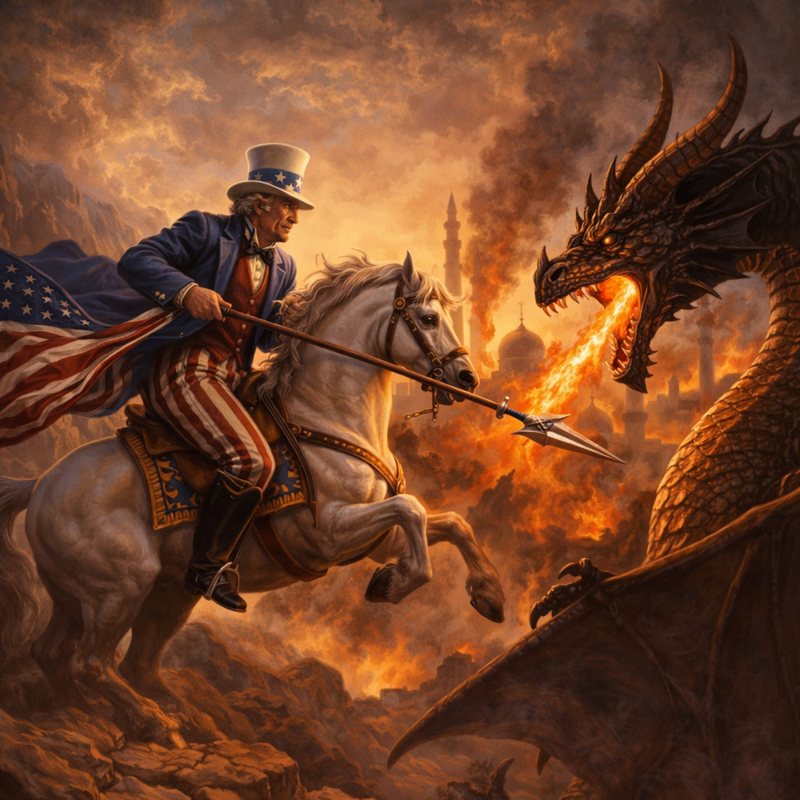
If you smash the existing order, even a bad order, you aren't guaranteed to get a liberal democracy. You are much more likely to just get chaos. And hovering above this intense, hyperpolarized 2005 debate, the author brings in a voice from even further back in American history, a warning from John Quincy Adams dating all the way back to 1821. Yes, the title of the peace. Exactly, and I want to read this carefully because as you know, it's the absolute anchor for the entire argument we are dissecting today. In 1821, Adams warned that America quote does not go abroad in search of monsters to destroy it's. Such a powerful line.
It really is, yeah. He argued that the United States could wish freedom and independence for all nations and could encourage it by example, but that America should be the vindicator only of its own freedom. What's fascinating here is how the author reflects on the evolution of that specific quote. They note that back in 2005, when they wrote their original blog post quoting John Quincy Adams, that line still sounded like a principle. It sounded like an active, guiding ethos that policy makers were at least pretending to debate. But looking at it now, in 2026, following these massive coordinated strikes against Iran and the deeply familiar justifications used to launch them, that 1821 warning reads more like a line we simply stopped believing entirely. It really does.
Because when you look at the actual actions taken over the last two decades, the United States unequivocally does go abroad in search of monsters to destroy. Think about that for a second. I want you, the listener, to just reflect on your own lifetime, however long you've been following the news. How many times have you heard the exact same justifications for military action recycled almost word for word, decade after decade? It's. A constant loop.
We must stop the weapons programs, we must disrupt the the proxy networks, we must remove this specific dangerous regime so we can finally create a safer region. Always the same script. Always. The author is pointing out that what Adams explicitly warned against two centuries ago hasn't just been forgotten. It has essentially become the standard operating procedure for foreign policy. And the author is intellectually honest enough to concede a point here, which is important, very important. They acknowledge that perhaps in this specific 2026 scenario with Iran, the arguments for the strikes will actually prove correct.
Right. History is complicated. It is, and it occasionally produces situations where military force truly is the least bad option on the table. But it isn't the specific tactical validity of the strikes that alarms the author. It is.
It's the overwhelming familiarity of the rhetoric. It's that creeping realization that we are running the exact same script we ran in 2005, expecting a different ending. Here's where it gets really interesting Because to understand why these interventions keep happening, and why they so consistently failed to produce the lasting democratic stability that interventionists like Sharansky promised, we have to look at how policy makers misunderstand the very nature of political order. This part of the essay is brilliant. It really is, and the author uses a highly clarifying metaphor to explain this.
To understand the mechanics of artificial political order, we need to talk about a pot of water on an aluminum stove. I love when incredibly dense geopolitical concepts are distilled down into something you can just visualize in your kitchen. Me too. The author says this image of the stove keeps returning to their mind every single time they watch another massive nation building project unfold. So visualize this.
You have a pot of water sitting on a stove. You turn on the flame and eventually the water begins to boil. Simple physics. Exactly. You turn the heat down and the boiling slows. You turn the flame off entirely and the water quickly cools down and stops boiling altogether.
Now let's map the elements of this physical metaphor onto the actual realities of foreign policy. In this analogy, the boiling water represents external political order. It's the structured, seemingly stable functioning system that an occupying or intervening force is trying to desperately create in a foreign country, and the flame underneath the pot that represents the outside power. The flame is the intervening nation or the coalition of nations, and the essay gives us a very specific, extensive list of the ingredients that actually make up that heat. Because it's not just dropping bombs. No, not at all.
When we talk about geopolitical heat, we aren't just talking about airstrikes and troops on the ground, though that those are obvious factors. The heat is a massive, incredibly expensive combination of resources. It's troops, yes, but it's also billions of dollars in funding. It's weapons shipments. It's thousands of military and civilian advisors. It's the leverage of economic sanctions. It's the quiet hum of intelligence networks and the constant heavy hand of diplomatic pressure. So as long as that massive complex apparatus of heat is actively applied to the bottom of the pot, a certain kind of order can actually be maintained. Yes, the water boils.
The society looks active, dynamic and structured according to the specific desires of the foreign power that's controlling the dial. You can look at that society and say, look, it's working. The government is functioning, the military is training, the institutions are running. What's fascinating here is if we connect this to the bigger picture, we are really talking about the physics of artificial order. Artificial being the keyword.
Exactly. The critical thing to understand is that this order is entirely 100% dependent on an external energy source. Because the absolute moment that heat is reduced, the moment the troops start pulling back, the moment the money stops flowing quite as freely, the moment the diplomatic pressure eases up to focus on some other crisis, the system immediately begins reverting. Because water doesn't stay boiling on its own. It doesn't. It reverts to whatever equilibrium the society itself produces organically.
The artificial boiling stops and the underlying historical structure of that society reasserts itself. And this highlights what the author identifies as a critical, almost tragic flaw in the mindset of the people who designed these foreign policies. It's a massive blind spot. It is Policymakers repeatedly, stubbornly assume that the boiling is permanent. They look at a nation that has been occupied, funded and micromanaged by outside forces for 5-10, maybe 15 years. They see the institutions functioning under that immense artificial heat, and they somehow convince themselves that the water has magically learned how to boil on its own. Which, as the author points out, is a fundamental misunderstanding of thermodynamics, both literally and politically.
The history of intervention keeps showing over and over again that the boiling is never permanent. It simply cannot be. Yet despite this blindingly obvious historical track record, the exact same playbook is continually used. Which raises a really important question. Why do smart, highly educated policy makers keep making this exact same mistake?
It is a profound disconnect, isn't it? It really is. I mean, is it just staggering hubris? Is it a total overestimation of American power? This belief that enough money and enough smart people can re engineer any society on earth and. You'd be a bit of that.
Or is it a profound, almost willful misunderstanding of how deeply rooted local cultures actually are? You apply infinite money and military power, you create a facade of water, and you mistake your own applied pressure for organic societal transformation. And if you are wondering if there is a real world example that proves this stove theory perfectly, a place where the water was boiled, the heat was removed, and the equilibrium immediately returned, the essay points us to one specific country. The ultimate case study. A country that has demonstrated this principle more clearly and more brutally than almost any place on Earth. The graveyard of empires.
Afghanistan. Afghanistan is the undeniable case study for this metaphor, and the author outlines a multi century pattern here that is frankly chilling in its exact repetition. It's it's almost unbelievable when you lay it all out. We're talking about empires marching into Afghanistan for centuries, and every single one of them arriving completely convinced that they were the ones who could finally reshape it. Let's look at the timeline the TXT provides.
You have the British Empire attempting to impose its will in the 19th century, then you have the Soviet Union trying it in the 20th century, and finally the United States attempting it in the 21st century 3. Different century. 3 entirely different centuries, 3 entirely different global superpowers at the absolute height of their strength, 3 completely different political ideologies motivating them. Right. And yet, the author notes that each and every time the exact same pattern appeared.
So what does that anatomy of an invasion actually look like? Well. According to the essay, it always starts exactly the same way the Empire arrives. They bring vastly superior technology. They bring overwhelming, unimaginable firepower.
And a theory. Crucially, they bring a very confident, very rigid theory about exactly how the country should be governed. They show up with their specific version of the quote UN quote correct political system. And how do the locals respond to this massive influx of power? The text uses a phrase here that I think is vital.
It says local factions cooperate just enough to survive. Just enough, right? They aren't suddenly converting to the Empire's confident theory of governance. They aren't having ideological epiphanies. They're adapting to the sudden massive influx of heat on the stove. Because with the Empire comes an absolute flood of resources. Exactly.
The essay notes that money floods the country, historical alliances shift constantly to accommodate the new reality, and everyone on the ground figures out how to extract as much benefit as possible from the presence of the foreign power. It is entirely transactional. It's survival and it's opportunism. The locals understand something the Empire doesn't. The Empire is just the flame.
As long as the flame is turned up, you utilize the heat. You take the weapons, you take the funding, you take the infrastructure. But the locals also know something else, something deeply ingrained in their history. Empires always eventually grow tired. Yes, the inevitable fatigue of the intervening power.
The author lays out exactly how this fatigue sets in. It isn't usually a military defeat in the traditional sense. The Empire grows tired because the public back home loses patience with a war they don't really understand right, Or the financial and military resources become too strained by other global commitments. Or the political leadership changes back in the Empire's capital, bringing in a new administration that campaigned on ending the war. Whatever the specific catalyst is, the result is always exactly the same. The hand reaches for the dial and the flame of the pot is turned.
Down. And what happens when that flame turns down? The equilibrium reasserts itself exactly as the metaphor. The author compares the immediate aftermath of two specific historical withdrawals to make this point. Look at what happened when the Soviets finally withdrew in 1989.
Right, a perfect example. The text notes that almost immediately, the country fractured into warlord territories that were dominated by various mujahedin factions. The artificial Soviet order evaporated the literal moment the Soviet troops drove back across the border. Right. And then we Fast forward 3 decades, the United States withdraws.
And he also points out that the exact same underlying political structure reemerged almost overnight. It was startling how fast it happened. It was, but here is the really sharp critical observation the author makes. The labels changed, but the reality didn't. 3 decades ago we called those fundamentalist fighters the Mujahideen. Today, we call them the Taliban.
The labels changed. The labels we applied to them in our newspapers changed, but the actual underlying political and social structure of the region did not shift an inch. There is a quote from the text here that is just devastating quote. Afghanistan simply waited out the empire. It perfectly encapsulates the entire reality of the boiling pot.
The water doesn't somehow change its fundamental nature just because it's boiling. No, it doesn't it. Doesn't become a different substance, it just waits for the heat to be removed so it can return to room temperature. The local organic structures simply outlasted the intense impatience of the foreign empires. So if Afghanistan gives us the absolute clearest, most undeniable picture of the failure to build a new state from the outside, the essay then pivots to an even darker reality. Yeah, this part is heavy.
Because if Afghanistan shows the failure of building a state, the recent history of the Middle East shows the terrible, often hidden costs of tearing one down. The author brings up what they explicitly call a deeply uncomfortable revelation about the removal of authoritarian regimes over the last two decades. And it is deeply uncomfortable because it forces the listener to confront of the brutal tension between morality and stability. It really does. The text examines 3 specific, very famous case studies to make this point. First, it looks at Iraq under Saddam Hussein. The author describes Iraq under Hussein as a centralized state with rigid borders and functioning infrastructure enforced by a security apparatus. That was incredibly brutal, yes, but also highly coherent. Brutal but coherent is the key phrase there. Then the text points to Libya under Muammar Gaddafi. Under Gaddafi, despite his erratic nature and his tyranny, Libya remained a unified nation state with functioning national institutions and a strict internal order. And the third example.
The third example provided is Syria. Under Bashar al-Assad, Syria maintains strict internal stability through deeply entrenched authoritarian power right up until the civil war fractured the entire country. Now, what ties these three specific examples together in the author's framework? The text points out that removing these authoritarian regimes, taking out the brutal dictators at the very top of the pyramid, did not automatically produce thriving Liberal Democratic societies. And remember, that was the entire promise of the interventionists back in 2005. That was Sharansky's thesis.
Exactly. Remove the bad guy, take the boot off the neck of the people, and the natural, inherent human desire for democracy will immediately flourish. But the uncomfortable revelation the author highlights is that removing these regimes actually revealed something terrifying. It revealed how remarkably, terrifyingly thin the underlying national cohesion of those countries actually was. This is a massive, vital point. It really is.
The author is arguing that these regimes, as horrific and universally condemned as they were, we're actually the only things holding together political systems that were incredibly fragile. Right, because these were not homogeneous societies. Not at all. These were societies defined by deep ancient tribal divisions, by bitter sectarian rivalries, and by massive regional disparities. The heavy authoritarian fist of the central government was in many ways the only force binding those arbitrary borders together.
So the question becomes, when an outside force comes in and shatters that central authority, what actually happens? The vacuum opens. That is what happens. You remove the dictator, you dismantle the security apparatus, and you create a massive power vacuum. And nature of horizontal the vacuum.
Exactly. And the harsh reality noted in the text is that when that vacuum opens, it is almost never filled by polite parliamentary debate. It is not filled by peaceful constitutional conventions where everyone agrees on a new Bill of Rights. The vacuum is filled by heavily armed militias. It is filled by warlords, by sectarian violence and by insurgency. So what does this all mean?
How did the incredibly smart policymakers who promised that removing dictators would inevitably lead to blooming democracies get it so incredibly, disastrously wrong? It's the $1,000,000 question. The text suggests it comes down to a fundamental, profound misunderstanding of how political systems are actually formed in the first place, and this brings us to the core foundational philosophy of the author. The author states their philosophy incredibly plainly. They say their instinct has always leaned much closer to sovereignty than to universalism. Let's unpack what those two terms actually mean in the context of foreign policy, because they are crucial to understanding the rest of the essay so far. Universalism is the belief that certain political values and systems, specifically Western liberal democracy, are universally applicable and inherently desired by all people everywhere, regardless of their specific history or culture. Right.
Universalism assumes that deep down, everyone is just a frustrated Democrat waiting to be liberated. Exactly. Sovereignty, on the other hand, respects the independent, often messy development of nations. The author asserts that cultures are real, distinct entities. Nations are real. And crucially, political systems cannot be mass produced. They grow organically out of centuries of specific historical experience, geographical realities and unique social structures.
I have to say I love the analogy the author uses here because it feels so perfectly tailored to how we think today. The software one. Yes, it's got a dry joke about tech support. The author critiques the idea that political systems can simply be installed from the outside, like software. It is such a brilliant way to phrase it. It really is.
You can't just take a nation with thousands of years of specific tribal history, deep sectarian divides, and totally different cultural foundations and just decide to download Democracy 2 point O into their capital city and expect the hardware to successfully run it right. It's like trying to install the latest iOS onto an old Rotary phone and acting shocked when you can't use the touch screen. That software analogy is absolutely perfect for illustrating the absurdity of the interventionist mindset. It makes it so clear. The modern doctrine of democracy promotion, according to the text, operates entirely on this flawed assumption. It assumes that every single society on Earth is naturally moving toward the exact same institutional endpoint, and that they simply need an enlightened outside power to help them get there faster.
And the author views that with skepticism. Deep, profound skepticism. They compare it to a modern form of ideological colonialism. Ideological colonialism. That is a very heavy, very loaded phrase.
It is meant to be. The text elaborates on this concept by comparing the empires of the past to the superpowers of the present. It notes that empires of the past, say the Spanish or the British, used to explicitly export religion and monarchy. They would conquer a land, build their churches, install their proxy kings and demand allegiance to their God. Today, the text argues, powerful modern states export political institutions.
Instead, we build parliaments and run elections. The vocabulary has completely changed to sound more benevolent, but the underlying arrogant assumption is remarkably similar. And what exactly is that assumption? It's the unshakable belief that our system is not merely ours, but the correct destination for everyone. That is the ideological arrogance the author is highlighting.
It is the belief that your specific way of organizing a society is the objective universal truth, and therefore you have a moral mandate to impose it on the rest of the world, whether they have the societal hardware to run it or not. And this realization leads the author to a really fascinating observation about the nature of American politics itself. Oh, this shakes up how a lot of people view the political landscape. It does. The author has come to believe that the real, defining divide in US foreign policy is not actually between the political left and the political right.
We are so heavily conditioned to see every single issue through a strict partisan lens. Democrats versus Republicans, liberals versus conservatives. Always. But the text argues the true dividing line is actually between interventionists on one side and those advocating for restraint on the other. This is where we need to gently remind you, the listener, of our impartiality rules.
Yes. Very important here. The author provides a very sharp critique of two major political factions here, neoconservatives on the political right and liberal internationalists on the political left. Again, we are impartially analyzing the author's thesis, not endorsing their specific framing exactly, but let's define these groups as the author sees them. Neoconservatives generally argue for using American military primacy to actively shape global events and promote democracy, often arguing that American security depends on a democratic world order. Right.
And then on the other side. Liberal internationalists also believe in active global engagement, but they often frame it more around humanitarian intervention, protecting human rights and enforcing international norms. Right. So these different language, they prioritize different immediate goals. But the author's thesis is that while these two groups, neoconservatives and liberal internationalists, often appear to disagree passionately on cable news about rhetoric, or about which global alliances to prioritize, or about the specific military tactics to use, they actually share a fundamental foundational premise.
Exactly. The author argues that both the right wing interventionist and the left wing interventionist share the exact same core belief that the United States has both the moral responsibility and the practical ability to definitively shape political outcomes across the globe. It's the same base code. Yes, in the author's view, despite all their bitter partisan bickering, they really just represent two different faces of the exact same doctrine of global intervention. They both believe they can keep the pot boiling. And establishing that premise, the idea that the establishment wings of both major political parties are fundamentally, inescapably interventionist is absolutely necessary to understand the very personal, highly political confession the author makes next in the essay.
Yes, the essay takes a very direct personal turn here. It does. And listener, as we noted earlier, we are entering the territory of recent presidential voting records. We are maintaining strict impartiality. We are not judging and validating or endorsing the author's vote.
But we absolutely must discuss it, because it is the linchpin to understanding the depth of their frustration with the events of 2026. So what is the the confession? The author openly confesses that they voted for Donald Trump, and not just once, but three times the. Crucial defining part of this confession is the specific reason the author provides for those votes. Yes, the reason is everything here.
The text explicitly states that the only reason the author voted for Trump three times was because he promised something very simple, very direct. No new Foreign Wars. According to the essay, Trump presented himself as a nationalist, A populist and most importantly for the author's framework, an anti interventionist. The author notes that Trump specifically and loudly positioned himself against both of the establishment interventionist wings we just define. He went after both sides. Right.
He campaigned aggressively against the neoconservative foreign policy that had historically dominated the Republican Party, mocking the Iraq war and nation building. And he also positioned himself against the liberal internationalist that had become common in the Democratic Party. So for the author it was a single issue vote. Completely for the author, and they describe themselves as a deeply weary voter who believed the US had spent two solid decades wandering blindly into unnecessary destructive conflicts. That specific anti interventionist promise mattered above absolutely all else, the text says. It was the singular decisive issue for them. So what does this all mean?
Understanding that deep seated desperate desire for restraint and the significant political choices the author made in pursuit of it, It brings us crashing right back to the present moment in the essay. Back to the shockwaves. It brings us back to the overswing, crushing disappointment of watching the news on February 28th, 2026. The text says simply quote and yet here we are again. Here we are again. You can practically hear the exhaustion radiating off the page in that phrase.
You really can. After decades of bitter debate, after all the stark warnings about boiling pots and the fragile nature of authoritarian regimes, after all the political realignments supposedly meant to stop the endless wars, the US and Israel launched massive strikes on Iran. The pot is back on the stove. Exactly. The author lists the cycle playing out a new step by predictable step. Another enemy identified as an existential strategic and moral threat.
Another urgent argument that military action is the only necessary option to prevent a much worse future. Another confident belief that removing a dangerous regime's leadership will miraculously produce a more stable political order. As we discussed earlier, the author does maintain a sliver of historical humility. Which is fair. They can see that perhaps in this one specific instance, the military intervention will actually change events for the better.
But they immediately counter that tiny concession with the overwhelming, overarching lesson of the past two decades. And this might be the most important take away of the entire essay. I think so too. History shows the destroying the monster rarely, if ever, destroys the ecosystem that produced the monster in the first place. That is such a vital, profound distinction. It is the difference between tactics and strategy. You might successfully target the leadership compound. You might launch the perfect strike and kill the supreme leader.
You might eliminate the specific monster you were aiming at. Right. But what about the soil that grew the monster? What about the historical grievances, the economic despair, the religion, religious zealotry or the sectarian hatred that created the conditions for that regime to rise? If you don't change the ecosystem, which as we've established is nearly impossible to do from the outside, a new monster just grows in its place.
And the text returns to the stove metaphor one last time to drive this point home permanently, unless the outside power intends to keep the flame under the pot burning indefinitely. Which means occupying forever. Exactly. Unless you are willing to occupy, fund, and militarily suppress that ecosystem forever, the system will eventually, inevitably cool and revert to its own historical equilibrium. Which serves as the perfect elegant segue back to where this entire philosophical journey started. John Quincy Adams.
Yes, the author revisits that 1821 warning with a much more nuanced interpretation. Adams did not argue that monsters do not exist. No, not at all. As the text notes, history provides plenty of horrific evidence that monsters absolutely do exist in the world. There are brutal regimes.
There are genocidal dictators and there are incredibly dangerous threats to human life. But Adam's warning wasn't about denying the existence of evil in the world. His warning was about what fundamentally happens to a nation when it defines its core animating mission as destroying those monsters abroad. The author points out the fatal, tragic flaw in that noble sounding mission. The supply of monsters never ever runs out.
Exactly. It becomes an endlessly self perpetuating cycle. The text lays out the brutal logic of this cycle. Every single decade produces a new adversary. Always.
That new adversary inevitably becomes framed by politicians and the media as a moral imperative, a threat so evil, so uniquely dangerous that it simply must be confronted militarily. And once the conflict is framed as a moral imperative, advocating for restraint suddenly feels like weakness. Yes, you are told you're an isolationist, or worse, that you are actively appeasing a monster. And when restraint becomes culturally synonymous with weakness, the crusade becomes permanent. The permanent crusade.
I want you to really think about that phrase. It means there will never be a final victory parade. There will always be another underground facility to strike, another regional proxy network to disrupt, another brutal regime to topple for the sake of supposed global safety. The author laments that America was to be the champion of freedom by example, rather than by crusade by right. You are supposed to build a society so free, so prosperous, and so stable that other nations want to emulate it organically.
You don't force them at gunpoint to adopt your institutions. And yet, as the tech states with a profound sense of resignation, once again the United States finds itself abroad heavily armed, confronting another enemy described as a monster that simply must be destroyed. The cycle has not broken. The stove is still on, which leads the author to ask the exact same haunting question they asked 21 years ago in 2005. Listen closely. Did this final thought from the text It's. Powerful.
If maintaining the system we want requires permanent intervention, permanent pressure and permanent war, then have we really exported democracy at all? Or have we simply placed another pot on the stove and turn the flame up again? It forces you to realize that what we so optimistically called building democracy might just be the meticulous, exhausting, endlessly violent management of a rolling boil. Wow. We've covered an incredible amount of complex ground today.
We started with the immediate chaotic shock waves of the 2026 military strikes in Iran, the convulsing oil markets, the uncertainty in the Persian Gulf, the sudden death of common A We. Covered a lot. We trace the author's profound feeling of recognition back to a 2005 blog post contrasting Sharansky's belief in exporting democracy with Buchanan's warnings about intervention causing chaos. We broke down the mechanics of artificial order using the incredibly vivid metaphor of a boiling pot on a stove. We. Look closely at the ghosts of Afghanistan waiting out three different empires.
We confronted the uncomfortable truth about the chaotic militia filled vacuum left behind by collapsed dictatorships in Iraq, Libya and Syria. We examined the profound philosophical difference between allowing sovereign development and forcing ideological colonialism. And we've seen how the desperate desire to escape the cycle of endless intervention drove massive political decisions. Only to end up right back where we started, locked in what looks exactly like a permanent crusade. It is a sweeping, somewhat sobering framework to view the world through. But before we wrap up, I want to leave you, the listener, with one final provocative thought to Mull over. Let's hear it.
It builds directly on the author's analysis, but looks at the consequences from a slightly different angle. The author talked extensively about how empires eventually turned down the flame because they get tired, the public loses patience, and resources become dangerously strained. The inevitable fatigue of empire that we saw with the British and the Soviets. Exactly so. Consider this realization. If maintaining this artificial order abroad requires permanent intervention, permanent pressure and permanent war, what does that permanent crusade do to the pot of water back home? Oh wow.
If an empire spends all its energy, all its money, and all its political focus acting as the eternal flame for the rest of the world, does it risk burning out its own societal equilibrium? That's a great question. Does the massive, exhausting effort to artificially export freedom ultimately degrade the very freedom, stability and prosperity the nation was trying to champion by example in the first place? It is a question of whether the flame, if left burning long enough, eventually consumes the stove itself. That is an incredibly haunting thought to leave off on. Can you endlessly export order abroad without eventually importing chaos at home?
I want to thank you, the listener, for joining us on this really complex, deeply important deep dive. It's been a great discussion. It really has. The next time you turn on the news and hear the familiar, confident arguments that a new monster is simply must be destroyed for the sake of peace, I encourage you to think back to the boiling pot. Remember the warnings of 1821 and ask yourself what kind of equilibrium we are actually creating. Welcome to you.
The debate to set the stage for today's discussion. The date is shortly after February 28th, 2026, and the geopolitical landscape has just experienced a really seismic shift. the United States and Israel have launched A coordinated military strike campaign against Iran. We're looking at opening waves that targeted military facilities, command centers, and leadership compounds. This actually resulted in the death of Iran Supreme Leader Ali Khamenei, alongside several senior figures in their military hierarchy, and unsurprisingly, the region has immediately ignited. Right.
And we're seeing the blowback happen in real time. Iran is retaliating with missiles and drones aimed at US bases and Israeli targets. Global oil markets are convulsing. Shipping through the Persian Gulf is suddenly fraught with just severe uncertainty. And governments worldwide are really scrambling to figure out what the next phase of this escalation looks like.
Which brings us to the core disagreement emerging from our source material today. The central question is, does removing a dangerous authoritarian regime actually create the necessary conditions for a safer Middle East and a more stable global order? And looking at the text, my stance representing the interventionist perspective, is that confronting immediate existential threats with military force is often the necessary least bad option to prevent far greater regional instability. Authoritarian regimes are inherently unstable and, well, sometimes you just have to act. And I take a much more skeptical view of that kind of intervention because human cultures and nations aren't smartphones.
You can't just install a new political system from the outside like a software update. My perspective representing restraint is that aggressive interventionism fundamentally misreads how human societies operate. Tragically, it usually creates the exact instability it claims to be solving. Let's start with a foundational idea from the early 2000s that the source material highlights. You're familiar with the philosophy popularized by figures like Natan Taransky. The Soviet dissident?
Yeah, he famously argued about the difference between fierce societies and free societies. Exactly. The core thesis there is that if people cannot walk into a town square and criticize their government without fear of arrest, that society is inherently unstable. IT projects this massive illusion of strength, but it's really a hollow structure maintained entirely by coercion. There is no actual consent of the governed.
From that viewpoint, dismantling structures of terror ultimately makes the world safer. But applying a Cold War dissidents framework to the modern Middle East is a massive leap. Is it, though? Look at Washington and Jerusalem's justifications for these 2026 strikes. We're talking about Iran's nuclear ambitions, its advanced missile programs, and its vast regional proxy networks financing terror from Lebanon to Yemen. These aren't theoretical concerns. They constitute A genuine, actionable, and empirical threat to global security.
Intervention is undeniably messy. It carries profound risks, but history occasionally produces situations where force truly is the least bad option. Removing a highly dangerous regime that operates as a Nexus of international terrorism is a necessary step to deal with a system that was already a profound threat. I completely disagree with that premise, and I draw heavily on historical warnings that have echoed through American history to explain why the foundation of the restraint perspective is perfectly captured by John Quincy Adams 1821 warning. He said America should not go abroad in search of monsters to destroy. We can wish freedom for all nations, we can encourage it by our example, But we should be the vindicator only of our own. You really think Adam's framework from the 1800s applies to a regime actively pursuing nuclear weapons in 2026? I think human nature hasn't changed since the 1800s. As Pat Buchanan and other critics of interventionism have long argued, the act of intervention itself routinely creates the chaos it attempts to cure. Political systems grow organically out of historical experience, social structure, and cultural realities. The modern doctrine of intervention, this assumption that every society is naturally moving toward Western democracy and just needs a few air strikes to get there faster, is essentially a form of ideological colonialism. Ideological colonialism is a heavy charge. But it's accurate.
Empires used to export religion in monarchy. Today powerful states try to export political institutions. It fundamentally misreads how cultures operate. To really ground this, let me give you a metaphor from the text that perfectly captures why external political order is an illusion. Imagine a pot of water sitting on an aluminum stove. You turn on the flame, and the water begins to boil. Turn the feet down, the boil in slows. Turn the flame off entirely, and the water cools quickly. External political order works exactly like that, and outside power acts as the flame.
It supplies the troops, the money, the weapons, the economic sanctions and the diplomatic pressure. As long as that intense heat is applied, a certain kind of artificial order is maintained. So you're talking about the artificial stability of an occupation? Right, but the absolute second the public at home loses patience and that heat is reduced, the society inevitably reverts to its own equilibrium. The boiling stops, and the underlying social structure reasserts itself.
Policy makers repeatedly assume that they can just leave the water boiling permanently, but history keeps proving that this kind of external order is an illusion. I understand the pot on the stove mechanics, but that metaphor has a fatal flaw. It assumes our only goal in 2026 is to perpetually boil the water to engage in endless utopian nation building in Iran that completely mischaracterizes the strategic reality. How so? The strikes killed the Supreme leader.
You don't decapitate a state without taking responsibility for the ensuing chaos. These strikes were not about building a new Iranian nation from scratch. They were about destroying an active ecosystem of nuclear and proxy threats. Let's lean on a crucial concession from the text itself. History sometimes produces situations where intervention genuinely changes events for the better. We don't have to keep the pot boiling forever if our primary objective is simply to take a highly dangerous element out of the pot, or, frankly, to break a stove that threatens to burn down the entire neighborhood.
Break the stove, then what? You just walk away. You auditor the immediate trajectory of a genuine threat. The disruption of a regime's capacity to build nuclear weapons doesn't require permanent occupation, It requires decisive action. You're assuming we can just surgically remove the bad parts and leave the rest intact.
Let me look at the actual data and the clearest historical example we have, which is Afghanistan. The source material points out that empires have marched into Afghanistan for centuries, convinced they could reshape it or at least neutralize it. Afghanistan is a completely different strategic landscape than Iran. The mechanics of foreign intervention are exactly the same. The British tried in the 19th century, the Soviets tried with mechanized infantry in the 20th, the United States tried with drones and nation building in the 21st, and the exact same pattern appears every single time the Empire arrives, with superior technology, overwhelming firepower, and a highly confident theory of how the country should be managed. And you're saying the local populations just wait them out? They do more than wait.
Local factions adapt just enough to extract the benefits. They cooperate just enough to survive. Money floods the country, alliances shift constantly, and everyone milks the foreign power for resources. Eventually, the empire tires. The public at home loses patience. The flame under the pot is turned down. When the Soviets withdrew the Mujahideen, the Islamic guerrilla fighters who battled them took over. When the US withdrew, the Taliban took over. The labels changed, but the underlying structure simply waited out the empire.
You cannot easily decouple A surgical strike from the massive gravity well of regional complexities that follow. I completely agree that Afghanistan showcases the profound limits of nation building. The hubris of attempting to permanently rewire a society's internal political structure is real, but the failure to create a Jeffersonian democracy in Kabul does not invalidate the strategic necessity of stopping acute international threats. But at what cost? We just keep repeating the cycle. Look at the consensus, the text points out. Neoconservatives on the right, the folks who want to export democracy, and liberal internationalists on the left, the folks who want to enforce global human rights norms. They share a deeper consensus.
They both agree that the United States has the responsibility and the ability to shape global outcomes. Yes, the establishment consensus, and that consensus has a terrible track record. It exists for a reason, though. It exists because ignoring these monsters is a luxury that the United States and the global order it anchors simply cannot afford. If a regime is actively pursuing nuclear weapons and orchestrating a network of regional terrorism, stepping back and allowing that organic equilibrium to form means accepting an equilibrium where dirty bombs or ballistic missiles dictate global security. We can acknowledge the structural resilience of local factions without abdicating our responsibility to neutralize threats that extend far beyond their borders. But you're ignoring the alternative. What happens when you neutralize the threat? Let's bring up the deeply uncomfortable truths of Iraq, Libya and Syria, discussing the material. Saddam Hussein, Muammar Gaddafi and Bashar al-Assad were brutal, ruthless dictators.
Nobody disputes that. Right. They maintained powers strictly through terror and secret police. Yet under their rule, those nations functioned as centralized states. They maintained rigid borders, functioning infrastructure, and internal order through their security apparatuses.
The Western assumption was that removing these dictators would allow the suppressed Liberal Democratic desires of the populist to flourish. Instead, removing them exposed how astonishingly thin the underlying national cohesion actually was. Because the cohesion was artificial, it was forced. But it was functional. Take a wreck. Saddam's Baathist Party was deeply oppressive. But when the central authority collapsed in a society fundamentally defined by tribal and sectarian divisions, Sunni, Shia, Kurd, the vacuum wasn't filled by parliamentary debate, it was filled by heavily armed militias. The intervention didn't create the divisions, it just removed the lid from a pressure cooker that was already boiling. The intervention didn't stop a monster. It fractured the society and birthed a dozen new uncontrollable monsters.
Exactly, which proves my point. The insight here is that dictatorship isn't stability, it's just a delayed explosion. You're relying on a mirage of stability. A delayed explosion is still an explosion, and the human toll of the ensuing civil conflicts in those countries was devastating. I fully acknowledge the tragic outcomes in Iraq, Libya and Syria, but let's apply the source materials framing of authoritarian fragility to those exact examples.
If Saddam Hussein or Muammar Gaddafi were holding together systems that were already that incredibly fragile, systems devoid of any organic national cohesion, then maintaining them in power was an illusion of true security. A system that fractures the moment the dictator falls was never stable to begin with. But replacing an illusion of security with the reality of a bloody civil war is not an improvement for the people living there or for the region. Leaving a dangerous regime in power simply because we fear the vacuum ignores what that regime is doing while in power. In the case of Iran in 2026, you have a regime explicitly dedicated to exporting terrorism and destabilizing its neighbors.
Leaving them untouched guarantees instability anyway. When forced to choose between confronting A fragile, hostile regime now or allowing it to achieve nuclear deterrence while spreading chaos, intervention remains the least bad option. Which your least bad option calculation completely ignores the domestic cost. You're looking entirely at the geopolitics and ignoring the political breaking point of the society actually executing the intervention. You mean the American voters? Yes, and the text introduces A striking personal anecdotes that we absolutely have to dive into.
The author confesses to voting for Donald Trump three times, strictly and exclusively because Trump promised something very simple. No new foreign wars. It's a powerful anecdote because it highlights a massive disconnect between the foreign policy establishment and the general electorate. Exactly, he presented himself as an anti interventionist, positioning himself against both that neoconservative right and the liberal interventionist left consensus you mentioned earlier. Think about what it means for a middle class taxpayer in Ohio. They're asked to fund multi trillion dollar campaigns in the Middle East while bridges at home are crumbling. For voters who felt the United States had spent two decades wandering into unnecessary, bloody and expensive conflicts, that promise of no new wars was the decisive issue. I don't dismiss that fatigue at all. It's empirically measurable and entirely rational after the last 20 years.
Then you have to look at the consequences of ignoring it. When the foreign policy establishment frames every new adversary as a moral imperative and every dictator as a monster that must be destroyed, they make restraint feel like a moral weakness. But Adam's warned us about this. Once you define your mission as destroying monsters abroad, the supply of monsters never runs out. The crusade becomes permanent, and a permanent crusade eventually hollows out the Republic from the inside, exhausting the very voters who were asked to fund and fight these endless campaigns. The domestic frustration is real. But isolationism, even when driven by understandable domestic exhaustion, simply cannot hold when the supply of real factual threats forces a response. The 2026 strikes on Iran weren't driven by desire for a permanent crusade.
They were driven by a regime actively hostile to global stability. But framing every regional power play as a threat to global stability is exactly how the Crusade becomes permanent. We can acknowledge the deep, legitimate desire for no new foreign wars, but we must also reiterate that being a champion of freedom by example does not immunize a nation from having to deal with hostile state actors operating aggressively on the global stage. If you declare that you will never intervene, you signal to authoritarian regimes that they have a free hand. They can expand their influence, develop weapons of mass destruction, and terrorize their neighbors without consequence.
So the United States has to be the global policeman forever, regardless of the domestic toll. The US and its allies do not have the luxury of retreating behind two oceans while the global order, which underwrites our own security and economic prosperity, is dismantled by adversaries. You can't separate domestic prosperity from global stability. But does our intervention actually secure that global order, or does it merely perpetuate a cycle of chaos? We keep identifying strategic and moral threats. We keep arguing that military action is necessary to prevent a worse future.
And we keep believing that removing a regime will produce stability, but history shows that destroying the monster rarely destroys the ecosystem that produced the monster in the first place. That's a fair challenge. You killed Khamenei in these 2026 strikes, but did you kill the underlying historical grievances, the religious fervor, or the regional dynamics that empowered him? No, unless Washington and Jerusalem intend to keep the flame under the Iranian pot burning indefinitely, that system will eventually cool and revert to whatever equilibrium the Iranian society itself produces. The structural realities always outlast the foreign bombs.
Looking at this debate comprehensively, I can see that the history of regime change is fraught with deep complexities, unintended consequences, and immense tragedy. You've made a strong case for the structural resilience of these societies. However, authoritarian regimes that aggressively seek weapons of mass destruction and export terror are inherently unstable. They pose an unacceptable risk to global security. Confronting these destabilizing forces, as seen in the 2026 strikes against Iran, is not an exercise in utopia nation building.
It is a tragic but necessary burden to prevent far worse geopolitical futures. Sometimes you have to break the machinery of a threat, even if you cannot control the exact shape of the pieces that remain. And from the perspective of restraint, the counter argument remains clear. True enduring stability cannot be enforced by external pressure or military strikes. Political systems and social orders must grow out of their own historical experience.
Continuously seeking out monsters abroad to destroy merely replaces organic societal development with permanent war, hollowing out our own Republic and exhausting our citizenry in the process. We have to recognize the limits of our power and abandoned the ideological colonialism that assumes we can bomb a society into a better equilibrium. I think where we fundamentally converge in this discussion is on the profound difficulty of balancing domestic patients with global security. The fatigue of the electric that you highlighted is undeniable, yet the threats on the global stage are equally real and pressing. Exactly As we look at the fallout from these 2026 strikes on Iran, we can both agree that the ultimate outcomes will likely hinge on whether the US and Israel we actually have a realistic, clear eyed plan for the equilibrium that follows the destruction of the regime's leadership.
Right, and that brings us back to the enduring relevance of John Quincy Adams warning from over 2 centuries ago. As the dust settles in Tehran and the global markets react, it leaves us all to ponder whether America is genuinely creating a safer world through these actions or for simply placing yet another pot on the stove, turning up the flame, and hoping this time the water boils differently. There's certainly much more to explore on how these events will unfold and how the underlying structures of the region will adapt. Thank you for joining. US fictional 2026 military strike against Iran, which uses John Quincy Adams warnings and a boiling pot metaphor to argue against America's continuous cycle of foreign interventionism. Let's dive straight into the feedback. Yeah, let's get right to it.
The abrupt transition from the deeply personal confession about voting for Donald Trump to the broader conclusion leaves a significant narrative and logical gap regarding the 2026 strikes. Right, so the weakness here is that the text reveals the author voted for Trump three times. Specifically because of his anti interventionist stance. Exactly. But it follows this almost immediately with the phrase. And yet here we are again, referring to the massive. 2026 strike on Iran.
The one that killed Supreme Leader Ali Khamenei? Yeah. The essay strongly implies that the politician elected to stop a new foreign wars is actually the one who initiated this new conflict. But it completely skips over how or why this happened. It really does, by abruptly jumping from that that very personal voting confession to the general conclusion that history occasionally produces situations where intervention changes events. It leaves the reader hanging.
Completely hanging on a massive political irony without unpacking the mechanics of that ideological betrayal. I mean, playing devil's advocate for a second, could the author just argue that they don't want to get bogged down in the weeds of domestic political maneuvers? I mean they could try. Maybe they just want to get to the philosophical point. Sure, but when you introduce a highly personal, provocative element like your own voting record, you're making a narrative promise to the reader. You've introduced a protagonist.
Right, the anti war voter and an antagonist which is the inescapable pull of the American war machine. But you've skipped the climax of the story. You skipped the part where the antagonist overpowers the chosen champion. Exactly. Without that connective tissue, the argument feels slightly truncated right at its most compelling character driven moment. That makes total sense.
We need to fill that gap. So what is the clear suggestion to fix this missing link? The suggestion is to bridge the gap between the Trump voting confession and the 2026 Iran strike by briefly exploring how this specific anti interventionist promise collapsed into neoconservative action. We need to show the reader the mechanics of this transformation. Yes, connecting the personal disappointment to the geopolitical reality of those strikes.
Let's see how we can strengthen this with some practical steps. What are some concrete examples for improvement? Well, keeping in mind that these are just a few out of all possible ways of solving the problem, the first approach could be to add a dedicated paragraph analyzing the systemic pressures of the presidency. You mean looking at the institutional forces, the things that happen behind closed doors? Right, like the intelligence apparatus or the military industrial complex. Or even international alliances forcing leaders into interventionism regardless of campaign promises. Precisely, it elevates the essay from a complaint about a single politician into a profound observation about the American state.
I like that. What's another route they could take? Another concrete example would be to describe a specific hypothetical shift in the administration's rhetoric. Oh, illustrating how they pivoted from no new wars to justifying the assassination of Iran's military hierarchy. Exactly showing that rhetorical evolution grounds the essay in a gritty, believable political realism. You can almost hear the shift happening in the press briefings.
Yeah. And a third example would be explicitly stating how the two faces of the same doctrine ultimately absorbed or outmaneuvered the populist resistance. And by two faces, you mean the neoconservative and liberal internationalist BLOB that the author mentioned earlier. Right, connecting that theoretical concept of the BLOB directly to the failure of the 26 administration creates a. Really tight narrative structure. It rewards the reader for paying attention. Moving on to the next area of focus, the argument that removing authoritarian regimes inherently causes instability overlooks the complex realities of non intervention and internal collapse.
This is a crucial point regarding the section on Iraq, Libya and Syria. Because the weakness is that the text points to those countries as examples where removing a strongman revealed fragile national cohesion. And created vacuums built by militias, Yes. But using Syria as an example of intervention causing collapse slightly undermines the argument. Because the Syrian civil war actually fractured the country while Assad was actively trying to maintain authoritarian power.
Exactly. Not merely as a result of his removal by a foreign empire. In fact, Assad was never removed. Furthermore, while the peace acknowledges that history occasionally produces situations where force is the least bad option, it never wrestles with the strongest counter argument. Which is the devastating consequences and moral hazards of strict non intervention when fragile states collapse internally.
Right, I see your point about Syria organically collapsing, but isn't the author just using it as shorthand for the region's overall fragility? It's a fair question, but when you write for a highly knowledgeable audience, historical precision is your currency. If you state that removing Assad caused the collapse of Syria, a knowledgeable reader will immediately pause. They'll say, wait, he wasn't removed and the collapse started from internal protests, and the moment the reader catches a historical inaccuracy they start to doubt the broader philosophical point. Neatly categorizing all instability as a product of Western intervention oversimplifies the chaotic nature of authoritarian regimes.
They often implode organically due to their own internal contradictions. Leaving that unaddressed leaves the whole piece vulnerable. So what is the core suggestion to bulletproof this section? The suggestion is to strengthen the essays robust logic by proactively acknowledging and dismantling the counter arguments regarding the human cost of restraint and clarifying the historical timeline. Let's unpack some concrete examples of how to do that.
How do we handle the Syria issue first? Just as one possible way to approach this, the easiest fix is to simply clarify the Syria example by noting that it was Assad's brutal retention of power that triggered the massive fracturing. And the organic failure of internal cohesion rather than Western regime chain right. Acknowledging this actually demonstrates that the author fully grasps the complexity of the region. What about the broader issue of non intervention and its consequences? A great concrete example there is to briefly contrast the chaos of intervention like the US and Iraq with the organic chaos of stripped non intervention.
Acknowledging that leaving the pot alone sometimes results in its own localized explosions. Yes. By conceding that restraint has a human cost, the author gains immense credibility. Then they can pivot back to their main thesis. Arguing that restraint remains the superior long term strategic choice.
Exactly what about the ideological debate going on in the background the text mentions not on Sharansky and Pat Buchanan. The author should address the Natan Sharansky argument head on. Sharansky argued authoritarian regimes are inherently unstable because they lack internal freedom. Like taking time bombs. Right.
The author should concede Sharansky's point that they are unstable, but then argue that exporting democracy via the military actually accelerates and weaponizes that instability. Rather than curing it, that's a great way to flip the strongest counterargument. Let's tackle the final main point. The powerful mechanical metaphor introduced in the middle of the essay clashes slightly with the biological metaphor used in the conclusion. Yeah, the vivid descriptive language here is brilliant, but the conclusion gets a bit tangled.
The weakness is a mixing of metaphorical language that slightly diffuses the thematic punch of the ending. The author introduces this extended metaphor, comparing foreign intervention to a flame under an aluminum pot of water. Turn on the flame. The water boils. Turn it off. The water naturally cools to its own equilibrium. It perfectly illustrates the temporary nature of foreign imposed order, but in the conclusion, the text pivots to stating that destroying the monster rarely destroys the ecosystem that produced the monster. Moving from the mechanical imagery of stoves and boiling water to the biological imagery of monsters and ecosystems. Which creates A slight disjointedness in the imagery right at the emotional climax of the peace. But isn't a monster a universally understood metaphor for the blowback of war?
Referencing John Quincy Adams going abroad in search of monsters to destroy sounds great. Oh, it sounds fantastic, but think about the cognitive journey you've just taken the reader on. You've spent a significant portion of the essay training the reader to visualize the mechanics of a stove. Internalizing the logic of heat and thermodynamics. To suddenly ask them to abandon that visual framework and conjure up a biological ecosystem breeding mythical monsters creates cognitive whiplash.
The competing vocabularies are fighting each other for the reader's attention. Right when you want maximum resonance. So what is our suggestion for harmonizing this? The suggestion question is to unify the metaphorical language in the conclusion so that it ties seamlessly back to the earlier imagery of the boiling pot, creating a tighter, more resonant ending. Bringing the monster into the kitchen, basically.
Let's get into some concrete examples for this. Sure, and again, these are just a few ways to resolve the clash. One approach is to reframe the ecosystem concept using the stove metaphor. Noting that keeping the flame high doesn't change the fundamental nature of the water in the pot. Exactly.
It only creates an artificial, temporary state of boiling that masks the underlying reality. So the monster isn't the product of an ecosystem. Right. What if they really want to lean into the John Quincy Adams quote though? They could weave the monster imagery directly into the fire metaphor.
Yes. Another concrete example would be suggesting that the monsters are actually born in the very fires of intervention America insists on keeping lit. That flips the narrative beautifully. The heat creates the adversaries. It really does. And a third example, if they absolutely want to keep the word ecosystem, is to explicitly link the two concepts. Clarifying that the ecosystem breeding the monsters is the natural equilibrium the water always reverts to once the Empire's flame is removed.
Yes, weaving the vocabulary of heat and equilibrium together with Adam's monsters makes the conclusion stop feeling disjointed. It hits with the force of an absolute, absolute, undeniable truth. To recap, this critique highlighted 3 main areas to elevate the source material. First bridging the narrative gap between the author's anti interventionist voting record and the 2026 strikes by exploring how that promise collapsed. 2nd bulletproofing the argument by clarifying the Syria example and addressing the counter arguments of non intervention. And 3rd, harmonizing the boiling pot and ecosystem. Metaphors for a stronger concluding punch. Implementing these actionable suggestions will make an already robust piece even more compelling. Please submit your revised work or future materials back to us for another critique.