Read the full transcript (6,682 words, machine made)
OK, let's unpack this. Have you ever had that nagging feeling, even when you're completely alone or you know in a crowd that you're being observed not necessarily by a person, but by something unseen? Or maybe you've sensed these unspoken rules, like invisible boundaries that you just know not to cross, but nobody ever actually spells them out. That feeling, yeah, that subtle unease. Exactly the feeling that you're living your life, making choices, expressing opinions, maybe even, you know, getting away with some minor transgression.
But there's this, this unseen observer taking notes. Well, what's truly fascinating here is how the source interior we're looking at today suggests this isn't just a feeling you know, or some fleeting intuition. It's presented as a deeply embedded systemic reality. Systemic. How so?
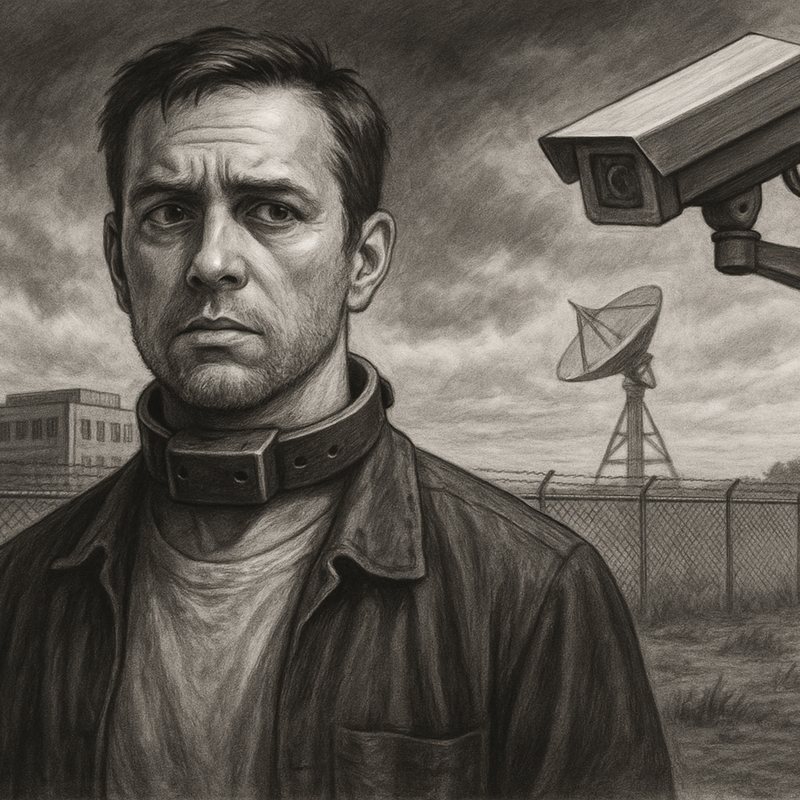
Today, we're embarking on a deep dive into, frankly, an alarming perspective that paints a picture of a nation operating under a pervasive invisible surveillance mechanism, a system designed not merely to observe, but to actively conditioned behavior on a national scale. The material describes America as what it actually terms a shock collar state with an invisible fence. A shock collar state. OK, so our mission today is to thoroughly explore how this alleged system operates, right? We need to delve into its surprisingly deep historical roots.
Which are quite extensive, as we'll see. Understand how our everyday technology becomes an integral part of its fabric and examine why, according to these sources, we might even be well complicit in its ongoing perpetuation. That's a key point they raise. We're going to pull apart the claims that virtually every action, every thought, every flicker of descent is meticulously recorded and permanently filed away. It's an unflinching look into what the sources call America's invisible shock collar.
Let's. Get into it. So let's jump right into what the material describes as this pervasive, invisible net. The central, frankly astonishing assertion is that literally every public action you take, whether you realize it or not, is being recorded and filed. That's a key assertion, absolutely.
The core claim is incredibly sweeping. Every protest you've ever attended, every sign you may be waved, every chant you've shouted in public, every tiny flicker of what the sources term righteous descent, It's all supposedly being scraped up, indexed, time stamped, and stashed in a dossier with your name on. It indexed and time stamped OK. And what's particularly emphasized is that it doesn't matter if you were arrested or not. It doesn't matter if you genuinely believed you were engaging in civil disobedience or simply participating in some, you know, harmless St.
Theatre. Or just venting maybe? Or just venting, or expressing a kind of performative rebellion that you maybe never gave a second thought to afterward. The material suggests all of it contributes to this this accumulating record. This is where it starts to get really interesting, isn't it? The material contends that it's irrelevant whether you labeled it civil disobedience or harmless St. theatre. It's all recorded.
Yeah, but the scope extends far beyond just public protests. It reportedly delves into what you choose to wear or even not wear, right. Like, for instance, the material really points to donning a pussy hat or a balaclava, A Meiji hat or a rainbow flag draped over your shoulders. Things people use to signal identity. Exactly. Even something as seemingly innocuous as your hoodie is claimed to make you a target and and what the sources refer to as a post COVID society wearing a mask could mark you. Which is interesting.
Just as not wearing a mask during the height of the pandemic was also said to make you a target, it repeats this picture of constant sort of low level behavioral assessment. So you're damned if you do, damned if you don't. Almost. In some contexts, according to this analysis, yes. What's absolutely crucial to grasp here is the implication that this is not a temporary or transient measure. It's not just for emergencies.
Not at all. The sources explicitly state that the technology spun up and normalized in the name of public health or public safety or border security never switches off. It just waits. It just waits. That's chilling.
It suggests a permanent, ever active system, constantly testing your boundaries when you believe you're invisible, watching precisely how you behave when you assume you're getting away with something. It's a mechanism that is perpetually online, perpetually collecting data on everyone, building an ongoing behavioral profile. And it's not confined to just visible public acts, right? The sources also delve into what they describe as more mundane transgressions. Yes, absolutely.
Think for a moment about every store you might have been allowed to loot, as they put it, or every petty act of vandalism you perhaps thought you got away with. Consider every instance where you felt the system simply shrugged and let you off with no bond, or maybe no trial, or perhaps blamed it on a District Attorney seen as soft on crime, right. Every cash register you might have hopped. Every self checkout scanner you managed to skate through without paying. Every moment you told yourself you were too insignificant to be noticed. You thought you were invisible.
The sources claim you were noticed. The phrasing is stark. The House took notes. The house took notes. Wow.
OK, this leads us to a truly evocative and frankly unsettling metaphor used in the source material America as the mansion of bait. It's a powerful image if you envision America as this immense mansion. The sources explained that every unlocked door, every Rolex left out on a hallway table, every $100 bills sticking out of a purse, every temptation, it was bait. It was a test. Bait, not just carelessness.
Deliberate bait. According to this view, the powerful implication here is that these opportunities for minor transgressions, these moments of perceived freedom or slight malfeasance, aren't mere oversights or coincidences. They're presented as deliberate setups. To see what you'll do. Precisely.
The material posits that every time you cracked open the liquor cabinet and congratulated yourself for getting away with it, the walls were watching the walls. Don't forget. This suggests A fundamental design, A pervasive system engineered specifically to expose character flaws, moral weaknesses, and a willingness to bend OR break rules when given the opportunity. And to really drive that chilling point home, the sources lean heavily into the familiar Willy Wonka analogy, don't they? They do, and it's quite detailed.
The Chocolate Factory in this context isn't just a magical place, it's portrayed as a perfect candy colored panopticon. A panopticon like the prison design where the guard can see everyone. Exactly. The entire factory itself is conceptualized as a mansion of bait, where every hallway, every tunnel, every fantastical room is in fact a carefully constructed test. So the kids aren't just lucky winners. According to this analogy, no.
Each child with a golden ticket is under the illusion that they've won some random lottery based on pure hearted luck, but each room is designed to expose exactly what they can't resist. OK, give us an example. Well, take a Gustus gloop for instance. He finds a river of chocolate described as deep enough to drown him. Which plays right into his gluttony.
Precisely. It directly exposes and exploits his weakness. Violet Beauregard discovers A forbidden piece of gum, chews. It turns into a blueberry Freak, starkly revealing her impulsiveness and disregard for rules. Right, she couldn't resist.
Then there's Veruca Salt. She encounters an army of trained squirrels and a mountain of shiny treasures, all meticulously placed to, as the sources put it, beg her to prove how rotten she is with greed. And even Grandpa Joe. Even Grandpa Joe. He initially seems like the moral chaperone, right? But he succumbs to temptation with the fizzy lifting drink. The analysis suggests these weren't accidents. They were precisely the point, each scenario designed to reveal an inherent weakness.
And Wonka himself, he doesn't really do anything directly, does he? That's the key observation in the analogy. Wonka never has to raise his voice, never has to physically intervene or shove anyone through a trapdoor. He simply stands back, hands folded. While the Oompa Loompas handle it. While the factory's hidden cameras, which are brilliantly conceptual as the Oompa Loompas, perform their true function, recording every moral slip, every greedy impulse, every rule break.
So the Oompa Loompas aren't just singing elves. They're portrayed as a Stasi in bright overalls and almost comically sinister force, operating in a Deutsche Democratic Republic of Moral Theater, singing their cautionary lessons while simultaneously filing away every observation. A Stasi. Wow. The entire factory then becomes an expansive open air bait box, systematically cattle living every child's weakness and laying bare every parent's failure. OK, so how does this connect back to the bigger picture of America?
The transition is made remarkably clear in the sources. The material states. You walk in thinking you're special. You leave as proof. You can't help but break the rules when the walls feel sweet enough. Wonka's factory is the American mansion. The only difference is there's no golden ticket. You're already inside.
We're already inside. That's potent. This analogy powerfully illustrates the core concept, constant observation and a system explicitly designed to tempt and then record behavior not for immediate punishment, but for future leverage. Which brings us directly to this really unsettling concept introduced by the sources, what they call a shadow rap sheet or permanent crime insurance. Right. This is crucial.
It's not about immediate arrest or conventional prosecution. This is something else. It's about a persistent, invisible and deeply personal file that follows you. The sources described this as an invisible file, a shadow rap sheet, or a pseudo rap sheet that meticulously logs every antisocial behavior you performed when you thought you were free. Antisocial behavior like.
What? Well, it allegedly includes a wide range of actions, from instances of looting a convenience store to do Donuts at 3:00 AM in a city intersection, punching out your roommate, bullying someone on video. Things people might post online themselves. Even exactly, Or even bragging about a sexual assault you were convinced would never come back to haunt you. Now, in older era, such actions might lead to a local police report visible, often limited in scope and duration. Right, something formal.
But the pseudo rap sheet is portrayed as far worse. It's invisible, it functions as soft leverage, it reportedly never expires, and, crucially, it doesn't even require a judge or any formal legal proceeding to be activated. No, judge. So who activates it? How? This immediately raises A profound question. If these files are indeed invisible and perpetual, what does that signify for our fundamental understanding of innocence or the very possibility of redemption? It suggests A pervasive, constant state of being observed where every past action, regardless of its legal consequence at the time, can perpetually be held over you, ready to be deployed as leverage later. Just waiting.
It's depicted as sitting there, waiting for that precise moment when an individual reaches a certain level of influence or accumulation of assets, or simply possesses a mortgage or a government job or an office to run for, or an opinion worth silencing. When you become inconvenient. That's the implication. It's characterized as permanent crime insurance for the system, ensuring that if you ever pose any significant threat, the pseudo offense gets triggered and you learn the jolt all over. Again, the jolt, like the shock collar. Exactly.
It's not presented as pre crime in the traditional predictive sense where they try to stop something before it happens. It's framed more as a highly sophisticated system of pre leverage. Your past actions aren't just archived, they are meticulously catalogued and stored specifically to be weaponized at the most opportune time. So they want the data on your past behavior. The material contends that the state wants to precisely map the map of your character when you think no one is watching.
Every social flashpoint, every moral candy you grab from the Mansion of Bait gets scooped up, meticulously mapped to your name, and tagged for later retrieval. It sounds exhaustive. It's a system, according to this analysis, that simply never forgets, creating a digital shadow that constantly trails you. OK, moving on. It becomes clear that this isn't merely about old school surveillance tactics.
The well known Broken Windows theory seems to have undergone A profound digital transformation. Precisely. The sources draw a Direct Line connecting the contemporary surveillance state to the long standing broken windows theory. You know, the sociological idea that cracking down on minor crimes like graffiti or broken windows prevents larger decay and more serious criminal activity. Giuliani's New York, that sort of thing.
Right. But the analysis argues that this Old Street level logic didn't die with urban decay in Giuliani's New York. It just went digital. How so? It's the same principle.
It's the very same mindset and underlying philosophy, according to the sources, but applied on a vastly different and unprecedented scale. So if we connect these ideas, what does this all mean for us? The seemingly minor acts of dissent or even petty crimes aren't just about immediate law enforcement responses. No, they're fundamentally about data collection on a truly massive scale. The sources state unequivocally that Broken Windows policing laid the moral groundwork for the PRISM dragnet.
Same mindset, new scale. Wow, Prism, that's a big connection. It effectively cultivated a public appetite, they argue, for surveillance that never switches off. The old version, the theory would essentially say stop the graffiti, stop the murders. Cause and effect. Right.
The new digitally adapted version, according to this analysis, effectively says hunt the memes, hunt the chatter, hunt the moral crack before they break open. It's about preemptive behavioral intervention through data. Hunting memes, so online activity is key here. Absolutely. And the truly ingenious and unsettling twist here, as put forth by the sources, is that the bait never disappears. Mansion is always open.
Every perceived opportunity for a minor transgression, every open liquor cabinet, every easy window smash, every riot with 0 bail is designed to feed into this same invisible file. The core objective, according to the material, is to observe and document who you are when the social contract phrase. When things get chaotic. Exactly. They want to know who you betray, who you scapegoat, who you loot alongside, and who you docks.
When you think you're righteous, the sources claim, you might think you're merely breaking windows. But they're breaking you. They're breaking you, mapping you, archiving you. The petty crime in this framework becomes the on ramp to total coverage, and the cheap moral panic at the street level becomes the very justification for transforming the entire country into a cold case waiting for better tech. Waiting for better tech that connects to the data storage idea.
Precisely. And this transition to digital, this transformation of the surveillance landscape, is powered by an astonishing proliferation of everyday technology, much of it found right in our homes. Yeah, you mentioned this earlier. The sources assert that since around 2020 especially, the entire place has been rewired with technology, things we use constantly, often without a second. Thought it's what specifically your.
Nest camera, your Ring doorbell, your grocery store loyalty car, your phone microphone, your smart TV. They're all described as becoming part of the same perimeter now. Part of the fence. Part of the invisible fence, yes. And it's not just their presence.
All this personal data, regardless of how seemingly innocuous it might appear on its own, gets atomized and recombined, hoovered into data centers you'll never see, governed by algorithms that outlive any president. OK. Let's break that down a bit. Atomized and recombined? What does that actually mean in practice? Well, think about it.
When your Ring doorbell records video, it often uploads it to cloud servers, right? And in some documented cases, that footage could be shared with law enforcement either directly or indirectly, often without a warrant. We've seen stories about that. Your smart TV, beyond simply displaying content, often has built in microphones and cameras, tracking not just your viewing habits but potentially listening to your conversations. Which is creepy.
And your grocery store loyalty card tracks every single purchase, building an incredibly detailed tell profile of your habits, health, even financial status. All of this, the sources suggest, get atomized, broken down into minute data points, and then recombined through advanced algorithms to to construct comprehensive, evolving profiles. So it's the connections they make between the data points. Exactly. This sophisticated digital system, the analysis argues, effectively replaces physical barriers by wiring boundaries directly into people's minds, the sources bluntly state.
The fence isn't a metaphor, it's a protocol. It's a set of rules, an operational procedure. Yes, a set of rules that governs the invisible digital boundaries. This immediately connects to what the source is called the cold case analogy for a perpetual data storage. It's a truly unsettling thought, isn't it? Comparing our digital footprint to forensic evidence that never degrades.
It is indeed. The sources illuminate this concept by drawing a parallel to how law enforcement handles physical evidence. They explained there was a time when a mere drop of blood at a crime scene meant almost nothing beyond perhaps a blood type. Before DNA testing. Exactly. Yet forensic departments rigorously kept those lab slides in freezers for decades, waiting for the day the science caught up the advent of DNA analysis.
A murder case from 1975 doesn't remain a purely 1975 case when it's reopened in 2025 with groundbreaking new technology. The old evidence becomes new again. The old dormant evidence suddenly becomes critically actionable. OK. So, applying this principle to our digital data, what does that look like? It paints a rather chilling picture of the future. Every petty crime, every riot, every antisocial outburst you think you got away with in 2020 sits in that freezer, your personal evidence locker.
My personal evidence locker. Wow. The core idea is that with the rapid advancement of technologies like quantum computing and next Gen. pattern recognition, things that are maybe just on the horizon now for. Coming fast.
Coming fast, the fence will close like it was built yesterday. Nothing stays cold forever. So beta collected now could be used against you decades later with tech we can't even conceive of. That's the argument. The sources offer a stark example. A man who thought he framed his buddy for a crime in 1975 and walked free for decades, only to be summoned back to the gallows when the data catches up.
The fundamental difference now, according to this analysis, is that you can't burn the evidence because it lives everywhere. It's duplicated, distributed, and perpetually accessible. O If we connect this to the bigger picture, it introduces this profound concept of digital immortality for your actions, doesn't it? It really does. It's not just about what can be done with the data now with current processing power, it's about what future unimagined technologies will enable with the immense volume of data being collected today. A.
Long game. The argument is that the true game, the ultimate objective, lies in the archive itself. The sheer ability to freeze your past actions in place to be re evaluated and potentially weaponized 1020 or even 50 years from now for something you did when you genuinely believe the system had moved on and forgotten. And it seems the system isn't just passively collecting data and archiving it, it's reportedly actively scoring us. The sources use the striking analogy of an ancient Egyptian mossit scale. Yes, the material describes this system as actively scoring you everyday.
It's based on a continuous aggregation of keywords and mundane actions stacked up until your soul cross the threshold. Your soul. That's heavy. Metaphorically speaking, yes. The idea is that a certain threshold, say 5 petty crimes, 10 moral cracks, 1 flag riot, amounts to enough weight and you become a specific target for deeper scrutiny or intervention. Like a demerit system but invisible. Exactly.
The source is powerfully drawn, the analogy of the ancient Egyptian scale of mat, where your heart was weighed against the feather of truth to determine your fate in the afterlife. Right, I remember that heavy heart. You get devoured. In this modern context, Anubis, the God of the underworld, is replaced by a black budget program and the feather of truth by an algorithm. If your heart and symbolically speaking, is deemed heavy with enough betrayal and antisocial behavior, the implication is that you get devoured.
Metaphorically devoured, presumably. Targeted, leveraged, neutralized. Perhaps if it remains light, you pass for now. The absolutely crucial point, emphasized by the sources, is that this scale never goes away. It just keeps counting one moral infraction at a time, until you forget what you were ever innocent of. Constantly accumulating, always being evaluated. Always evaluating, always accumulating, constantly shaping your invisible score.
That's a chilling thought. Let's delve now into what the sources present as the core mechanism of control in this system, behavioral conditioning. The material describes America not as a traditional prison with visible bars, but is something far more subtle and insidious, a shock collar state. That's a truly powerful and disturbing distinction made by the sources. They unequivocally claim this country doesn't need prison bars and iron fences to keep you in line. It's a shock collar and an invisible fence, exactly like you'd use for a dog or livestock. Like for a dog.
Wow. The argument is that instead of expending vast resources on building ugly visible physical walls, the system chooses to wire the boundaries into your head, effectively creating mental rather than material barriers. And there's a clean here, almost brutally pragmatic economic rationale behind this, isn't there? The the sheer logistics? Oh. Absolutely.
The logistics of physically controlling 340 million Americans with a relatively small force of perhaps 4 to 5 million law enforcement and military personnel are presented as impossible. The numbers, as the sources put it, simply don't pencil out. You can't watch everyone all the time. You literally cannot post a soldier on every street corner or wiretap every whispered conversation in real time. So the alternative, they argue, is to train the population to do the policing, the self surveillance for themselves. Turn everyone into into wardens.
Exactly. The material suggests that the design of this system effectively transforms everyone into an unpaid warden, a snitch, A moral informant. You are, in essence, taught to perceive fences and patrols that don't physically exist. You imagine the boundaries. And while the shot caller is metaphorically kept on everyone's necks, the more insidious step is that you wire the fence into their skulls, making the control internal.
This, the sources contend, gradually creates a form of collective Stockholm syndrome, where the populace begins to identify with or even defend the very system that invisibly controls. Them OK, let's really unpack this. The genius here, if one can call it that it's disturbing, is the radical shift from overt visible control to covert, internally driven self-control. It's about making you your own jailer. Precisely. The sources elaborate on the power of the jolt, that momentary, unpleasant reminder of the boundary. You test the system once, perhaps twice, and when you feel that metaphorical jolt, you quickly learn where the edges are.
Like a dog learning the edge of the yard. Just like that. After that initial conditioning, the ZAP isn't even necessary. You see it put out of habit. Out of habit, not even fear necessary.
This profound conditioning means, according to the sources, that every day you wake up and measure your worth in the eyes of the hive, the moral points, the lines you dare cross, the small materials that keep you safe. The Hive constantly assessing yourself. The implication is that every protest, every riot, every petty crime is bait to see how you manage yourself when you think you're invisible. It's designed to make you internalize the boundaries so completely that you come to inhabit this open air prison so intimately the people start defending the walls they can't even see. Defending the walls they can't see, that's powerful.
The true math, as they argue, is that you don't have to pay 4 million people to chase 340 million if you can successfully engineer the 340 million to chase themselves. The sources take this concept even further, describing this pervasive system as nothing less than livestock management. Livestock management and behavioral conditioning at a national scale, refined through decades of Pavlovian loops. That's the explicit terminology used. Pavlovian loops like conditioning responses through repetition. And this is precisely where the illusion of freedom becomes critical.
The material states you're given the illusion of freedom and told the First Amendment is sacred, but the moment you act like you believe it without the script, the file opens, the footage runs, the blackmail writes itself. Without the script meaning off the approved narrative. That seems to be the implication. The sources draw a direct and unsettling historical parallel to what was done to Martin Luther King Junior decades before any of this digital panopticon even existed. How so? They didn't arrest him outright for dissent, at least not always.
Instead, intelligence agencies meticulously tracked him. They hoarded every affair, every rumor, every hotel room rendezvous they could use to blow up his credibility if he ever stepped too far out of line. Kompromat, basically. Essentially, yes. And crucially, they didn't burn that file.
They kept it as a persistent source of potential leverage. And the sources claim this same principle works now, only scaled up to everybody. That's the argument. It's particularly effective, they argue, on a younger demographic, noting that a huge chunk of the population under 26 is so consistently busy filming themselves documenting their lives. Social media constant documentation. That they don't even realize the raw footage is the leash, the very material being used to build these files. The footage is the leash.
The analysis states, rather cynically, that an undercooked frontal cortex is a beautiful thing for the ones who run the machine. They allow you to test the fence. They give you the sensation of being free. Let you run wild for a bit. They even permit you to run wild, brag about the date rapes, the carjackings, the petty violence, the weekend you smashed up a target. And often there are no immediate charges, no follow up, just. The file.
Growing just an invisible file that sits there waiting for the day you have a mortgage or a government job or an office to run for, or an opinion worth silencing. This isn't presented as pre crime as we discussed earlier. Right, it's pre leverage. It's permanent crime insurance. The collar, though hidden, is reportedly on everyone all the same. What's striking is that these ideas aren't entirely new or rooted solely in modern technology. The sources suggest that none of this is tinfoil, meaning these concepts of behavioral control have surprisingly deep historical roots in U.S.
government programs. That's a crucial underpinning of the sources argument. They vehemently stress that the US government and its contractors have tested, studied and run live experiments on population behavior for generations. Generations. Wow, like what kind of programs? Well, the material details several specific historical programs, beginning with the Stanford Research Institute, or Sri.
This was described as a Cold War hub for what is now commonly referred to as behavioral engineering. Behavioral engineering sounds ominous. They engage in explicit testing of phenomena like how crowds respond to a planted rumor, how they react to staged conflict, and how easily they'll scapegoat an enemy by feeding them moral panic, the sources flatly state they wrote the manuals for. It they wrote the playbook. These were not abstract theories, but concrete applied methodologies.
Then, of course, there's the infamous M cultra. Yes, the CIALSD experiments. A very real CIA program that explored how substances like LSD, hypnosis, blackmail, and various forms of psychological torture could break or rewire a mind. These methods, alarmingly, were tested on prisoners, patients, students, people who never volunteered. Unethical, to say the least.
Deeply and beyond Bicultra, the sources cite other equally concerning programs like Operation Chaos, Operation Bluebird, and Artichoke, all presented as examples of concerted efforts aimed at cracking identity, comprehensively mapping the human mind, and even testing whether ideology could be implanted, erased, or overridden. Trying to fundamentally alter people. That appears to have been part of the exploration, yes. What's fascinating here is how these historical examples aren't just isolated anomalies. The sources portray them as foundational architectural blueprints that didn't simply disappear after the Cold War or public outcry, but instead profoundly evolved.
Evolved into what? Well, consider COINTELPRO, the FBI's domestic counterintelligence program. The material vividly describes it as a behavior experiment turned weapon. It wasn't simply about gathering facts or intelligence. Its methods extended to active measures like seating paranoia within target groups, disseminating forged letters, actively spreading DIS info to turn allies on each other, and even blackmailing leaders with sexual dirt. So active sabotage.
Active sabotage and psychological warfare, Yes. The core objective according to this analysis was not mass arrest. It was to keep people so divided and discredited that the public would self police any real threat to the status quo. Self police. There's that theme again. Exactly.
The extensive files amassed by J Edgar Hoover during his tenure at the FBI are presented as the primitive version of the shadow rap sheet we discussed earlier, Laying the ground and work for what was to come. OK, so this extensive, deeply ingrained architecture of surveillance and behavioral influence, as the sources emphatically claim, didn't just vanish with the end of these specific programs. It transformed. It underwent A profound and transformative evolution. The material asserts that all of that architecture didn't disappear.
It got privatized, digitized, scaled and sold back to the public. Sold back to us. In the form of behavioral analytics, threat assessment, predictive policing, and national security profiling terms we hear all the time now. Right, they sound almost mundane now. The dramatic shift, according to the sources, is that what used to take a team of operatives, now it takes an API call to Amazon's recognition or Palantir's Foundry platform. OK, explain API call again.
It's essentially a request from one computer program to another. It allows automated systems to access and process fast amounts of data much faster and more efficiently than human agents ever could. Amazon's Recognition, for example, is a powerful facial recognition service. Used by law enforcement sometimes. Yes, and Palantir's Foundry platform is renowned for its data integration and analysis capabilities used by government agencies and corporations worldwide.
The sources are quite stark here. The fence isn't a metaphor, it's a protocol, and you are already inside the test. Inside the test, this illustrates a clear, uninterrupted continuity and modernization of the surveillance approach then. That's the core argument. This evolution brings us directly to the more contemporary systems that many of us are at least vaguely familiar with, like Echelon and Prism. But the sources seem to suggest these are almost quaint now. That's a fair characterization of the sources perspective. Yes, they contrast these older systems. Echelon, for instance, was a global signals intelligence program primarily run by the Five Eyes Alliance, the USUK, Canada, Australia, New Zealand intelligence sharing group. Its focus was largely on scooping up international phone calls and faxes.
Then came Prism, which gained notoriety post 911, a system that flagged directly into the data streams of major US tech firms like Google, Microsoft and Yahoo. Snowden revealed a lot about. That he did. And while these operations were framed as lawful interception, the data Hoover, as the sources describe it, was bottomless. So if we consider all of this, what does it truly mean for our lives? Snowden, as the sources grimly point out, showed the world the taps were never really turned off. And the NSA's construction of that enormous Utah data center in Bluffdale, housing billions of gigabytes of raw signals, becomes chillingly relevant in this context. All that storage capacity.
The sources particularly emphasize the idea that metadata is the message. It's not just the content of your communications, but who you called, when, where you were. That's the outline of your life, the patterns, the patterns. And the cold case analogy applies here, too. All the metadata you generated when you thought you were beneath the radar, the looting, the doxing, the petty riots, it all sits there, cold, stored, waiting for quantum computing and predictive analysis powerful enough to reprocess it like a fresh file. It feels inescapable.
The conclusion drawn is that what was once the exclusive realm of spy thrillers is now streamlined, automated, and profoundly integrated into our everyday digital lives, often without our conscious realization. It's one thing for such an expansive system to exist, but the sources introduce a truly unsettling point. Why do people not only tolerate it, but in some ways even desire it? That's maybe the most disturbing part of the analysis. It seems to be rooted in the idea that every tribe wants the caller when it serves them.
This race is a truly fundamental and unsettling question. If, as the sources suggest, this pervasive machine feeds itself on our righteousness and anger, how do we even begin to question its existence, let alone dismantle it, when we are all to some degree invested in its operation against the other side? Because we want it used against them. Exactly. The sources explicitly detail this phenomenon, stating that the right wants it when it hunts Antifa looters and anarchists.
Conversely, the left wants it when it hunts January 6th trespassers, online bigots and real or imagined Nazis. It cuts both ways then. It's a striking indictment of how partisan divisions can inadvertently fuel the expansion of such a system. And it stretches even further beyond those readily identifiable political binaries, doesn't it? It does.
The analysis suggests that border Hawks desire this system for tracking migrants. The so-called blue cities reportedly want it for monitoring rural militias, even techno utopians. People who believe tech solves everything. Proponents of technology as a solution for societal ills are portrayed as wanting it for combating misinformation and enhancing safety. It paints a picture of an almost universal human desire for control. Specifically control over the other, whoever that other may be.
So everyone wants control, just pointed in their preferred direction. Precisely. The sources deliver a blunt conclusion. Nobody wants the fence torn down. They just want to be the one with the shock button in their hand. This, they claim, is the fundamental reason why there is no longer a robust party of civil liberties or an ACLU with teeth, as they phrase it.
Everyone, it seems, is too preoccupied fighting over who gets to sit in the control room rather than challenging the existence of the control room itself. What's also quite provocative and counterintuitive in this analysis is the argument that major leaks, Snowden, WikiLeaks, manning, things many might see as blows against the system. You'd think they'd weaken it. Right. Exactly. But the sources argue they actually serve to reinforce it. How does that work?
The sources make a truly audacious claim here that the biggest leaks, the Snowden archive, the WikiLeaks cables, the Manning drop, didn't blow up the machine at all. They made you fear it more. Fear it more? They're not portrayed as genuine disclosures aimed at dismantling the system, but rather as carefully orchestrated inoculations or scarecrows. They're depicted as the shot caller buzzing in public, so you learn to keep your head low in private. A public demonstration of power.
That's the argument these leaks primarily serve to remind the public that the system is always on. The chilling implication is that the state or the system itself has a vested interest in allowing you to see the monster's teeth once in a while. Because, as the sources argue, if these files and surveillance capabilities stayed sealed and invisible forever, the public would eventually get too brave. Complacent. Complacent.
Perhaps. Defiant. So whether on purpose or by accident or by design, these leaks occur. So you whisper to yourself at night. They can see everything.
It's presented as a master class in psychological conditioning through controlled exposure. And they give a recent example, right? January 6th. The quick identification and roundup of more than 1000 January 6 trespassers is presented as a prime recent example of this principle in action. It was achieved not by hiding the dragnet, but by explicitly broadcasting it. Showing their work, essentially.
Exactly. They show the public the files, the phone tower pings, the doorbell camera footage, the Google geofences. This, the sources contend, was a powerful behavioral reminder and echo that if they can do it to terrorists, they can do it to you. Making you think twice. It's meticulously designed to make you begin watching your own edges to self police your words, your direct messages, your search history.
You essentially become your own warden because the system has so effectively taught you how and why. Finally, the sources suggest that the system's immense tower supply remains entirely uncut, regardless of who occupies the highest office. It's almost independent of politics. Yes, the material starkly states it doesn't matter which suit is standing at the podium. Donald Trump is the 45th and The Sweeney 7th President of the United States. And yet the shock collar hums away exactly the same, because no president in living memory has ever voluntarily cut its power supply.
No one turns it off. This suggests that the surveillance apparatus is a deeply entrenched, bipartisan, self perpetuating system that effortlessly outlives political cycles and specific administrations. It's not dismantled or even significantly reined in by new leaders. Rather, it is consistently streamlined and adapted. Made more efficient perhaps?
Perhaps it's enduring control is in this view based on the fundamental math of 340 million people essentially training themselves to stay put to self regulate within the invisible boundaries of this pervasive system. So what does this all mean for us? We've delved into how these sources paint a truly unsettling picture of America as an intricately designed mansion of bait, constantly logging our behavior and meticulously building a permanent, invisible digital file on each of us. A file that never goes away. This isn't just about catching criminals. It's presented as a sophisticated system of livestock management and behavioral conditioning that encourages us to self police to internalize the rules, even to the point of defending the very walls and fences we can't physically see.
If we connect this to the bigger picture, the sources suggest that you, the individual listener, are a test subject in a maze that has no exit signs anymore. No exit signs. They pose a truly profound and unsettling question if the system wants you to believe you're hearing a warning, a subtle jolt to keep you in line, but you're also simultaneously hearing a lullaby that gently tucks you back inside the very walls you vehemently swear you can't see. A lullaby that keeps you compliant. What does that imply for the concept of true freedom, for genuine independent thought, and for the very nature of personal autonomy in this digitally pervasive age? What stands out to you about this deeply provocative perspective on America's invisible fence?