Read the full transcript (4,726 words, machine made)
So have you ever really stopped to think about this? That the very technologies we use everyday, the ones designed to, you know, connect us, might actually be controlling us, Maybe subtly, maybe not so subtly. It's a really unsettling thought, isn't it? It is. And then what if these systems of control, the ones developing in places we think of as totally different, like the US and China, what if they're actually becoming more alike than we imagine?
Yeah, that's a really provocative question. We tend to put things in neat boxes, right? US versus them, free versus unfree. It's comfortable. Exactly.
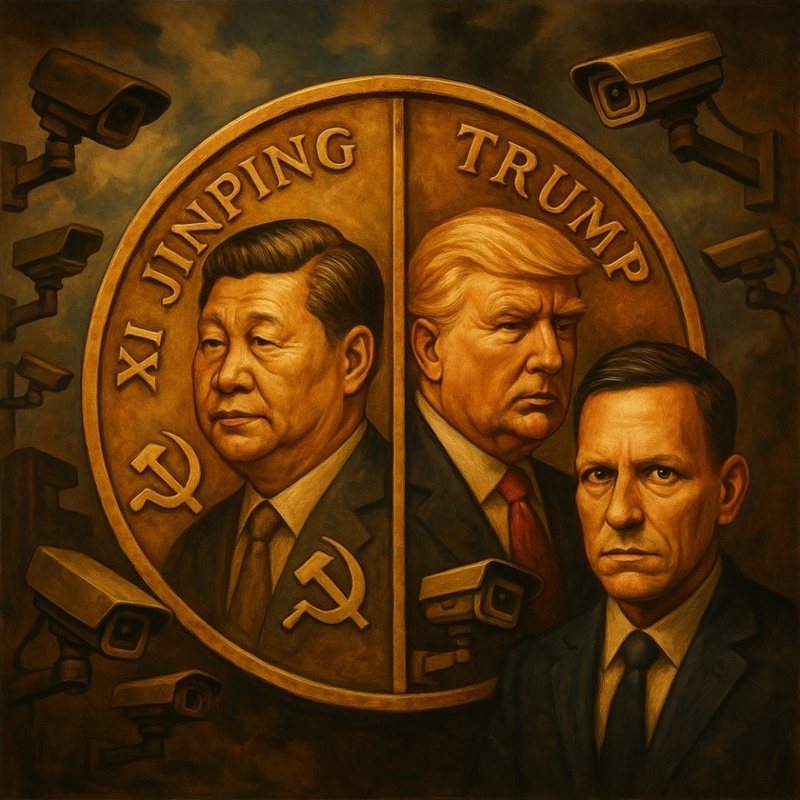
But the reality, especially with digital power and surveillance, well, it seems to be way more complex. And the material we're diving into today argues they're converging in some pretty surprising and maybe uncomfortable ways. Absolutely. And that's what we're tackling today. We're doing a deep dive into this really fascinating, maybe even a bit disturbing piece of material called Two Sides of the Same Coin when Silicon Valley and the CCP start speaking the same language. And this isn't just some dry academic paper, right? It makes a really bold claim.
It challenges our basic assumptions about surveillance, about power, and honestly, about what freedom even means anymore in this digital world. Right, so our mission for this deep dive is to really pull out the key insights from this text. We're going to unpack its main argument, which is pretty startling. But just. And that the world's two biggest powers, the US and China, are maybe without even fully intending it, sometimes building these mirrored surveillance societies.
Yeah, we'll look at the mechanisms they're using, the motivations behind it all, and some, you know, really unexpected similarities, the material points out. OK, but crucially, we're not just stopping there because like you said, things aren't always neat boxes. To really get it, you need the whole picture. Exactly. So we'll also dig into the counterpoints, the critical analysis that's actually in the source material itself. It pushes back on its own claims. That's good, so we get the full nuance view. The goal is to help you listening in get really well informed on this because it's super important, but without feeling totally overwhelmed by it. All yeah, it's dense stuff, but vital. And what's compelling about this source is that dual approach. First, it hits you with the strong, almost unsettling argument about the similarities in digital control between the US and China.
Right, the convergence idea. But then it doesn't just leave you hanging there. It pivots. It offers this really rigorous critique of its own arguments, gives you counterpoints, fact checks, brings in broader context. It kind of tempers the drama.
A bit, so it forces you to think critically, not just accept the first argument. Precisely. It's a balanced way to tackle a really charged topic. OK, let's peel back that first layer, then Section 1, the core argument, this idea of two sides of the same digital coin. Right. And it kicks off with a really bold statement. It says both the US and China are building these quote surveillance societies, and not just in a vague sense. It claims they're often using the quote same machinery, think data, algorithms and this relentless drive to know, to score and ultimately to shape what citizens do and think. Same machinery.
That's a strong claim. It is, and what really jumps out is the core distinction it makes, or rather, the distinction it minimizes. It argues the main difference isn't in the technology or the goal, but primarily in, quote, the branding and the story we tell ourselves. Wow. So how we justify it?
Basically, yeah. This immediately clashes with how we usually think, right? We see the US and China as fundamentally different on this. China surveils, the US values privacy. Or so the story.
Goes right, That's the standard narrative. But this material says maybe that distinction is getting blurry, superficial. Exactly. It pushes us to ask why this convergence might be happening now. It's not just about the tech being available, though that's part of it.
What else? It points to a mix of tech maturity. We can do this pervasive surveillance now and really importantly, some big ideological shifts, especially happening within the US. So the tools are ready and certain powerful people are thinking, hey, we can and maybe should use these tools for control. That seems to be the implication which brings us right to a really central figure in this whole argument, Peter Teal. Teal OK billionaire investor.
PayPal Co founder. Yes, but the material introduces him as much more than that. It calls him, quote, the intellectual godfather of the New Right. That signal his influence goes way beyond just tech and finance. He's painted as a real thought leader. A philosopher king for a new era, as the material puts it somewhere.
That sounds pretty dramatic. It does, and his philosophy is apparently key here. His skepticism about democracy. His belief in hierarchy, his fascination with, quote, the management of human desire. Managing desire?
What does that even mean in this context? Well, it seems tied to this idea that he sees technology not just as a business tool, but as a way to shape society itself, to impose a certain kind of order based on hierarchy. It's about fundamentally structuring power. OK, so how does that translate into actual influence? Is it just ideas or is there more?
Oh, it's tangible. According to this analysis, the material says Thiel has quote seeded a generation of politicians, tech entrepreneurs and policy architects, people who share or have adopted parts of his worldview. Examples. Well, his early crucial support for Donald Trump is 1 big one funding anti woke candidates and really relevant here, his investments in companies that are basically the plumbing of America's surveillance capacity. Palantir, Facebook. Right Palantir.
Especially data analysis for government defense. Exactly so. The material positions Teal as this crucial bridge, a bridge between Silicon Valley's biggest players, the monopolists, and the populist right. He connects. Quote memes, money and power.
So it's not just investing cash, it's linking ideology, communication strategies and the tech platform platforms themselves. Precisely translating philosophy into tech and politics. OK. And this ties into that management of desire thing. How does someone like Teal, this philosopher king type use tech to control what the material calls the chaotic masses?
This is where it gets really interesting and maybe a bit dark. The material points to Teal's interest in Renee Gerard's concept of memetic desire. Memetic desire, remind me. The idea that we don't really know what we want intrinsically, we copy our desires from others. This can lead to rivalry, conflict, social chaos as desires clash and escalate. OK, now Teal, according to this analysis, sees this potential for chaos not just as inevitable, but maybe even desirable, or at least useful.
Useful. How could chaos be useful? If you believe you're one of the few who can manage it, if you see it as a force that can be channelled to break down old structures and impose a new hierarchical order, perhaps led by the CEO kings, the material mentions It's a very strategic, almost manipulative view of social dynamics. Wow, OK, that's a heavy concept. Managing chaos through tech and surveillance. Which brings us to how this plays out in practice. Section 2.
Unpacking the parallel surveillance in practice. Right. And the first point is how surveillance has become like the material says, the water we swim in. It used to feel like something distant, right? Something the CCP did to its citizens. Exactly.
That was the narrative. But the argument here is that the same kinds of tech, the same methods are now tracking American gig workers, protesters, immigrants, minorities. And this expanded dramatically when. The material points, particularly to the period since 2016, surveillance, moving beyond just borders, going deep into cities, into our online lives. How specifically?
What are the examples? Well, it talks about agencies like ICE and DHS and it mentions this thing called the Mimetic Engineering complex. Mimetic engineering complex. What's that? It's defined broadly, not just Meta X, Google, Amazon, Open AI, but also talk radio, the whole advertising PR world, basically the entire ecosystem that shapes information and attention. OK, so this complex, what did ICE and DHS do with it? They systematically scraped social media looking for risky posts, using algorithms to flag individuals based on their online words and connections.
And who were they targeting? Just immigrants. No, and that's a crucial point. The material stresses It wasn't just non citizens. It included U.S. citizens with immigrant backgrounds and even people holding what the government deemed dangerous beliefs, views that went against administration policy. So, ideological screening using social media. That's the implication.
The analysis points to Trump era executive orders that gave DHS huge latitude to use publicly available information, tweets, Facebook posts, even private messages if they got warrants to build deportation cases. And the impact? An immediate chilling effect, especially in immigrant communities. People got scared. They started self censoring, deleting accounts.
Warnings spread like wildfire. Yeah, anything you say online can and will be used against you. It sounds like the machinery started producing similar effects regardless of the flag. Fear self censorship. That's exactly the parallel being drawn.
OK, so it's not just tracking actions, but potentially thoughts or expressed beliefs. It's thought police. Right, the material argues. This mimetic engineering complex isn't just selling ads anymore, quote. They sell influence. Influence over what we buy or more. More influence over what we think, how we feel. The algorithms, it says, are designed to maximize engagement. And how do they do that often?
Outrage. Conflict. By amplifying outrage, envy, and tribalism. That's the quote. It's an attention economy fueled by strong emotions. You see it in your own feed, right? The stuff that gets you riled up. Yeah, absolutely.
And the scary part, the material argues, is that since 2016 especially, these platforms became tools not just for fun or commerce, but for state and mob enforcement of ideological conformity. State and mob. How does that? Work well, think about it, depending on the year and the political wins, people posting certain views, anti vax, anti lockdown, pro Palestinian, anti trump. They didn't just get argued with, they faced doxing online harassment mobs.
And sometimes actual official consequences. Yeah, targeting by ICE or local police investigating them based on online activity. It shows how the platforms become spaces where conformity is enforced both informally by crowds and formerly by authorities. That reminds me of that Rand Paul quote you mentioned is in the material. Exactly.
It fits perfectly here. When you have a government that can collect massive amounts of information, that data becomes a powerful instrument for control. It doesn't have to be used for heavy-handed prosecutions. The mere existence of it creates a Society of caution, suspicion and conformity. The mere existence of the data changes society.
Wow, it creates that chilling effect, that sense of being watched, which leads to self censorship. And this goes beyond just individuals expressing views online. What about organized groups like protesters? Yes, the material talks about predictive policing in this context, using platform and data not just after the fact but before protests to monitor discussions and flag potential agitators. Predicting trouble. Essentially, and in some cases, cities actually partnered with tech firms to map out networks of influence among activists, identifying key people, potential flashpoints. Mapping activist networks.
The material describes it starkly, an approach straight out of the CCP's playbook for dissent control, again drawing that direct, unsettling parallel in methodology. OK, so the methods start to look similar. What about the relationship between the state and the tech companies themselves? That seems like a key difference usually. Right.
And the material tackles this head on with the idea of state corporate fusion, calling it the new Leviathan. Sounds ominous, yeah. How does it compare the US and China here? In China, it's pretty straightforward, right? The CCP basically compels tech companies to hand over data. Share everything with the state top down command. OK, that's clear authoritarianism. But in the US, the approach is different, maybe more subtle. The state doesn't usually compel in the same way. Instead, it quote, contracts out its surveillance. Pays companies for the data.
Exactly. Huge government contracts for data access, Algorithmic analysis, Predictive tools. But the material argues the effect is largely the same. How so? Because it results in a quote, seamless flow of data from your phone, your bank, your face, into the hands of power. Whether compelled or contracted, the data ends up in the same place.
And this public private partnership is presented as the new norm. The new bipartisan ideology, according to the text. It's just how things are done now, regardless of who's in charge. It's less about if the state gets the data, more about the mechanism and the payment involved. And Teal's role comes back here, his investments in Palantir Facebook. The material argues these aren't contradictions to this philosophy, but logical extensions of it. Belief in monopoly hierarchy, Managing memetic desire. Maybe Chaos is fine if you have the tools to manage it. Tools provided by companies like Palantir. So he invests in the tools to manage the chaos he potentially sees as inevitable or even useful. That's the interpretation offered. It paints a picture of him seeing these tech platforms not just as businesses, but as instruments for shaping society according to his hierarchical vision. And what about the political angle? Politicians who criticize Big Tech publicly. Like Trump and his circle railing against liberal Silicon Valley?
Yeah, the material suggests that even while they criticize publicly, they privately see these very tools, the data, the algorithms, as essential means to achieve their goals, restoring order, achieving greatness. So criticize the power structure, but uses tools anyway. A strategic embrace, perhaps A bit cynical. Maybe like that Josh Hawley quote in the material about fighting the robber barons of Big Tech to recover America's populist democracy. Right, I remember that. He's voicing a real concern, but the underlying theme across the political spectrum often involves wanting to control or shape the information flow, even if the justification is different.
OK, the material then focuses on a really specific and disturbing parallel targeting immigrants and minorities. It calls it a universal playbook. Yeah, it starts with a known example, the CCP's use of surveillance against Eagers and dissidents. That's the established benchmark for this kind of targeted control. But then it applies it to the US. Directly, it highlights how under Trump, ICE used social media monitoring and predictive analytics, specifically against immigrants and even U.S.
citizens with immigrant family backgrounds. Based on what their posts, who they do online, both. Building cases. Identifying perceived risks within specific communities based on identity associations. Online speech. The material mentions anecdotal reports from that time. Of people being detained or deported based on old tweets, Facebook friends.
Exactly. Things like that. And the core logic the material claims is disturbingly the same. Identify, isolate, neutralize. Wow.
Identify, isolate, neutralize. The argument is the only real difference lies in the mechanics and branding, not the fundamental goal of controlling a specific population group deemed problematic. That branding difference, yeah, it comes up again with the language used, right? The philosophical rhetoric. Yeah, absolutely.
The CCP talks about harmony, stability, national rejuvenation, words that sound positive, collective. While the US right like Trump or Thiel talks about order security, American greatness also sounds positive but maybe more nationalist or security focused. Right. But the material argues both sets of terms are essentially code for control, code for managing risk, for channeling that potentially chaotic mimetic desire away from the powerful and towards acceptable targets. Immigrants. Dissidents.
Political opponents. So different words, same underlying goal. Keep power, suppress threats, manage the masses from the top down. That's the core assertion, and it ties back to Thiel's skepticism about democracy. His comments like competition is for losers. We're questioning if freedom and democracy are compatible. How does that mirror the CCP?
The material says it mirrors the CCP fundamental distrust of pluralism, of dissent, of messy democratic processes. It suggests both share a core belief the crowd is dangerous, the individual as a potential threat and the solution as hierarchy, surveillance and the management of desire. A very similar worldview operating under different political labels. It really brings that Harry Truman quote from the material into focus, doesn't it? About governments committed to silencing opposition, only having one way to go. Down the path of increasingly repressive measures until it becomes a source of terror and creates a country where everyone lives in fear.
Yeah, that hits hard in this context. And this leads to the point about denial and camouflage the American way. How so? The material observes that the CCP is, in a way, more honest about its authoritarianism. They don't really pretend it's something else. Right, it's overt.
Whereas the US administration, particularly the one focused on in this section, tends to cloak it in the language of law and order and securing our borders. Using familiar acceptable terms to justify the same fundamental approach. Slightly different wrapping. As the material puts it, it's about making control palatable within a democratic narrative. A key difference in presentation, if not always an underlying technique. So where does this convergence potentially lead? What's the end game according to this argument? An unsettling one?
No place to hide It paints a picture of a world where the actual infrastructure of control is global, modular and for sale to the highest bidder. Meaning the tech developed in one place can be easily sold and used anywhere. That's the fear a universally available toolkit for social management crossing borders easily. And in that world, the line between free and unfree gets. Blurred by data, the material concludes that the only real difference left might just be who gets to pull the levers.
That's a pretty. Bleak outlook. The tools become universal, the branding fades, and it just comes down to who's in charge of the data flow. It is stark, though, that Reagan, code included, also offers a warning, but from a different angle, doesn't it, about the threat coming not from foreign foes but from power slipping away from the grassroots to a remote central authority? Yeah, a warning about domestic centralization of power, which fits the digital surveillance concern too. So wrapping up this core argument, the material suggests the US and CCP systems aren't opposites anymore, if they ever truly were in this digital realm, they're becoming reflections, learning from each other, competing, and maybe ultimately resembling each other. Wow, OK, that is a really powerful and, like you said, unsettling argument.
It is, but remember, that's just one side of the coin, right? The material itself insists we look at the other side, the counterpoints, the critiques. Right, Section 3. The other side of the coin, Counterpoints and critical analysis. We need this balance.
Absolutely. And the first big counterpoint is basically. It's not so neat. Meaning the mirror image idea is too simple. Exactly. It's too neat, maybe overlooks crucial differences. The reality is messier.
Like what key differences? The most fundamental one, the CCP, is a one party authoritarian state. Period. No Free Press, no independent courts that can really challenge the party, no meaningful elections. That structure changes everything about how surveillance is used and experienced. OK, where's in the US?
In the US, even with a growing surveillance apparatus, there are still brakes. Imperfect ones, sure, but they exist. Courts can rule against the government. Whistleblowers leak things. Journalists investigate. There are lawsuits.
There's Congress, messy as it is. So mechanisms for pushback and accountability still exist, even if they're under pressure. They do. They add friction which isn't really present in the same way in the CCP system. What about the methods of control? Are they really the same?
The material offers the carrot versus stick distinction here. America's version, it argues, is often about selling the convenience of being watched. The give us your data will give you dopamine model. Yeah, basically, you trade privacy for personalized services, targeted ads, easy logins, cool features. There's often an element of perceived benefit and opt in, even if the implications aren't always clear. Where is the CCP PS approach is?
Much more stick. Overt social credit scores affecting your life. Direct punishment for non compliance re education camps in extreme cases. It's coercion, not convenience. So similar tech maybe, but the incentive structure and a lived experience are totally different. Fundamentally different, this counterpoint argues. OK, this sounds related to that other big rebuttal surveillance capitalism.
The surveillance. State exactly, drawing on Shoshanna Zubach's work, the core ideas about the motive. Right, in the US, the main driver is. Profit. Overwhelmingly.
It's about profit Algorithm shape behavior to get you to click ads, buy products, stay engaged longer. It's about monetization, not necessarily direct ideological control by the state. So Meta, Google, Amazon, they feed on our engagement, our outrage, sure. But. But crucially, they don't answer to a single party chairman. Their primary loyalty is to shareholders, to revenue growth. It's a commercial logic, not primarily a political one dictated by a ruling party.
That creates a very different dynamic. They might enable state surveillance through contracts, but their core business isn't the same as the states. That's the distinction this rebuttal emphasizes. OK, what about the fact checking part? What did the material confirm is true and what did it say was maybe overstated in the main argument?
It confirms some key things we discussed. Yes, ICEA did scrape social media for risky immigrant posts. Yes, predictive policing was used to flag activists. Yes, Peter Thiel has publicly questioned democracy. These are factual. It was overstated.
The idea of the US system being same machinery, same result, that's called 2 pat. It ignores constitutional limits even if they're tested and the real pushback from activists and courts. Outcomes aren't identical. And the no place to hide idea is also flagged as overstated. While surveillance is pervasive, we do have countermeasures.
Encryption is still widely available and legal. We have things like GDPR influencing privacy globally, FOIA requests, lawsuits, tools like Signal and Tor. So there are ways to resist or create friction. It's not a totally sealed system. Right. There's still agency, still tools for pushback. The material also adds more complexity, right? These contextual threads and tangles. Yeah, complicating the simple narratives, For example, Thiel and Trump, or the GOP more broadly, it's not a unified block on surveillance.
You have libertarians opposing mass surveillance clashing with populist who might favor it. For law and order, there's internal division. Makes sense and the state versus corporate dynamic? It reiterates that difference. China compels data sharing. the US contracts it out.
The counterpoint argues the outcome isn't quite the same because of that friction. We mentioned court battles, leaks, contract negotiations. It's not as seamless as the main argument might imply. OK, and what about big tech itself? Is it just a tool for the right or? No, and this is important, the material points out big tech's inconsistency.
Yes, they sometimes censor conservatives, but they've also censored leftists, pro Palestinian voices, anti vax people. It's described less as a consistent ideological enforcer and more as a chaos machine. A. Chaos machine meaning. Driven by engagement, ad revenue, and often clumsy reactive content moderation policies rather than a single coherent political agenda, it challenges the idea that it's a simple monolith serving one side.
It's messier than that. And the nuance extends to China too, right? Avoiding the cartoon villain trap. Yes, the counter analysis cautions against that. It suggests thinking of the CCP leadership as strategic, long term thinkers.
They think in centuries. They test, adapt, respond to carrot and stick. More practical than evil, as the material puts it. Not excusing them, but understanding their approach. Exactly, understanding their pragmatism, their realism, their nationalism.
And it adds that they watch the US with a mix of fear and amusement, which adds a layer beyond just seeing them as a monolithic threat. OK, that's a lot of important nuance. What about those quick FAQs mentioned? Right distilled points feel on democracy. Clear skepticism.
Competition is for losers. US copying China's playbook, Similar tech, different incentives, profit versus absolute control. Trump expanding surveillance. Yes, ICEHHS used social media in new ways and the Biden admin hasn't reversed. All of it shows continuity.
And the big one, can we resist? The answer given is yes. Privacy tech, strong data laws, whistleblowers and relentless pushback all work. And crucially, encryption is still legal. For now, it points to concrete tools and strategies. So resistance is possible.
It's not a completely hopeless situation. Not according to this analysis, no. There are levers we can still pull. OK, so taking all that in the core argument and the counterpoints, where does that leave us? Section 4. The path forward resistance and reflection. Well, the starting point is accepting A baseline reality. Surveillance is here to stay.
It's baked into modern life now. Right, we can't really put that genie back in the bottle. Probably not. So the real question, the critical fork in the road, isn't if surveillance exists, but whether it ultimately imprisons or empowers. Imprisons or empowers?
Meaning, does it just lock us into hierarchies and control? Or can we somehow harness it? Can data be used to build a freer future if we keep dragging it into the light? Can we make it work for transparency, accountability, individual agency instead of just top down control? That's a huge question. Can we turn a tool of control into a tool for freedom? It's about agency, isn't it?
Can we collectively shape how these powerful tools are used, ensure they serve us, rather than just observe and manage us? And the material ends with that metaphor, right? The coin, yeah. The coin doesn't just have two sides, it spins. Meaning it's not a fixed state, it's dynamic, always changing. Exactly.
It's not US versus China as static opposites or surveillance versus freedom as a done deal. It's an ongoing process. Control and influence are constantly shifting, adapting. The situation is. Fluid, which means we need to stay vigilant, keep questioning. It's a call to active engagement. Definitely challenge the narratives, demand accountability.
The tech itself might be neutral, but how it's used, the context, the intent, that's what matters for freedom and power. OK, wow, we have covered a lot today. A really deep dive into these parallels, often unsettling ones, between US and Chinese surveillance explored feels influence. But also, importantly, consider those crucial counterpoints that add the nuance we need. It's definitely a lot to chew on, but understanding these convergences, the differences in motivation, the shared tools, it feels essential for figuring out where we're headed.
You know this stuff impacts your life every single day. Absolutely. So the big question for you listening in What does this all mean for you? In this world of constant data collection, how much control do you feel you have? Maybe more importantly, how can you help ensure these tools serve freedom, not diminish it?
Can we really imagine that future? The material asks about where data empowers rather than imprisons? What would that even look like? This deep dive, really, it's just scratching the surface. It's the start of understanding these huge shifts in power and tech. What stood out most to you today? What are you going to do with this information, this perspective?
Keep digging, keep asking questions. And keep challenging the stories we tell ourselves about freedom, power, tech. Because, like the material says, that coin is spinning, and understanding which way it's turning, well, that feels more important than ever.