Read the full transcript (1,338 words, machine made)
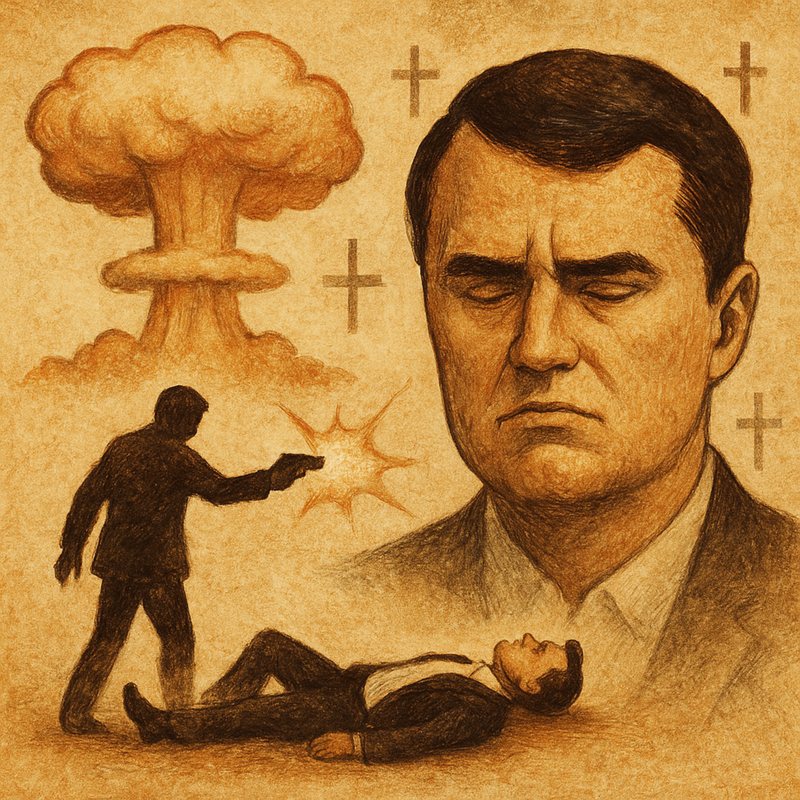
Let's dive right into a pretty provocative idea. What if trying to shut down ugly speech doesn't actually stop violence? What if it causes it? We're going to unpack a theory that makes exactly that case, and it all starts with a fictional but maybe chillingly familiar political crisis. Just think about those words for a second. The source uses them to describe the funeral of a major political figure, Charlie Kirk.
And right there, that single phrase just perfectly sets the stage. You can feel a nation grappling with an event that's about to push it right over the edge. It captures the deep reverence on one side, and you can just feel the simmering fury on the other. The scene the Source paints is an America so deeply polarized that a political assassination doesn't bring people together. No, it becomes a Sarajevo moment.
You know, that one single shot that acts as the spark for a massive, massive conflict. It's the thing that ignites all these tensions that were bubbling just under the surface, not just at home, but all around the world. And look at how fast it all happens. I mean, the timeline here is just staggering. We are talking about one week, just seven days to go from a single assassination to a full blown worldwide political frenzy. You've got global leaders getting involved. Social media platforms are completely fracturing, and the calls for revenge are just deafening. So how does the author argue we even get to a point like this? Well, this brings us to the first big concept from the source material, the latter of escalation. The core idea here is that when you punish and suppress speech, you don't actually make it go away. In fact, the argument is you do the exact opposite. The theory lays out this really clear four step process. Step one, simple enough.
Someone says something ugly, could be an insult, a controversial tweet, you name it. But then comes Step 2, punishment. That speech gets shut down, maybe through public shaming, maybe someone loses their job. Now, according to this model, those silenced ideas, they don't just poof, vanish. They move to Step 3, festering in darker channels, you know, online and off. And all of that leads to the final explosive step. Some of the people who feel silenced, they stop talking, and they turn to violence instead.
And right here, just when you think you've got it figured out, the argument takes this wild turn. The author says, hey, this isn't just some abstract social theory. This is nuclear physics. I mean, wow, that's a huge claim. And it's clearly meant to completely reframe how we think about this entire problem. So this brings us to the absolute core of the whole theory, the implosion trigger.
It's this incredibly powerful metaphor, and it's designed to explain the, well, the physics of how words can literally ignite violence in a society that's already polarized. So this is the key question, right? The theory isn't just saying suppressed speech leads to violence, it's trying to explain the mechanics of how how can something as small as a tweet or a bad joke become the actual detonator for something so incredibly destructive? This slide just leaves the analogy out perfectly. On the left you've got the physics of a nuclear bomb.
On the right are social dynamics. So think of a polarized society as that unstable plutonium core. They call it the pit. And the waves of public shaming and outrage, Well, those are the conventional explosives wrapped all around it, designed specifically to squeeze inward. In both cases, the result of that intense compression is a devastating runaway chain reaction.
So here we have the formal definition. The implosion trigger isn't the speech itself, and it's not the violence itself. It's the dynamic. It's the process by which one thing ignites the other. It's kind of like how TNT, a relatively small force, can be the thing that sets off a massive nuclear chain reaction.
All right, so let's break this metaphor down at piece by piece so it really makes sense. First, you've got the pit in the bomb. That's the plutonium core in this social analogy. It's a society that is already fragile, it's brittle, it's deeply divided. It's already primed and basically just waiting for a catalyst. Next up, the explosive lenses.
Now, in a real bomb, these aren't just random explosives. They are precisely shaped charges, all designed to focus the blast perfectly inward. The author identifies these as our media outlets and social media influencers, the ones who amplify and focus outrage, directing all that energy right onto the pit with perfect, crushing symmetry. Then comes the force itself. Compression.
In this model, that force is the immense social pressure of public shaming, of deplatforming, and what people often call cancel culture. It's that relentless inward squeezing force that gets applied to anyone who expresses what are seen as forbidden opinions. And what happens when that compression becomes too much? The system reaches what the author calls criticality. That's the point of no return. The pressure becomes completely unbearable, and society basically implodes in a chain reaction of violence. Just like that, plutonium core achieves fission. OK, so if that's the author's diagnosis of the problem, which is pretty bleak, what's the proposed antidote? The final part of this document shifts gears. It goes from describing the path to implosion to outlining a path to prevention.
The framework is called Protecting the Civic Square. Now, to introduce the solution, the author turns to a really surprising source theology. This quote is used to set up a concept that tries to find a middle ground between two extremes. Our culture seems to love total indulgence on one side and merciless punishment on the other. And that middle path is called Stern Mercy. It's a paradoxical idea, right?
It means you protect a person's right to speak. You're essentially forgiving the speaker well, at the same time you are firmly, loudly rebuking the content of their speech. It's an attempt to hold 2 competing ideas in balance, which is not easy. So how do we actually put Stern Mercy into practice? The theory proposes these 4 pillars. First is legal restraint.
That means upholding a really high bar for what actually counts as incitement to violence, like the US Supreme Court's Brandenburg Standard, which protects all speech unless it's aimed at causing imminent lawless action. Second, institutional resilience. This is about companies and universities resisting that constant pressure to punish every single transgression instantly. Third, cultural toughness. A society that can actually learn to hear ugly words without demanding immediate punishment for the person who said them.
And finally, merciful exactness. This one ties it all together. It means fiercely defending a person's right to speak while just as fiercely rebuking the content of what they're saying. So as we get to the conclusion, the document frame is this entire issue not as some inevitable decay we're doomed to, but as a conscious choice. A society, the author argues, has real agency in how it decides to deal with speech and dissent. And this quote just brings the entire nuclear metaphor full circle.
Words. They're like the charges around that plutonium pit. The choice isn't whether or not the words exist, They're going to. The choice is how we arrange them. Do we arrange them in a way that focuses all their energy inward to cause a massive implosion? Or do we create an environment where they can just disperse harmlessly into the air?
And so this explainer leaves us with this final and I think really critical question. In an environment that seems to thrive on outrage and amplification, what are the real pillars? The legal ones, the institutional ones, the cultural ones that can actually protect the civic square from imploding? It's definitely a question worth thinking about.