Read the full transcript (8,311 words, machine made)
This is the brief on Charlie Kirk's assassination, free speech and the implusion trigger. OK, So what we're looking at here is this really intense essay. It analyzes the fictional 2025 assassination of Charlie Kirk, you know, the political guy. And it uses this wild analogy, a nuclear bombs implosion trigger, to argue that when you try and force hostile speech underground, it doesn't actually go away. It just compresses all that anger until, boom, it explodes into real violence. All right, so three big things to pull from this. First off, there's the event in the essay itself, Kirk getting killed in September 2025.
Right away, it's labeled as Sarajevo moment. You know, like that one shot that triggers a massive escalation and the fallout totally global. Trump promising vengeance, his VPJD, Vance calling Kirk a martyr, Far right protests erupting like everywhere, London, Rome, you name it. OK, second, why did it explode like that? Well, the essay digs into this implosion trigger theory. It's basically saying, look, when institutions punish dissent, you know, cancel culture, people losing jobs, getting expelled, that hostility, it doesn't just vanish, it gets all concentrated, like social pressure building up, turning ugly words into actual real world violence.
It kind of metastasizes. And finally, how do we prevent this kind of thing? The essay talks about this paradox. Stern mercy. Sounds weird, right? But it means protecting the speaker's right to talk even if you hate what they're saying, while also strongly challenging the speech itself.
It means institutions got to tolerate tough disagreements and really defend free speech using the Brandenburg Doctrine standard, which basically says speech is only punishable if it's directly meant to incite violence right now. So the bottom line, if we want to avoid political implosion, it's got to be about resilience and restraint, not jumping straight to vengeance. Welcome to the debate. Our focus today is on the analysis following the 2025 assassination of Charlie Kirk, an event described in the source material as a well, a Sarajevo moment. The global political fracture that came after really exposed an unnerving fragility in, you know, modern societal discourse.
And the discussion really centers on the source's primary framework, this chilling nuclear analogy. It calls the implosion trigger. This theory that conventional discourse, words, dissent, even outrage can act like those explosive lenses compressing a nuclear core, pushing a brittle society past a point of no return towards large scale political violence. Exactly, the material argues the structural failure causing this collapse lies in how we manage speech. So our central question for debate today is this does the primary danger of societal implosion arise mainly from the institutional suppression of difficult or offensive speech, which the argument goes builds up concentrated hostility? Or is the more potent immediate threat the sophisticated high speed amplification and strategic arrangement of inflammatory words that actually, you know, triggers the detonation?
Right, 2 related but distinct failure points. Yes, and I'll be arguing that the long term structural mechanism of institutional suppression and punishment is the chief factor. It creates a society brittle enough to implode. Suppression is the compression mechanism, essentially. OK.
And I'll maintain that while yes, institutional failures create underlying fragility, the sheer speed and calculated precision of modern digital amplification constitute the immediate and most potent danger, acting as the final detonation charge that transforms that concentrated pressure into catastrophic implosion. OK. Well, let me start then. The source material provides, I think, a pretty clear diagnosis of structural failure, detailing what it calls the ladder of escalation. It emphasizes that when difficult or or hostile speech is choked, you know, when people are deplatformed, fired, shamed into silence, those sentiments, they don't just vanish. Instead, the text says, they metastasize and find darker channels.
Mm Hmm. So I assert that institutional punishment of dissent, the loss of jobs, academic expulsions, social shaming campaigns, what we generally might call institutional cancel culture, these are the critical early steps on that ladder. This suppression paradoxically doesn't prevent violence. It actually concentrates the hostile material, forcing it inward, creating the high pressure pit needed for criticality. The source even calls every punitive cancellation of Mini Versailles breeding precisely the kind of deep, concentrated resentment that leads to the next major political conflict.
OK, I see why you think that, but I would frame the relationship between the structure and the trigger well differently. I agree that institutional failures build the core of hostility, definitely. But a bomb needs more than just compressed material, right? It requires A precise engineered detonation. The material describes the true drivers of criticality not really as the gradual buildup, but as the precision and the timing of the final charge. The text points explicitly to the high speed strategic elements.
Outrage influencers are explosive lenses. Retweet storms are detonation wires. Media amplification is compression. Now, if society is already near critical mass due to those prior failings you mentioned, the most acute threat becomes the orchestrated global noise that instantly forces the symmetry and timing required for detonation. The danger, I argue, is the calculated, strategic use of words by political actors in a moment of crisis, not just the institutional failings that might have preceded it.
But that immediate detonation you describe, it can only be effective if the social structure is already too brittle to absorb the shock. I mean, if institutional resilience were high, if citizens were, let's say, A accustomed to hearing ugly words without immediately demanding punitive consequences, the amplification wouldn't find purchase, would it? The source's key paradox here is foundational words must be tolerated because they are dangerous. Suppression is the structural flaw that ensures the resulting hostile energy is organized into a symmetrical concentrated pressure field, basically making it ready for the smallest trigger. I come at it from a different way though.
The immediacy of the detonation as described in the source. It forces us to prioritize the active trigger over the, let's say, passive structure. We saw the true danger in the week following Kirk's assassination. This wasn't some slow pressure release. It was instantaneous political warfare.
You had Trump blaming the radical left, JD Vance endorsing doxing campaigns against journalists, Elon Musk calling Democrats the party of murder. I mean, this was rapid, global and highly orchestrated political manipulation. Right, the reaction was immediate. Exactly. So if the danger is truly an implosion, a process needing exact symmetry and timing, then the strategic use of high speed media to organize and focus political hatred instantly is the primary mechanism of failure. And I think that far surpasses the gradual pressure buildup from suppression in terms of immediate danger. OK, let's ground this in the key metaphor. The source uses the explosive lens. You focus on digital outrage patterns as the lens, but I argue the institutional punitive action is the original lens. The source argues that by denying hostile sentiment and outlet, the institution compresses the core, that denial, the cancellation, the punishment. That's the mechanism that shapes the energy internally, making it symmetrical and concentrated for implosion. It sets the condition.
I'm sorry, but I just don't buy the institutional silence is the active lens. That confusion between structure and action seems key here. Institutional suppression creates the fuel and concentrates it, yes, but the source defines the metaphorical explosive lenses specifically as, and I quote, social media outrage patterns that compress discourse into violence. That implies the actual act of compression. The engineering of the symmetry comes from the digital organization of outrage, forcing the mass to reach criticality. But isn't that digital organization only possible because the underlying material is already concentrated? Well, think of the real world analog the explosion of conspiracy theories.
The material suggests that institutions trying to scrub forums or de platform users on, say, peripheral platforms only push those groups to more obscure, focused and pressurized channels. OK, that is compression, I grant you, but it's the subsequent precise targeting of these groups by outrage influencers delivering focused political charges at high speed. The retweet storms, the immediate coordinated targeting that achieves the critical symmetry needed for widespread real world action. So we have to prioritize the precision of the detonation, I think, over the existing pressure. But that digital warmization only achieves fatal symmetry because years of institutional suppression have fundamentally weaken the social containment field, what the source calls cultural toughness. The outrage hit so hard because the public arguably already lacks the resilience to hear ugly words without immediately demanding political action or, you know, punitive sanctions. OK.
And let's look at the institutional response after the assassination. This touches directly on your point of amplification, but I think it proves my point about underlying fragility. The material documents how the political fracture accelerated when institutions responded well performatively. Flags that have Stafford Kirk the Pope praying, Fox News announcing A tribute, Comedy Central pulling a mocking South Park episode. Exactly. That week proves institutions weren't passive failures. They became powerful amplifiers.
Now did these establishment reactions accelerate the fracture or did they provide necessary containment? I argue the coordinated amplification and frankly, canonization of Kirk. That sudden unified global noise was a calculated political move that further drove society past criticality. Institutions were supposed to absorb the shock and model resilience. Instead, they jumped right into the high speed political theater. I acknowledge their immediate failure to moderate absolutely, but I stress that this amplification was only so devastating because of the pre-existing fragility caused by those prior suppressive failures, The source argues the real goal should have been institutional resilience, the ability of citizens to hear ugly words without collapsing. And this resilience, the argument goes, was destroyed by years of institutional overreaction to mere transgression, paving the way for the later destructive amplification to take hold.
If the Republic wasn't brittle, if the pit wasn't already concentrated, the digital noise might have just been noise, not a detonator. So just to be clear, you were arguing that if a few universities hadn't fired or punished figures years before for, say, offensive speech, then the calculated global political outrage, the orchestrated efforts by major political figures media outlets in the week following the assassination would have simply dissipated harmlessly? That that seems to put too much weight on the initial containment failure, and maybe too little on the massive organized power of calculated political outrage operating at today's speeds. The threat feels like it has evolved past just structural weakness. It feels tactical now.
I'm not convinced by that line of reasoning, primarily because the sources only stated solution hinges entirely on restoring that structural resilience. The only solution actually provided is this paradoxical concept of stern mercy to protect the speaker's civic right while actively socially rebuking the speech's content. Stern mercy, yes. Embodied by that gospel phrase, Neither do I condemn you. Go and sin no more. This framework requires defending the civic square, maintaining legal restraint, something like the Brandenburg Doctrine, which only punishes speech, inciting imminent lawless action while allowing robust social correction of the content.
This balance, the source implies, is mandatory to prevent the pressure pit from forming in the first place by legally dispersing the hostile energy while socially managing the content. That's, well, that's a compelling argument because if it does define the only path out of that binary trap of what is the source? Call it indulgence or vengeance, which it notes secular liberalism tends to collapse into. OK. However, have you considered the practicality, I mean the practicality of implementing such a delicate, highly nuanced ideal, stern mercy or merciful exactness in a cultural context that operates at the speed of the implosion trigger? It's difficult, certainly.
Right. We have highly polarized media institutions that are often commercially incentivized to promote outrage, binary moral judgments. Is it really realistic to expect a brittle Republic, as the source calls it, to suddenly adopt this complex balancing act? You're proposing sort of a surgical approach in a cultural environment that seems to demand broad, immediate, and often punitive responses. It may be extraordinarily difficult, yes, but it remains the mandatory structural solution.
According to the source. The alternative is permanent instability. Consider how this works, or should work, in the legal versus social spheres. If a figure says something deeply racist, the principle of Stern mercy mandates that the law, the courts, the state protects their right to say it right up until the point of incitement. That's the mercy part.
But society, employers, colleagues, commentators is obligated to sternly and fiercely rebuke the content. That's the sternness. OK. The failure occurred, the argument goes, because institutions started confusing the legal sphere with the social sphere. They began punishing content as if it were incitement, thus concentrating the hostile energy rather than dispersing it through robust criticism.
So suppression creates the pit. Tolerance, when coupled with strong social rebuke, disperses the material legally and addresses the content socially. But that level of intellectual precision requires faith in institutions that the source material itself suggests have already failed spectacularly. The events of that September week show The detonator was already set and it was activated immediately globally, strategically, the speed and coordination of the outrage and political manipulation, the strategic arrangement of words using people as quote blasting caps suggests that the primary threat is now fundamentally active and immediate. If we focus exclusively on restoring a long term structural solution like Stern Mercy, we risk missing the fact that the digital architecture has made instantaneous detonation just too easy. We might be past the point where simple structural tolerance is enough to disperse the energy.
We have to contend with weaponized amplification that exploits any pre-existing weakness immediately. Well, we certainly agree on the catastrophic stakes, which the source confirms by stating quite starkly that the nuclear analogy is not hyperbole. My core warning remains focused on avoiding the hard dissent. Suppression is the structural mechanism that concentrates the energy, turning a brittle society into a potential bomb. Protection of the civic square coupled with social accountability is mandatory, I argue, to prevent that pit from forming.
And I reiterate that while suppression is structurally harmful, absolutely, the instantaneous and globally coordinated implosion demonstrated by the event surrounding Kirk's death suggests that the active strategic amplification and arrangement of words that high speed digital architecture employed by political actors is the more immediate and potent threat driving society past criticality today. The detonation mechanism itself is the point of catastrophic failure, not just the compression that preceded it. So we've clearly illuminated 2 profoundly different yet deeply connected dynamics presented in the material. The structural weaknesses caused it by long term suppression and the instantaneous targeted exploitation of those weaknesses through amplification. Yes, the tragedy of Charlie Kirk's death as depicted really highlights the immense complexity of balancing speech protection and social stability, especially in an age of instantaneous communication. Indeed, the material clearly offers competing explanations for this collapse, confirming that the Republic must immediately address how it manages speech, recognizing both the pressure cooker effect of institutional suppression and the volatility of high speed strategic amplification. Lest his killing truly becomes The detonator, there is clearly much more to analyze in the material regarding this dangerous dynamic.
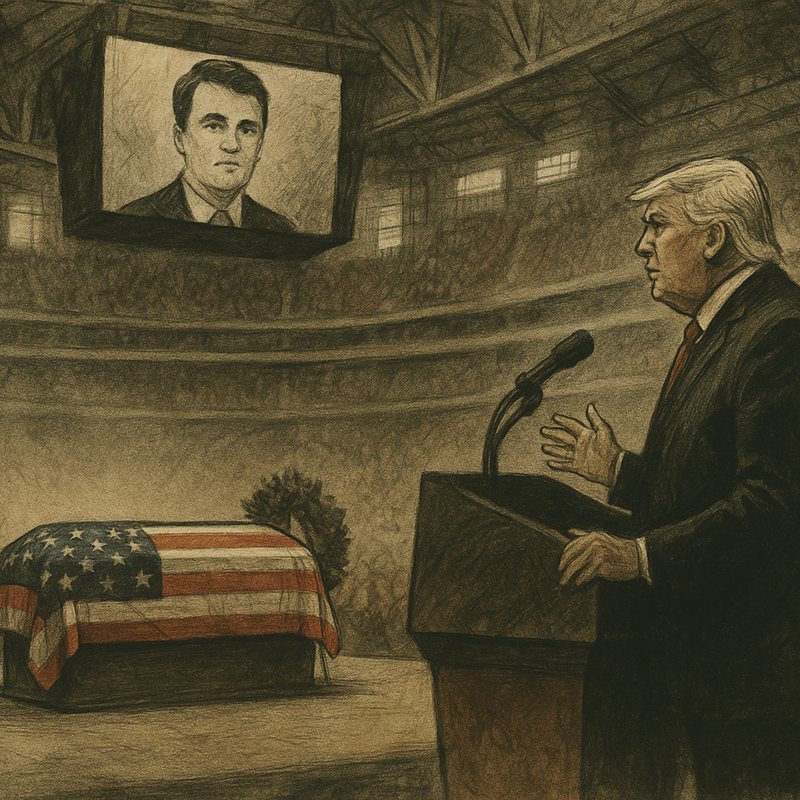
Imagine this, a really punishing hot September afternoon, the sun just beating down on these huge empty parking lots outside State Farm Stadium in Arizona. But inside, under that giant roof, the air is just thick, you know, thick with tension, with shock, and definitely thick with political heat. 10s of thousands of people, not for game, but for a funeral. Charlie Kirk's coffin draped in the flag on this platform. It felt less like a memorial, honestly, and more like like war had just been declared. And the big screen showing his face, that familiar grin. It was just this grim echo of his usual Turning Point conferences and the words from the podium. Immediate, brutal, completely unconciliatory, deliberately so. He had Donald Trump back in the White House, not really offering condolences but promising vengeance. He said we will not allow radical left lunatics to destroy America.
Strong words. Very strong and right away setting a tone. Exactly. Then JD Vance, the VP, calls Kirk a martyr to the cause of truth, amplifying it. Helping the stakes, framing it as a martyrdom. And maybe the most striking thing, the source notes Cardinal Dolan comparing Curt to Saint Paul. Yeah, which immediately puts the whole thing into this kind of cosmic good versus evil battle.
So no room for nuance there. None. It wasn't about national healing. It was clearly about accelerating the division. Yeah. OK, let's unpack this.
Our mission today really is to explore this powerful, pretty unsettling analysis we've been reading. It takes this specific event, Kirk's assassination in 2025, which was tragic, highly charged, and uses it like a forensic tool. The source material wants to dissect what happens when a society tries to suppress speech, even really unpopular or frankly ugly speech, instead of just tolerating. It What's fascinating here is how the source frames it. It calls that single shot in Utah a Sarajevo moment. Like Archdude Ferdinand in 1914.
Exactly. The argument is just like that one shot tipped a really brittle, polarize Europe into war footing. Kirk's killing acted as a similar flashpoint. It instantly turned American politics into what felt like a battlefield. The violence was sudden, yeah, but the conditions for it, the essay argues. They were laid down years before. And that brings us to these core ideas. We need to explore the latter of escalation and the big one, the implosion trigger.
So the essay is basically saying that when we try to shut down, talk about a problem, you know, censor it, punish the speakers, we essentially turn the conversation into a bomb. Is that the gist? That's precisely the argument, yeah. The implosion trigger theory suggests society is like, well, like fissile material plutonium, the essay says. It doesn't just randomly explode into political violence. It gets pushed past a critical point when dissent, when speech itself isn't allowed to just air out, you know, dispulse, when it's instead concentrated, compressed, forced into what the essay calls these darker channels. And that's where it metastasizes. So we're really diving into the mechanics of how our speech environment, according to this source, created the exact conditions for this kind of violence. And the source claims this wasn't unforeseeable. Which is, yeah, a pretty chilling place to kick things off.
So let's look closer at that immediate aftermath, because the funeral, the reactions right after, they really show how brittle things had become. The sources are clear. Zero attempt at conciliation. No reaching across the aisle. It was a rallying cry, full stop.
Right, Erica Kirk might have talked about her husband's voice living on, but the politicians on that stage, they grabbed that platform to sharpen their swords immediately. Yeah, prepping for the fight ahead. And if you connect that to the bigger picture, that immediate fallout just highlights how completely divided the public space was. This inability to find any common ground, I mean, even a facing a political murder. That's the essay's first real piece of evidence for this implosion trigger idea. And there are specific examples, right? But yeah, look at the symbolic stuff the source points out. Specifically.
Flags flew at half staff in DC for Kirk. OK, but they did not fly for Melissa Hortman, a Democrat murdered just weeks earlier. Maybe less politically charged, sure, but still. That's wow. That's a staggering detail. It's critical, the essay argues, because it shows the nation couldn't even mourn together anymore. Grief itself was instantly partisan. So the official symbols, the flags. They validated one side's victimhood and basically ignored the others, which just reinforces this feeling that the whole system is a battlefield where only certain lives get national respect.
And then outside the stadium, actual physical conflict. Yeah, protesters clashing with police, with attendees and online social media. They just exploded. It was an absolute war zone. Fractured.
Instantly you had hashtags lamenting genuinely grieving, and then others just full of open, vicious Glee. No middle ground at all. That vacuum was just filled instantly with conflict. And crucially, this wasn't just happening in the US The source really stresses the global convergence. Swift, immediate.
It mobilized far right movements everywhere, treating Kirk's death as this universal political signal. You mentioned London. Yeah, reports of 10s of thousands marking in London, holding placards with Kirk's face, treating him like a global martyr. Instantly. The ideological connection was just massive and synchronized. And the ripples in Europe.
You had Matteo Salvini in Rome saying I cried for Charlie. Now everything changes. Right. The source treats his death not just as some isolated tragedy, but as a deliberate political catalyst. It proved that this polarization we talk about, you know, as an American problem, it has immediate, volatile international political weight. So the murder became justification. For global ideological alignment, yeah. And promised action.
It showed the implosion wasn't contained by borders. Which brings us back to the essay's point about perception, doesn't it? Exactly. When a big chunk of the population already sees politics as a battlefield, like a 0 sum fight for survival, then a single dramatic shot like this, it just instantly confirms that worst case perception. So the global reaction, the funeral, the clashes. All of it demonstrates this profound, immediate implosion of the civic space.
The ground was primed, the essay argues, by years of suppressed speech. The assassination was the spark that lit the fuse of perceived war. And the suggestion is that people who dismissed Kirk's rhetoric, you know, they go, oh, it's just words. They didn't get the power of speech to concentrate hostility when it's pushed underground. Right.
And that concentration, that's what we need to get into next, the actual theory of mechanics of how this happens. OK, so now we really need to dive into the mechanics of this implosion trigger itself, because this is where the source gets, well, really analytical and maybe disturbing. It moves beyond just reporting the event. It argues this violence was the inevitable result of a structural failure, a failure to manage dissent. What's fascinating here is the analogy.
It uses the sophisticated nuclear physics analogy to explain how social pressure turns words into actual kinetic violence. Right. The ladder of escalation that feels like the starting point, the path to disaster. The source details these steps, how ugly words can turn into a systemic crisis. And it starts simply doesn't. It it does a harsh tweet, an insult on campus, a provocative sign at a protest, those are just the sparks. The sparks themselves aren't the issue then. Not according to this essay, no.
The danger comes from the institutional response to the sparks. Instead of modeling tolerance even for harsh or unpopular speech, institutions react punitively like. Firing people, Yes. Expulsions. Exactly.
Job losses, Expulsions. Public shaming campaigns, what gets broadly termed cancel culture. The message sent by the cultural infrastructure is immediate and overwhelming. These opinions aren't just wrong, they are unutterable. They must be wiped out.
This is where the latter gets really dangerous. The source claims the core mechanism of the trigger is what happens next. Right. The sentiment, the hostility, the belief behind the speech. It doesn't just evaporate because it's banned.
It metastasizes. That's the word the essay uses. Metastasizes. If people can't voice their hostility openly, the feelings don't vanish. They find, quote, darker channels, and in those channels they get concentrated, radicalized, and eventually this is the critical step. The suppress group doesn't just talk privately. The source warns that a fraction decides they have to act, not speak.
That. Shift from words to action. That's the penultimate step before the implosion, the trigger point. And this is where the nuclear analogy comes in to explain that transition. Perfectly, according to the source, it uses the specific design of an implosion type nuclear bomb, and it highlights this stunning irony. You use conventional explosives like TNT, meticulously arranged. To set off something as terrifying as nuclear fission. Exactly, and the argument is suppression is the conventional explosive charge that triggers the social fission. OK, I get the metaphor, but is it? I mean, isn't it maybe a bit much? Yeah.
Comparing cancel culture to the lead up to WWII or a nuclear bomb. Does the essay address that potential hyperbole? It does. It argues the comparison isn't about scale, it's about the mechanism. The source suggests the hyperbole is intentional because it captures that non linear sort of exponential increase in danger once you hit criticality.
It says dismissing the link between suppression and violence is like saying arranging TNT around plutonium is fine because TNT isn't nuclear. The analogy is about the structure, the physics of it. Fair enough. Let's break down the mechanics then, piece by piece, like the essay does. Socially speaking, we start with the core, the pit society itself is this brittle plutonium core.
Polarized? Yeah, but normally subcritical, it can't sustain a chain reaction on its own. Right. And to push that core past criticality, you need these carefully shaped charges of conventional explosives around it, compressing it perfectly symmetrically. These are the explosive lenses.
And socially, what are the lenses? The essay defines them as the outrage influencers, the professional people or maybe organizations whose main job is generating and shaping hostility, directing it at specific targets. They don't just report news, they actively structure the anger. So the influencer is the shaped charge focusing the blast inward? Yeah, that makes a terrifying kind of sense. Then you need the infrastructure to deliver the charge, the detonation wires.
Which in the analogy, are the retweet storms that rapid, massive super focus spread of outrage online, often driven by algorithms that prioritize speed above all else. Why are the wires, the retweets so crucial? Because they ensure simultaneous compression. If the charge isn't a bonfire unevenly, the core just kind of fizzles. The retweet storm make sure millions get the same compressed rage inducing message at almost the exact same time. No pause for thought, no counter argument. Instant high pressure uniformity. That's the social equivalent of synchronizing the detonation wires according to this theory.
OK, so influencer shaped the charge, retweets deliver it simultaneously. What provides the actual compression force? That's media amplification. This is where mainstream media, even when just trying to report on the conflict, ends up giving disproportionate attention to the most extreme voices. Unintentionally, maybe, but they end up concentrating the very hostility they're covering.
Right. So you put it all together. Influencers, retweet storms, media amplification. They take a society that was polarized but stable, sub critical and push it over the edge. Hostility becomes reactive. A runaway reaction starts political violence. And the final piece, the blasting caps, the small things that set off The Big Bang.
Yeah, these are defined as the minor incidents that get blown way out of proportion, like a comedian's bad joke, a professor misspeaking in a lecture, some random ugly tweet from a teenager. Small charges. But precisely placed, the essay says, to ignite the whole sequence. So the implication, the whole argument, rests on this. Yeah, the Assassin's bullet, Tyler Robinson's act. It wasn't the start of the explosion. It was the result, the result of this implosion sequence set in motion years earlier by the systematic decision institutional cultural, to suppress and concentrate speech instead of letting it disperse.
So Kirk's assassination becomes not just a political murder, but the inevitable implosion of a speech environment primed for exactly that that. That's the chilling conclusion the source draws. OK, so the source then pivots. It gives us detailed day by day walkthrough of the week after the assassination, treating it as real time proof of the implosion trigger mechanism in action, the shooting itself. Quick, immediate. Kirk's on stage at Utah Valley University mid debate. Tyler Robinson fires from hiding and the most destabilizing part? The source really stresses this.
Cameras were rolling. Raw footage goes global in minutes. And that speed is absolutely key. It let the compression cycle start instantly, before any facts could even be established. So let's walk through that seven day timeline.
The source maps out how each day fed the implosion. Right Day one, CNN reports the death, and immediately, immediately before anyone knows the shooter's motive, President Trump provides that rhetorical charge, blames the radical left. Yeah, that's the explosive lens firing instantly, setting the narrative vengeance, not investigation. Exactly, the essay argues it immediately legitimize that battlefield perception. We talked.
About and the lack of hesitation is key. No call for calm. None. No plea for unity, just immediate confirmation of the existing political warfare narrative. That White House move just cranked up the compression pressure fast. Day 2, The source notes vigils popping up not just in Arizona, but London, Malta.
Which proves that instantaneous ideological convergence. Supporters raising crucifixes, calling Kirk a martyr. European far right leaders hailing him, seeing it as confirmation of this necessary global fight. So the compression was global synchronized, strengthening the reaction. Day three, Trump escalates the formal response. Using institutional power again orders flags at half, and the source cites an ABC News report plans to posthumously give Kirk the Presidential Medal of Freedom. Which legitimizes the martyrdom idea even further elevates it from a crime to this national historical crisis. Maximizing the compression.
Maximizing the perceived scale of the conflict. OK, day four seems critical. The cultural backlash, non political spaces fracturing. Why focus on figures like Stephen King or Coldplay? Because they illustrate that institutional or cultural failure to handle the outrage.
When Stephen King tweets something inflammatory right away that claim Kirk advocated stoning gaze, which he later apologized for, He inadvertently adds more explosive material, but the response was just as destabilizing. According to the source. Comedy Central Panics pulls a South Park episode mocking Kirk. Why is pulling the episode seen as a failure? Because the source sees it as institutions failing to allow comic descent or deflation, eliminating a crucial pressure release valve.
You remove the possibility of laughter, diffusing tension in a crisis, humor, even dark humor descent. They can be safety valves pulling the episode just reinforce the idea that speech about Kirk was too explosive, too dangerous, must be suppressed, which in the implosion trigger framework just increases the density of the hostility and. Coldplay. Their awkward dedication to love and healing, the source argues. It just showed mainstream culture couldn't even acknowledge the violence without resorting to these empty, useless platitudes. No real engagement.
OK, then come the explicit calls for vengeance. The compression is working. Yep. Day 5. Yep.
Fox News solidifies their side of the media. Amplification announces a big tribute. Wired. Reuters report spiking calls for vengeance online Clear sign the compressed hostility is finding an outlet. And the VP getting involved directly. That's maybe the peak of institutional failure described here.
The Guardian noted JD Mann's endorsing A dachshund campaign against Kirk critics. The sitting vice president. Instead of stabilizing, moderating the anger, the executive branch actively participates in the compression, legitimizing vigilante action. That's state sanctioned use of the detonation wires. Chilling stuff.
The last two days just solidify the global implosion day 6. The violence threatens to spill over. More armed men show up at an Arizona memorial. The threat moves from digital to physical confrontation. Trump double s down designates Antifa a terrorist group, again amplifying division, not seeking containment.
Day 7 international frenzy hits critical mass. Right. Elon Musk calls Democrats the party of murder. The European Parliament refuses a moment of silence for Kirk. Predictably, a French MEP who supported that gets death threats.
Showing how the local event fuels global hostility instantly. Exactly. Even the Pope gets drawn in praying for Kirk, the source concludes. The sequence wasn't random. It was a textbook, inevitable implosion of a society compressed past its breaking point.
So this next part really tackles the ethics, the philosophy behind the analysis, and it presents this central, really counterintuitive argument. It flips how we usually think about speech right on its head. The paradox is words have to be tolerated not because they're harmless, they're definitely not harmless, but precisely because they are dangerous. That's the absolute core shift in thinking the source demands. Yeah, if you connect it back. The essay argues that suppressing speech doesn't get rid of the danger, it just concentrates the ideology, creates a higher density of hostility, pushes that social pit closer to criticality.
So trying to enforce civility through censorship or punishment. Only ensures the underlying venom finds a more destructive outlet than just words. Words, paradoxically, are the container for the venom. Let them out, the argument goes. So if a university fires a professor for, I don't know, terrible offensive joke, the essay says that action actually makes society less safe.
Significantly less safe is the argument, because the institution just modeled that the only acceptable response to offensive speech is immediate career ending exclusion. And this leads to a really harsh critique of the institutions themselves. Employers, universities, media, the ones that should be the cooling rods in society. The source suggests that when they cancel speakers, fire staff for jokes, expel students, they aren't preventing explosions. They're actively arranging the lenses the phrase used, preparing the pit for detonation.
They send the message that certain idea can't be debated or refuted, they can only be annihilated. Yeah, a devastating critique of institutional function. They're not absorbing dissent. They're amplifying outrage. Treating every ideological slip up as a capital offense needing total exclusion. And this brings us to that historical analogy, the mini Versailles.
Right, the Versailles analogy that feels like one of the most intellectually potent and maybe disturbing parallels in the whole piece remind us why Versailles applies to cancel culture. OK, so the Treaty of Versailles ended World War One famously punitive towards Germany, crushing reparations, loss of territory. The key historical lesson, widely accepted, is that this punishment was so severe, so humiliating, so absolute, it directly bred the resentment and instability that allowed Hitler and the Nazis to rise, leading to World War Two. OK, the essay argues, every time a powerful institution punishes or cancels one side ruthlessly, without nuance or mercy, they're not winning a culture war, they're performing a mini Versailles. They're breeding the resentment, the silence, the desire for vengeance that will inevitably fuel the next, potentially much more violent conflict.
Suppression creates the conditions for violent payback. So institutional failure, this lack of resilience, this embrace of punitive cancellation, that's the core mechanisms beating up the implosion. And this failure, the source says, creates the need for a different framework, something it calls stern mercy, something secular institutions seem unable to provide. Exactly. The argument is that modern culture doesn't get either side of the equation right. We either indulge everything, total permissiveness, nothing matters, or we punish mercilessly, Total vengeance. Everything's a capital crime.
And both extremes are destabilizing. Profoundly, because they strip speech of both responsibility and freedom. So to find that balance, the source looks to theology, citing John's Gospel. Yeah, where Christ tells the woman caught in adultery, neither do I condemn you. Go and sin no more.
That's presented as the perfect example of the paradoxical balance we've lost. What is that balance exactly? It means the community or society has to forgive the Sinner or in this context, protect the speaker and their right to speak no matter how offensive the words might be, while at the same time naming and rebuking the sin or the ugliest parts of the speech contest. Protect the person, protect the right, but refute the bad idea mercilessly. That's the necessary combination, the essay argues. Sternness and reputation and mercy in protection. That's what holds freedom and responsibility together, stabilizes the public square, and without it, you get that oscillation between total permissiveness and total vengeance, which leads to violence, the collapse of the public sphere into, quote, laughter and bullets. Wow, that's a powerful thought.
The square held together by holding those two contradictory ideas. So what does Stern mercy look like? Practically? The essay gives 4 steps to stabilize this civic square. Right. Yeah, 4 concrete requirements.
First is legal restraint, absolute adherence to the Brandenburg Doctrine. Mind us, speech is only punishable if it incites imminent lawless action. That bar has to stay high. If we lower it, say to punish words that just hurt feelings or cause discomfort, we start punishing expressions. Expression itself, which is what concentrates hostility and primes the pit.
The legal system must tolerate ugly noise, OK? 2nd. Institutional resilience. This is the tough one for big organizations, universities, companies, media. They have to fight that immediate algorithmic urge to punish every single transgression. They need to tolerate dissent, even hateful speech that doesn't meet the Brandenburg test model of thicker skin for everyone else.
So if someone says something stupid but not actually inciting violence. The response should be debate refutation, not firing them instantly. 3rd is cultural toughness. This sounds like it's on us, the individuals. It is the burden is on the citizen. We have to individually learn to hear ugly words, hurtful words, false words without collapsing culturally. We have to stop equating words with physical violence because the source notes collapsing that distinction. Saying speech is violence is exactly what ends up justifying real violence against speech.
Violence is violence. Speech is speech. Keep them separate. Vitally important for stability, the essay argues. But how realistic is that in this age of constant algorithmic outrage?
The source acknowledges it's hard, but it argues the outrage algorithms only exploit A weakness that's already there, our cultural drift towards fragility. Cultural toughness isn't a luxury, it's presented as a necessity. If we demand institutions protect us from uncomfortable ideas, we're basically asking them to compress society for us. OK, and the last one, merciful exactness. This basically sums up the Stern mercy idea. Rigorously defend the speaker's right to speak, but also mercilessly refute the content if it's genuinely ugly or wrong. So protect the square, but fight the bad ideas within it. Exactly, the essay warns the alternative to this careful balance.
The alternative is just torches. You either engage the ugly idea or you eliminate the person speaking it. And the lesson from Kirk's death? Is that a society? Choosing elimination over engagement is choosing implosion.
So wrapping this up, the core warning seems to be about that ladder of escalation climbing from ugly words to political violence. It's terrifyingly easy to go up, but. Profoundly hard to come back down. Outrageous. Effortless, isn't it? Restraint is exhausting.
We saw that in the immediate global reaction to Kirk's death. Absolutely. Sarajevo proved it a century ago. Versailles proved that punishment just sews the seeds for the next worst war. And the essay leaves us with that final, stark image.
The nuclear analogy isn't just hyperbole. No society is the plutonium pit, always near critical mass, always brittle because of our differences and words. All words, good, bad, true, false interestness. They are the charges placed around it. We can't eliminate the charges. People will always say ugly things, false things. That's not the choice.
The choice then, is just about how we arrange them. Do we suppress them? Concentrate them? Use outrage, influencers, cancellations, media amplification to arrange them perfectly. Pushing us past criticality until we implode?
Or do we choose the much harder path? Do we tolerate them? Allow counter speech, rigorous debate to disperse them harmlessly into the air? And sure, they never reached that critical density. The death of Charlie Kirk was obviously a deep personal tragedy, but the essays ultimate warning is that this tragedy gets infinitely worse if his killing becomes The detonator for a Republic, for a civic square that can't tell the difference anymore between speech and war.
Yeah. And maybe the final thought for you listening is whether you as an individual choose to participate in that compression or whether you choose the harder, slower path, that path of stern mercy, of cultural toughness needed to disperse the hostility. Because the ultimate tragedy would be learning the cost of implosion only afterwards, too late. Welcome. Today we're looking at a piece that uses a fictional Charlie Kirk assassination to explore how suppressing speech cancel culture can trigger implosion and lead to violence. It's a powerful concept.
Let's get straight into the feedback. OK, first up the ladder of escalation. I really like the nuclear analogy here, the idea that suppression concentrates descent. Me too. It's a strong image, but this is also maybe the first area where we could strengthen the structure a bit. While the essay establishes a powerful theoretical correlation between the punitive suppression of ugly words and subsequent kinetic violence, the conceptual link between social ostracism and physical action needs to be structurally fortified. Yeah, I felt that too.
It moves quite quickly from, you know, institutional punishments like job loss or public shaming. Right expulsions. Straight to the kinetic outcome. That line, some fraction of those silenced will act, not speak. It's compelling, but. It leans heavily on the physics metaphor, doesn't it? It is nuclear physics, but the the human pathway isn't fully mapped out.
Exactly. That's the weakness. The psychological or sociological bridge between feeling that social pain and actually resorting to violence feels a bit abstract. We see the fuel being concentrated, but not quite the engine turning it into force. So the suggestion is to dedicate a bit more space to analyzing that process. How does radicalization actually happen in those darker channels? Define what form this metastasization takes when sentiments cannot be spoken, and detail the steps between feeling unutterable and choosing violence. We need to show that internal shift. OK, how do we do that concretely without, you know, bogging it down?
Well, one way is to lean into the sociology. How does resentment harden went to a political grievance? The essay already mentions JD Vance's point about becoming a martyr to the cause of truth. Right. Losing your job for a joke turns you into a sacrifice.
Exactly. That shift itself is the mechanism. So one approach is detailing how the loss of a job for a joke escalates to viewing oneself as a martyr, providing that moral justification for, well, extreme actions. That makes the connection much clearer. It traces the psychological path. And then there's the environment, those darker channels.
We need to specify them. I think so. Another approach is to explicitly analyze what those darker channels are. Maybe specific digital echo chambers show how that shared exclusion amplifies the subcritical insult into critical mass. So it goes from I was punished to we were punished and then.
The system needs to be dealt with something like that. Defining the psychology and the location makes the whole implosion trigger concept feel much more grounded, more intellectually solid. Got it. OK, let's move on to the assassination itself, the fictional case study. Which is incredibly vivid, really grabs you. The chronology is powerful.
It definitely is, but I suspect you're going to say its main function right now is more narrative than analytical. Slightly yes. The fictional case study of Charlie Kirk's assassination is incredibly vivid and engaging, but the highly detailed chronology currently functions more as a narrative timeline than a direct illustration of the core implosion trigger mechanism. Right. That section, a week in September, lists all the reactions.
Trump's blame. Coldplay's song. The Pope. It shows the outcome of the implosion, but doesn't explicitly demonstrate how the explosive lenses, as the essay calls them, or working in real time during that week. So the weakness is that the theoretical concepts like outrage influencers are introduced earlier. But then the timeline just lists events sequentially. Stephen King's tweet, Comedy Central pulling South Park Musk's comments.
They're mentioned, but not directly tagged within that timeline as functional parts of the trigger mechanism. OK, so the suggestion here is about integration. Precisely, stop using the case study just as a backdrop and start using it as active evidence for the theory. Integrate the specific examples from the day one to seven timeline directly into the theoretical sections that define the implosion trigger. Yes, the strength of the fictional event should be used to provide direct specific labels for the actors and events, making the theory highly concrete. So the theory names the character, and the character's action proves the theory.
Exactly when the essay talks about outrage, influencers or explosive lentes. Perfect. Or it should immediately say, like Trump blaming the left on day one, Perfect. Or identify Elon Musk calling Democrats the party of murder on Day 7 as a specific example of outrage amplification. That makes the connection explicit. It really leverages the fictional element. It turns the story into part of the analytical engine, and you can do the same with institutional responses, right? Like the South Park episode being pulled. Absolutely frame that not just as, you know, institutional fear, but as an active part of the mechanism, an amplifier of outrage rather than a moderator.
Because it reinforces the punishment aspect from the latter of escalation. Exactly. Show how that specific fictional institutional failure proves the danger of overcorrection. It makes the whole argument feel tighter, more interwoven. Theory and narrative working together, not just side by side. OK, that makes sense.
Now for the third main point, the solution. Stern mercy. Which is a brilliant concept, really cuts through that binary of indulge endlessly or punished mercilessly. It's the philosophical anchor drawing on that gospel phrase. Neither do I condemn you.
Go and sin no more. Very profound. But. But the concept of stern mercy to protect the speaker while rebuking the speech is the philosophical anchor of the solution. Yet the transition from this theological paradox to the practical solutions is significantly underdeveloped.
Yeah, the essay sets up this powerful dichotomy. And then offer solutions like legal restraint, institutional resilience, cultural toughness. But it doesn't fully spell out how a modern institution, or even just a person, actually does that delicate balance act, that merciful exactness. That's the weakness. There's a gap between the high level ethic and the actionable steps.
How do you turn this quite complex theological idea into, say, HR policy? Or a university's code of conduct. Without it just becoming permission or punishment again. Exactly. And bridging that gap is the opportunity.
Here we must define a clear, practical framework for how institutions, universities, corporations can incorporate sternness and mercy simultaneously, ensuring the proposed solution avoids collapsing into either simple permissiveness or vengeance. Actual mechanism. How do you enforce responsibility without, you know, destroy someone? Right, so let's think about concrete examples, specific policies. Take a corporation. An employee makes a controversial comment online, maybe on their private social media. The usual paths are ignore it or fire them, indulgence or vengeance.
So, stern mercy for a corporation instead of immediate firing, vengeance punishment for controversial comment, the company could defend the right to speak mercy by retaining employment while mandating that the employee publicly participate in a constructive debate or educational module designed to analyze the impact of the content. Sternness. OK, I like that Mercy is keeping the job. Sternness is requiring engagement with the consequences of the speech. It models resilience. It demands responsibility without resorting to just punitive action.
And for a university, maybe with a controversial speaker. Same principle, instead of justice canceling them under pressure, the university could defend the speakers right to be there Mercy, but simultaneously fund and promote strong counterprogramming that rigorously critiques or refutes the speaker's ideas sternness. Defend the square, but rebuke the sin intellectually. Precisely, it strengthens that cultural toughness idea by replacing censorship with robust debate. It shows that stern mercy isn't just about being nice. It's a policy.
It demands something merciful. Exactness. Exactly. It makes the solution feel achievable, not just aspirational. OK, this all feels very actionable.
The core thesis is strong, but these refinements could really elevate it. Agreed. So just to quickly recap the main opportunities we discussed. First, really nail down that link between social ostracism and actual violence. Define the psychological pathway more explicitly. Show the radicalization process.
2nd. Weave that excellent Charlie Kirk case study directly into the theoretical framework. Use the fictional events and people as the examples of the implosion trigger components. Make the narrative serve the analysis directly and 3rd operationalize stern mercy. Right. Provide concrete policy examples for institutions, corporations, universities, showing how they can implement both the mercy and the sternness together.
Avoid the trap of just being permissive or or just being punitive. By integrating these suggestions, the essay can move from being a really compelling speculative piece to a robust and truly actionable philosophical argument. We definitely encourage you to explore these revisions. We think they'll significantly enhance the impact of the work. And please submit the updated version back to us for another look.