
Ugly Words, Dangerous Fires

Episode 417 of 455 · · 6:35
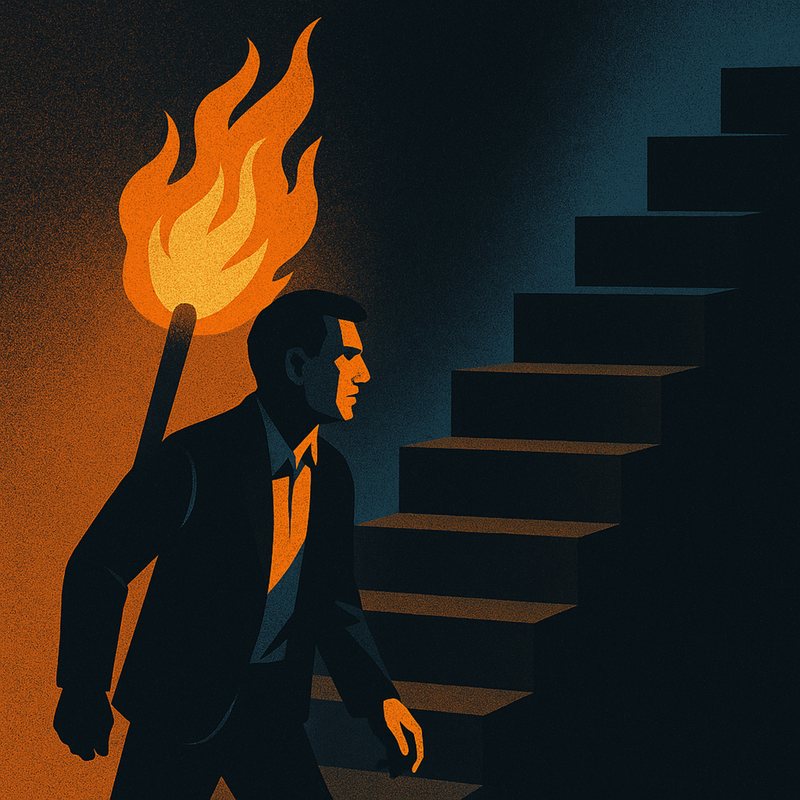
Poster of a man in a suit carrying a flaming torch up a dark staircase.

Play this episode on Spotify, or subscribe: Apple Podcasts · Overcast · Pocket Casts · RSS

Share: X · Facebook · LinkedIn · Reddit · Bluesky · Threads · Email ·

Why protecting even offensive words is the only way to prevent violence

By Chris Abraham for Substack

Every generation rediscovers an old lesson the hard way: words are not bullets, but if you confuse them long enough, bullets eventually appear.

Lately I’ve been struck by how quickly our civic conversations move from irritation to punishment. A clumsy remark or ugly slogan goes viral; the mob mobilizes; firings and cancellations follow. It’s tempting to say “well, that’s accountability,” but the speed and severity of these reactions tell a different story. What we are really doing is rehearsing a very old drama: escalation without a ceiling.

Think about Sarajevo, 1914. A teenager named Gavrilo Princip fires a pistol at Archduke Franz Ferdinand. One act of political violence sets off treaties, obligations, and mobilizations. Within weeks, a continent is on fire. The war that followed didn’t solve the problem — the punitive Treaty of Versailles created conditions for something even worse. What began as one shot became decades of blood.

In our own time, the weapons are reputations, jobs, and platforms. The principle is the same. A careless post spirals into professional ruin. A mob decision substitutes for law. The difference between a town that argues and a town that shoots isn’t etiquette — it’s survival. Civilized societies invest in procedures: courts, ballots, deliberation. Mobs invest in immediacy. And immediacy always tempts violence.

I am not blind to the harm of speech. Racist, vile, or threatening words sting. But the constitutional line exists for a reason. U.S. law is clear: speech only loses protection if it incites imminent lawless action. Everything else, however ugly, is permitted. That boundary protects not just bigots but everyone who dissents from the reigning consensus. Without it, majorities punish minorities on impulse.

Cancel culture, whatever name you prefer, is efficient at punishment but poor at persuasion. It does not change minds; it exiles people. It does not reduce resentment; it deepens it. Every mob firing creates martyrs. Every public shaming fertilizes resentment. And resentment, history shows, is a renewable fuel for conflict.

Even in theology, escalation is a central theme. The Gospel’s “go, and sin no more” joins mercy with responsibility. Mercy without limits collapses into indulgence. Punishment without procedure collapses into vengeance. Both errors invite cycles that consume communities.

Revolutions prove this. Marx promised liberation through rupture. Mao promised purification through violence. Che romanticized guerrilla struggle. What followed was not paradise but repression breeding new radicals, one cycle after another. The dueling codes of earlier centuries made the same point: treat words as violence, and violence answers back.

We flatter ourselves that the modern age is different because our weapons are digital. But doxxing, mass reporting, and professional exile are simply new swords. The old instinct is unchanged.

There is also a dangerous illusion that pauses equal peace. Versailles looked like peace; it was only a ceasefire. Contemporary ceasefires often work the same way: an interval to rearm. Punishment without reconciliation buys time, not resolution.

So what should we do? Protect the square. Keep the civic forum open even to speech you despise. Reserve punishments for true threats, not for dissent. Train institutions to resist the adrenaline of the mob. Encourage citizens to answer ugliness with argument, not annihilation.

This isn’t naivety. It’s strategy. If you want fewer bullets, you must tolerate more words. Ugly words, even dangerous-sounding words, are less corrosive than the torches we light to silence them.

History has already taught us what happens when we confuse offense with violence and treat every slight as existential. Once the crowd is chanting and the torches are lit, the path back down the ladder is hard to find.

Transcript

Read the full transcript (1,222 words, machine made)

You've seen it happen, right? A single dumb comment online suddenly spirals into this massive crisis. We're talking firings, public shaming, the whole shebang. Well, today we're going to unpack a really powerful argument that connects these modern Internet pylons to some of the biggest catastrophes in world history. OK, let's get into it. So the author of our source material here kicks things off with this, a pretty surprising self description. I mean, this is a guy who's deep into old stories, ancient history, theology.

So why on earth has he become one of today's biggest offenders of really ugly, modern and often super offensive speech? That's the puzzle we're going to try to solve. So how does it all start? It usually kicks off with something small, something you've probably scrolled past 100 times. But the author argues that there's a new and pretty dangerous pattern at play now, one that's turning simple words into full blown weapons.

What really got this author thinking was this one little incident after a major political event, a clip of a student making this just shocking, off the cuff comment goes completely viral. You know, it's the kind of thing that maybe a decade ago would have just vanished, but not today. No way. And that clip does exactly what viral clips do now. It just explodes. It sets off this immediate furious reaction. A digital mob forms, the student's personal info gets blasted all over the Internet, and whatever institution they're connected to goes into complete total panic mode. And the fallout is incredibly fast and incredibly harsh. The author points out this whole cascade of people getting fired, making these public apologies.

And here's the key take away right A few thoughtless words aren't just words anymore. They're now being treated as actual events that demand immediate and severe punishment. OK, so this brings us to the core idea of this whole piece. The author has this central metaphor he uses to explain what's going on. He calls it the ladder of escalation. And he argues it's this timeless pattern that explains everything from a Twitter mob to, believe it or not, a World War. And you can see this modern ladder playing out all the time. It starts with one offhand comment. That comment becomes a viral clip. Then comes the massive public pile on. And the final rung?

Well, it's often the complete destruction of someone's career and reputation. It's a clear, predictable, and frankly, a pretty terrifying progression. Now, to show that this isn't just some new Internet fad, the author puts our modern ladder right next to this one from history. A single assassination in Sarajevo, right? That one act climbed the rungs of alliances and outrage until it became World War One.

And the treaty that ended that war, it was so harsh, it basically just set the stage for the next, even bigger war. The pattern he's saying is the same small acts, when they're met with fury instead of procedure, they escalate and they get out of control fast. So if this ladder of escalation is so dangerous, what's actually letting it happen? Well, the author points to this really crucial difference between our official legal system and this new informal system of judgement that has a ton of power. Think of it like this. There are two systems running at the same time. On one side you've got the official US legal system. It has all these built in brakes like the First Amendment that protects speech.

But on the other side, you have private power. We're talking social media platforms, your boss, online mobs. They have 0 constitutional constraints. They are, as the author calls them, efficient enforcers that can ruin your life over a tweet in a way the government simply can't. All right, this brings us to what's probably the author's most challenging idea. He argues that the solution isn't to get better and faster at punishing ugly speech.

In fact, he says, we need to do the exact opposite. We need to learn to tolerate it, because that messy, difficult process is the essential work of a free society. And let's be really clear here. He's not saying this because he enjoys hateful content. He says right here he hates the viciousness. His defense is all about strategy. He genuinely believes that tolerating ugly speech is, in the long runway, less dangerous to a society than empowering mobs to go on purge missions.

And this gets to the absolute core of his definition of what civilization even is. It's not about everyone being polite and nice. It's the slow, frustrating but vital art of stopping our first impulse, our desire to grab an axe or, you know, a digital pitchfork, and choosing a process. It's dead. So really, we're faced with the choice between two kinds of societies. You have a town that argues where the currency is, law and procedure, even if it's slow and clunky. And then you have a town that shoots where the currency is violence and getting things done. Right now, the author's basically saying that all these online cancellations with their demand for quick, satisfying justice, it's just the modern version of a frontier duel. And that leads us to the final choice, the ultimate question the author is posing here.

It's a really stark decision between 2 completely different ways of handling our deepest, most bitter disagreements. See, when you start relying on outrage and these quick solutions, there are major long term consequences. Naming and shaming becomes how you govern. You stop trying to persuade people, you just cancel their livelihoods. And that doesn't solve anything.

It just creates martyrs. It builds deep resentment. And as the 20th century showed us over and over, that kind of repression often just breeds an even more extreme reaction. The argument here is that this frontier logic, this impulse to settle things now with force, it's universal and never really went away. We may have put away the dueling pistols, but the core logic is exactly the same today.

Our weapons are just different doxing algorithms and complete professional annihilation. So what's the solution? Well, he calls it an ugly, simple answer. Protect the public square, even when it's messy and filled with things you hate. Handle disputes through slow, deliberate procedures, not quick, satisfying purges.

We have to train ourselves to resist that addictive rush of performative anger. And most of all, we have to remember the lessons of history. And that leaves us with this final, really provocative question. The author's entire argument kind of boils down to this. If we as a society formally decide that words are a form of violence, what does that make a legitimate response to that violence? The historical answer to that question is not pretty, and we'll end with this haunting warning that ladder of escalation it's easy to climb up, but it's almost impossible to climb back down.

The author's whole plea is for us to choose the difficult, frustrating work of argument over the satisfying warm glow of the torches, because history teaches us that once we choose fire, the path back to civilization can be lost for a very, very long time.